Korean Companies That Could List in the US Next: A Status Tracker
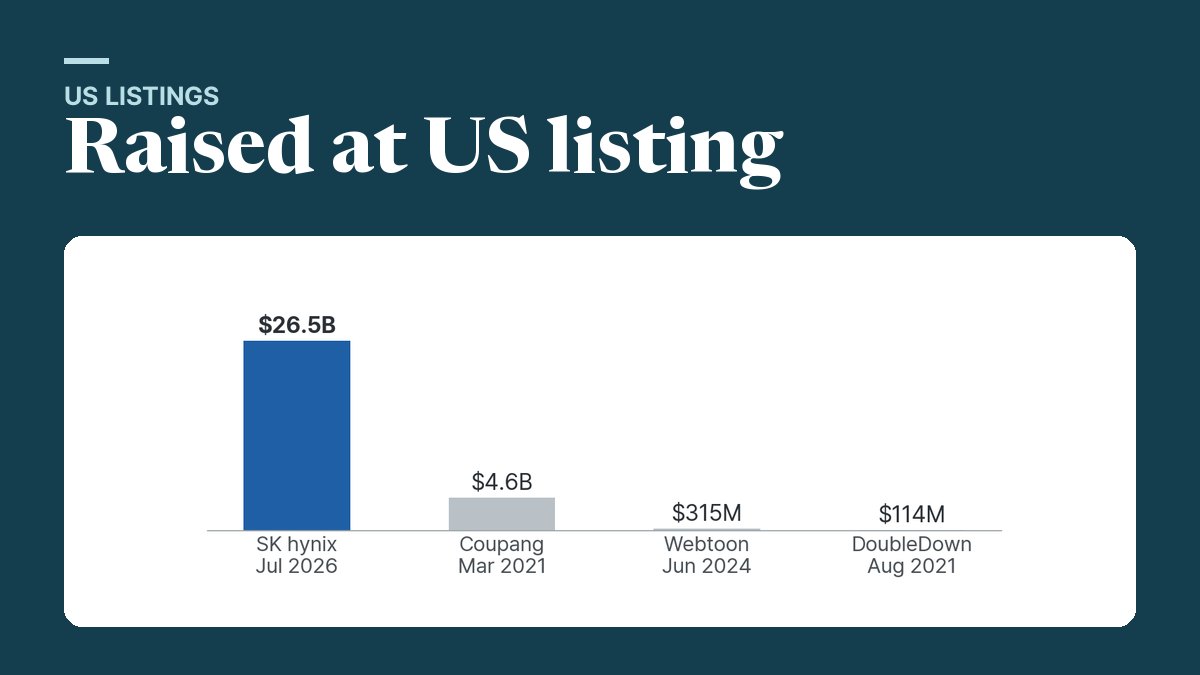
In July 2026 SK hynix raised about $26.5 billion on Nasdaq, reported as the largest US debut by a foreign company. Which Korean companies are actually close to following it?
The short answer: several companies have said they want to, one got as far as a confidential SEC submission, and none has completed an offering. Two well-known names chose to list in Seoul instead.
None of the candidates below can be bought in New York yet. What you can do now is watch which plans are moving and know what to check before a deal arrives.
Already here
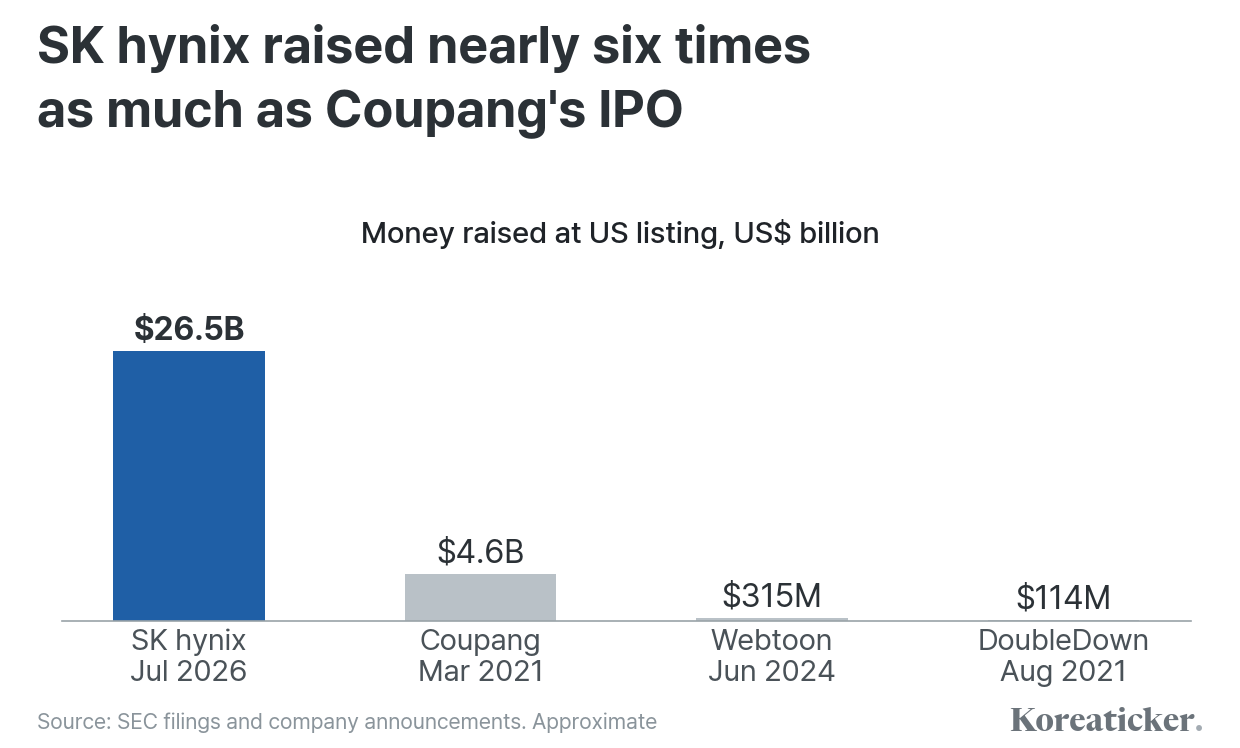
We found eight Korean companies in SEC filings that have listed on a US exchange since 2021. One deal, SK hynix, accounts for most of the money raised.
| Ticker | Exchange | Listed | How | Raised | |
|---|---|---|---|---|---|
| Coupang | CPNG | NYSE | Mar 2021 | IPO | about $4.6B |
| DoubleDown Interactive | DDI | Nasdaq | Aug 2021 | IPO (ADS) | $114M |
| Webtoon Entertainment | WBTN | Nasdaq | Jun 2024 | IPO | $315M |
| SK hynix | SKHY | Nasdaq | Jul 2026 | ADR offering | about $26.5B |
| Roze AI | RZAI | Nasdaq | Sep 2026 | Direct listing | none |
Three smaller companies also listed: Hanryu Holdings (2023 IPO, about $9 million), Captivision (2023, by SPAC merger) and K Wave Media (2025, by SPAC merger). In our count the yearly number has stayed between zero and two, and small SPAC mergers may be missing.
The eight came by different routes (IPO, ADR offering, direct listing, SPAC merger), so the money raised is not comparable across them. What they add up to is a short list: if you want a Korean company in a New York account today, the choice is mostly these eight plus the ADRs.
Coupang and Webtoon are incorporated in the US, with their main business or parent in Korea. Their US-listed shares are not ADRs, so there is no conversion ratio to Seoul shares. The full list of Korean ADRs is on our Korean ADR list.
Who might be next
Each status below is as reported by the press in the month shown, and we have not confirmed them with the companies. Treat the table as a watch list: a row moves closer to something you can buy only when a public SEC filing appears.
| What it does | Status as reported | As of | |
|---|---|---|---|
| Kakao Mobility | Ride-hailing and taxi app (Kakao T) | Paused, in dispute | Nov 2026 |
| Toss (Viva Republica) | Finance app: payments, banking, brokerage | Preparing, no public filing | Nov 2026 |
| Yanolja | Travel booking and hotel software | Timing not set | Apr 2026 |
| Naver Financial and Dunamu | Naver Pay and the Upbit crypto exchange | Market not chosen | Aug 2026 |
| Rebellions | AI chip designer | Korea first, US later | Jul 2026 |
| Musinsa | Online fashion retailer | Chose Seoul | Sep 2026 |
| Samsung Electronics | Memory chips and phones | Not considering ADRs | Jul 2026 |
The two furthest along:
- Kakao Mobility was reported to have made a confidential SEC submission for an ADR of about $1 billion, built on the stake of its second-largest shareholder, TPG. Kakao's board opposed the structure in September, and TPG was reported in November to have filed for international arbitration
- Toss dropped a Korean listing in 2024 in favor of the US. Reuters reported a target of the second quarter of 2026; that date has passed with no public filing
Of the others, Yanolja set up a Delaware entity in 2024 but would first need to reorganize, Rebellions aims to list in Korea in the first half of 2027, and Musinsa considered Nasdaq before applying for a KOSPI listing. A Seoul listing is still within reach of a US investor with Korea Exchange access, just not through a US ticker.
A confidential SEC submission is not visible on EDGAR until the company files publicly, so the absence of a filing does not prove that nothing has been submitted. It also means a would-be buyer has no public registration statement to read until then.
Why go to New York at all
The argument made in Seoul is valuation and reach. A US listing puts a company in front of a larger pool of investors, and Korean press has described the move as a way around the "Korea discount."
SK hynix's ADRs traded at a premium of up to about 51% over its Seoul shares in their first weeks, according to one brokerage report; our ticker guide explains why that happened. For a US buyer, a premium like that is a cost, because the gap can shrink even if the Seoul shares hold.
The record is mixed. A Samjong KPMG study counted 25 Korean companies that listed in the US between 1994 and 2024. Only 60% were still listed at the end of 2024, for reasons we have not checked one by one, and the study gives no comparison with other countries.
If you buy a future Korean listing, a later US delisting could leave you with shares that are harder to sell, so it helps to know whether the company also trades in Seoul.
Why plans stall
Listing a subsidiary abroad can dilute the parent's control, which is where Kakao Mobility's plan stopped. A company run from Korea with a US entity may need to change which one sits on top before it can list, as was reported for Yanolja.
Others chose Seoul. Musinsa and Rebellions both went for a domestic listing first, and in April 2026 the Korea Herald quoted a brokerage official who said the improved domestic market seemed to be changing the trend.
A Korea Times report in July 2026 described the pool of near-term candidates to follow SK hynix as limited. For a US investor waiting for a particular company, the Seoul listing may be the only one that comes, so the realistic route may be a Korea Exchange account.
For US investors
How US investors can buy Korean companies today
Sources and notes
- SEC EDGAR filings (424B4, 8-A) for Coupang, DoubleDown Interactive, Hanryu Holdings, Captivision, Webtoon Entertainment, K Wave Media, SK hynix and Roze AI
- New Straits Times (Reuters), SK hynix ADR pricing (2026.07); Al Jazeera on the offering's size (2026.07)
- Renaissance Capital, Roze AI direct listing (2026.09)
- Korea Times and Korea Herald, Kakao Mobility's US listing plan (2026.08); Korean press on the board decision and arbitration (2026.09, 2026.11)
- KED Global (2024.10) and Reuters (2025.07), Toss's US listing plan
- Korea Times (2024.06) and Dealsite (2026.04), Yanolja
- MTN, Naver Financial and Dunamu (2026.04, 2026.08)
- Reuters, Rebellions chief executive interview (2026.07); Korea Herald, AI unicorns and Korean listings (2026.04)
- SBS Biz and MTN, Musinsa's KOSPI application (2026.09)
- SamMobile and Korea JoongAng Daily, Samsung Electronics on ADRs (2026.07)
- Samjong KPMG, Korean companies listed in the US, as reported by Asia Economy (2025.04)
- Korea Times, candidates to follow SK hynix (2026.07)
Listing dates and amounts for completed listings are from SEC filings and company announcements. The status of companies that have not listed is from press reports and may have changed. The list of completed listings may miss small SPAC mergers with holding companies outside Korea.
Cover photo: a Coupang delivery truck in Seoul, by Bonnielou2013, CC BY-SA 4.0, via Wikimedia Commons.
For information only, not investment advice. See our full disclaimer.
Update history
- Nov 14, 2026 Tied the candidate table and the survival figure more closely to what a buyer of a future listing should check, noted that the eight listings came by different routes, and reworded several lines after a reader-impression review. No figures changed.
- Nov 13, 2026 Added what each part means for a US investor: what can be bought in New York today, what a buyer cannot see before a public filing, how a Seoul listing changes the route, what the SK hynix premium and the survival record mean for buyers of future listings, and what has stopped plans so far.
Corrections and changes to facts are listed here. See our editorial policy.