Korea ETFs in the US: EWY, FLKR, KORU and the New Theme Funds
For most US investors, the simplest way to own Korean stocks is a US-listed ETF. You buy it in dollars, during US hours, through most US brokers. The funds are not interchangeable, though. They differ in what you pay each year and in how far your money rides on a few companies.
So which fund fits what you want to own, and for how long?
The short answer
EWY is the largest of the US-listed Korea funds we found. FLKR holds a similar basket for 0.09% a year against EWY's 0.59%. Samsung Electronics and SK hynix make up about 43% of EWY and 37% of FLKR, so either fund rides heavily on two chip makers.
- EWY rose 43.2% and FLKR 43.9% in 2026 through November 10, counting price changes only.
- KORU, a fund that aims for three times the index's daily move, fell 20.6% over the same period. Someone who held it from the start of 2026 to November 10 lost money while EWY gained.
- Funds for defense, chips and manufacturing exist, but all except KDEF hold under $5 million.
The funds we found
| Fund | Expense ratio | Assets | Holdings | Largest positions |
|---|---|---|---|---|
| EWY, iShares MSCI South Korea | 0.59% | $20.1 billion | 81 holdings | Samsung Electronics 22.3%, SK hynix 20.8% |
| FLKR, Franklin FTSE South Korea | 0.09% | $1.6 billion | 150 holdings | Samsung Electronics 17.4% plus 2.4% in its preferred shares, SK hynix 16.9% |
| MKOR, Matthews Korea Active | 0.79% | $106 million | 52 holdings | Picked by a manager; no index |
| KORU, Direxion Daily MSCI South Korea Bull 3X | 1.32% | $871 million | EWY shares and swaps | Aims for 3 times the index's daily return |
| KDEF, PLUS Korea Defense Industry | 0.65% | $75 million | 21 holdings | Hanwha Aerospace 18.9%, KAI 6.9% |
Figures are from StockAnalysis.com, checked on November 11, 2026, with prices as of the November 10 close. It is a secondary source and its figures can differ from the fund managers' own. KDEF's holdings are as of November 6; the site gives no date for the others.
Three newer funds hold only Korean stocks but are much smaller: KMCA (manufacturing, about $4.3 million), KCHP (semiconductors, about $4.9 million) and KSMH (actively managed AI chip stocks, about $1.2 million), each charging 0.65%.
On November 10 each traded somewhere between about 1,200 and 5,300 shares. With volume that thin, check the bid-ask spread before buying. A K-beauty fund, KBTY, had its registration take effect on October 28; we could not confirm that it has started trading.
EWY or FLKR
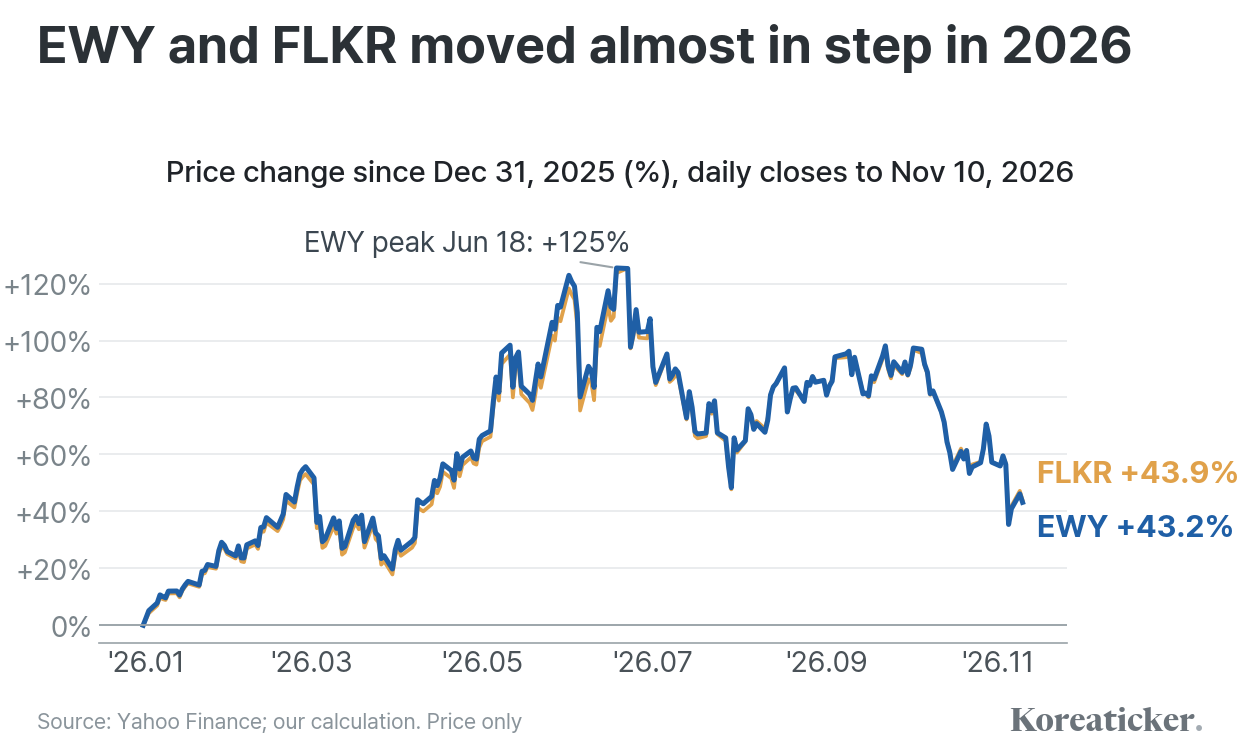
The two funds follow indexes from different providers, MSCI for EWY and FTSE for FLKR. They ended up holding much the same large companies, and through November 10 their 2026 returns were 0.7 percentage point apart. What remains for a holder to compare is mainly cost and trading volume.
- Cost. On $10,000 held for a year, EWY's fee is about $59 and FLKR's about $9. The gap adds up for someone who holds for years.
- Trading volume. In the 22 trading days to November 10, EWY traded about $2.8 billion a day on average and FLKR about $52 million, by our calculation from Yahoo Finance closes and volume. That depth matters more for someone who trades often or in large amounts.
- EWY's index is changing. An October 23 filing said EWY would switch around November 9, 2026 to the MSCI Korea 25/50 Daily 25 Capped Index. It trims any single group above 25% back to 22.5%, and caps the groups above 5% at 50% combined.
If a company group such as Samsung's sits above those caps, the index would give it less weight, and EWY, which tracks the index, would likely follow. We have not calculated the groups' combined weights.
We could not confirm on the manager's website that the index switch has happened. Our EWY page lists the fund's holdings.
Why KORU fell in a rising year
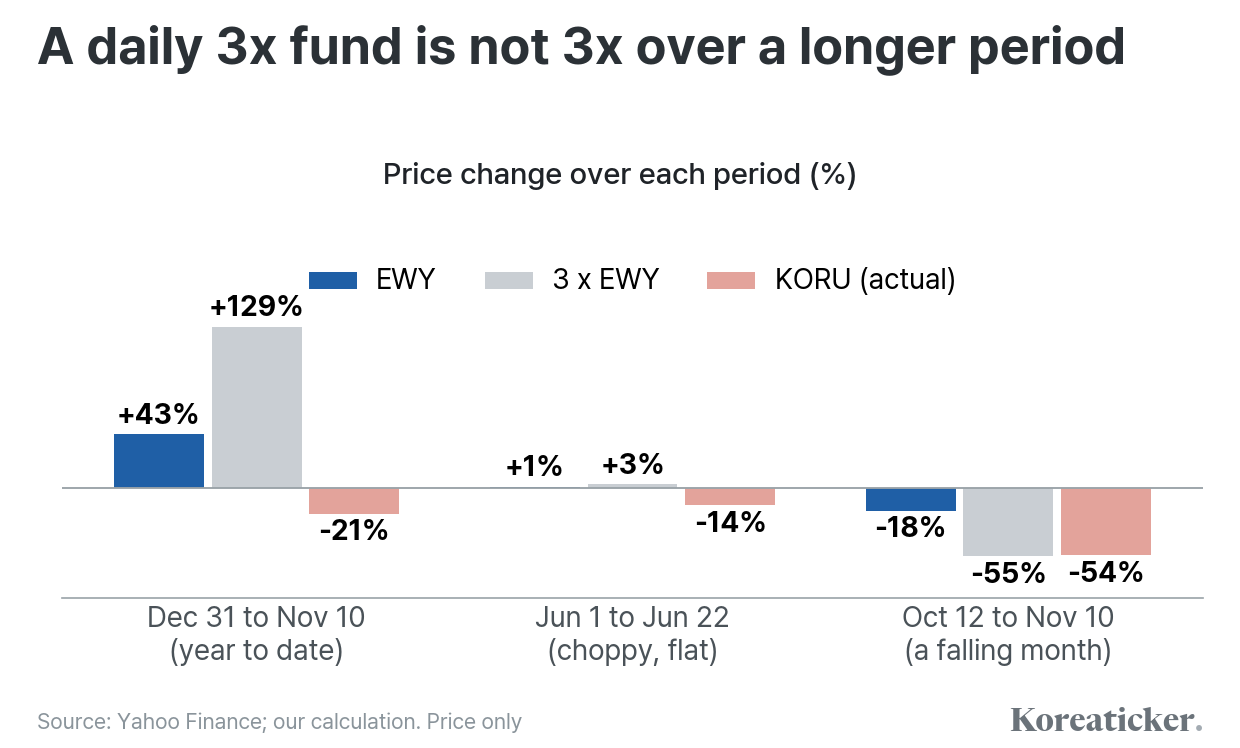
KORU aims for three times the daily return of the MSCI Korea 25/50 index and resets every day. Over anything longer than a day, the result can be far from three times. We compare it with EWY, which tracks the same index family, because we do not have the index's own daily figures.
From December 31 to June 1, EWY rose 122.9% and KORU 596.5%, more than three times as much. Between June 1 and June 22 the market swung sharply in both directions: EWY ended up 1.1% while KORU lost 13.9%. In the month to November 10, KORU's 54.2% loss was close to three times EWY's 18.2%.
For a holder, the path mattered as much as the direction. Tripling EWY's daily move and compounding it gives about a 4.5% loss to November 10. KORU lost 20.6%. The gap of about 16 points reflects fees, financing costs, tracking differences and EWY being only a stand-in for KORU's index; we did not split it.
KORU split 20 for 1 on July 15, 2026. The figures above use split-adjusted prices.
Currency and taxes
Currency. The unleveraged funds hold Korean shares priced in won; KORU gets its exposure through EWY shares and swaps. The won strengthened about 7.8% against the dollar between the end of 2025 and November 10, which added to a US holder's dollar return. A weaker won would work the other way.
EWY rose 43.2% in dollars, against 24.3% for the KOSPI in won, but the two hold different mixes of stocks, so the gap is not all currency. Among the funds we found, none hedges the currency, so holders of the unleveraged funds carry the won along with the stocks.
Dividend tax. Korea withholds tax on dividends the fund receives. If a fund chooses to pass that foreign tax through, your 1099-DIV shows your share and you may be able to claim a US credit, according to IRS Publication 514. In that case the Korean tax can reduce your US tax bill.
We could not confirm whether EWY passed the tax through for 2025. The rates are explained in Korean Dividend Tax for US Investors.
For US investors
How to buy Korea ETFs from the US
Seoul is closed while these funds trade in New York, so the price of a fund holding Korean shares can sit above or below the value of those shares during US hours.
Sources and notes
- StockAnalysis.com, fund pages for EWY, FLKR, MKOR, KORU, KDEF, KMCA, KCHP and KSMH (checked 2026.11.11)
- Yahoo Finance daily price and volume data for EWY, FLKR and KORU (downloaded 2026.11.11); returns, trading value and the compounded 3x comparison are our calculation
- SEC, iShares prospectus supplement on the EWY index change (2026.10.23). sec.gov
- SEC, Direxion prospectus supplement on the KORU share split (2026.06.10). sec.gov
- SEC, Guinness Atkinson post-effective amendment for KBTY (2026.10.28)
- IRS Publication 514, Foreign Tax Credit for Individuals. irs.gov
- KOSPI closes from Naver Finance; won-dollar rate from Yahoo Finance
All returns are price changes and exclude distributions. KORU's 1.32% expense ratio is as listed by StockAnalysis.com.
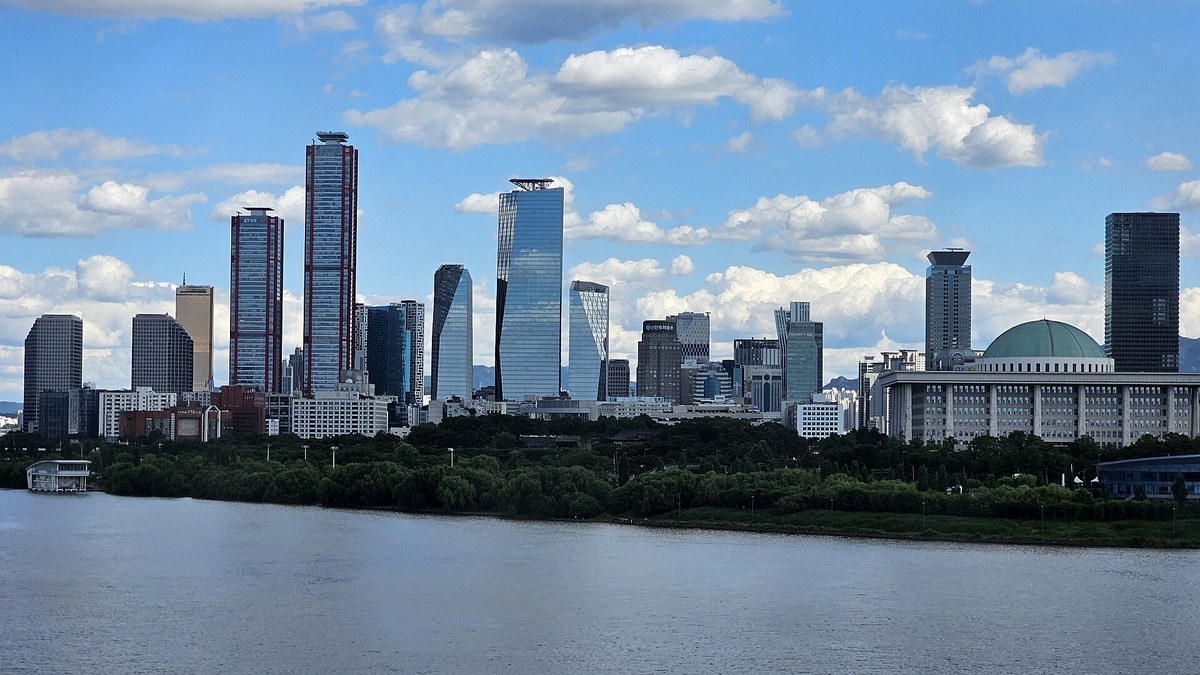
Cover photo: "Yeouido view 20240528" by Ox1997cow, CC BY-SA 4.0, via Wikimedia Commons.
For information only, not investment advice. See our full disclaimer.
Update history
- Nov 13, 2026 Rewrote each section around what the facts mean for a holder: how much of EWY rides on two memory makers, when the fee gap or the volume gap matters more, what the coming index change could do to EWY's mix, what KORU's daily reset did to a buy-and-hold investor in 2026, and how the won and the withholding tax reach a US holder's return.
Corrections and changes to facts are listed here. See our editorial policy.