EWY ETF: Holdings, Expense Ratio and How It Works

EWY is the iShares MSCI South Korea ETF, a US-listed fund that holds Korean shares. You buy it in dollars on NYSE Arca during US market hours, and it gives you large Korean companies in one ticker. In the fund's latest annual report, though, two memory chipmakers made up almost half of it.
If you buy EWY for Korea, much of what you get is two chip stocks and the won. This page shows how much of each.
The short answer
- What it is: an index fund from BlackRock's iShares, listed since May 2000, with about $27.7 billion in net assets on Aug 31, 2026.
- What it holds: SK hynix was 23.7% and Samsung Electronics 22.4% of total investments on Aug 31, 2026.
- What it costs: the prospectus lists 0.59% a year, about $59 on $10,000. For the year to Aug 31, 2026, the annual report shows costs of $93 on a hypothetical $10,000 investment, or 0.52%.
- What changed in November: EWY was set to move around Nov 9, 2026 to a new index that caps any one company group at 25%, which could trim the chip weight depending on how MSCI classifies the groups.
EWY at a glance
| Full name | iShares MSCI South Korea ETF |
|---|---|
| Ticker | EWY on NYSE Arca |
| Manager | BlackRock (iShares) |
| Started | May 9, 2000 |
| Net assets | $27.7 billion on Aug 31, 2026 |
| Holdings | 81 on Aug 31, 2026 |
| Expense ratio | 0.59% (prospectus, Dec 30, 2025) |
| Hypothetical cost of a $10,000 investment | $93, or 0.52%, in the year to Aug 31, 2026 |
| Return (NAV) | 156.3% in the year to Aug 31, 2026 |
| Share price (close) | $139.18 |
| Price date | Nov 10, 2026 |
The price is a Yahoo Finance close. Fund figures come from iShares' annual report and prospectus filed with the SEC. The annual report warns that returns like the past year's 156.3% should not be expected to repeat, so the figure says little about the next year.
The $93 cost is larger than 0.52% of $10,000 because the report figures it on an investment that grew during the year. On the same money, the fee you pay rises with the fund's value.
What is inside
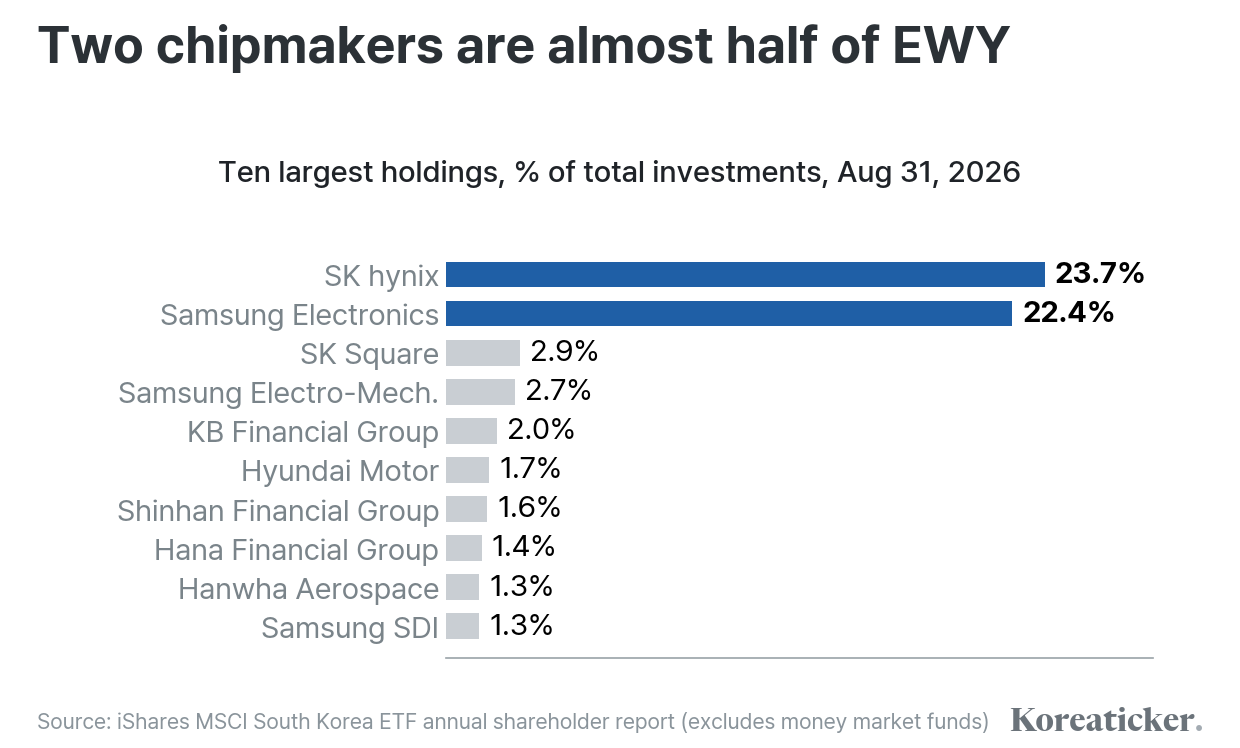
SK hynix and Samsung Electronics together were 46.1% of EWY's investments on Aug 31, 2026, and no other holding was above 3%. At the annual report's weights, a 10% fall in both chip stocks would by itself take about 4.6% off the fund, before anything else moved.
After the two chipmakers come SK Square, Samsung Electro-Mechanics, three banking groups, Hyundai Motor, Hanwha Aerospace and Samsung SDI. The ten largest holdings together were 61.0%, leaving 39% for everything else, so the count of 81 holdings overstates how widely the money is spread.
By sector, information technology was 51.3%, industrials 19.2% and financials 11.1%. Weights move every day with share prices: between rebalances, when the chip stocks rise faster than the rest, their share of the fund grows, and so does your exposure to them.
Each of the two large holdings has its own page: SK hynix stock and Samsung Electronics stock.
The November index change
EWY was set to switch to the MSCI Korea 25/50 Daily 25 Capped Index on or around Nov 9, 2026. The fund announced the change in an Oct 23 filing.
The new index caps any "group entity" at 25%, and caps the combined weight of group entities above 5% at 50%. MSCI treats companies as one group when it finds a control relationship; it starts with listed companies holding 20% or more of another and can also use other evidence of control.
Between quarterly rebalances, a close above 25% triggers a rebalance that brings each group to 22.5%.
Using the fund's Aug 31 holdings, not the index weights, SK hynix plus SK Square totaled 26.6%, and Samsung Electronics, Samsung Electro-Mechanics and Samsung SDI totaled 26.4%. The same-date N-PORT filing gives different weights, so even these sums are uncertain.
These sums do not show how MSCI classifies group entities or whether the new index would trim either group, and the iShares fund page we checked on Nov 11 did not confirm the switch.
So the August figures are the latest we can confirm, and the weights have moved with share prices since. The fund's holdings tab will show whether the new index trimmed the chip weight.
The won and US trading hours
EWY's holdings are priced in won, and the fund's value is figured in dollars. Its prospectus lists currency risk: the fund can lose value if the won weakens against the dollar, and the reverse helps. For a US holder, the exchange rate works on top of Korean share prices, and the prospectus describes no hedge against it.
EWY also trades while Seoul is closed. During US hours its price reflects what buyers and sellers expect Seoul to do next, and it can sit above or below the value of its holdings at the last Seoul close.
If you buy at a premium and the price later falls back to the fund's net asset value while that value stays put, you lose the gap. The prospectus says iShares publishes the fund's premiums and discounts, so check them before buying.
EWY or FLKR
The Franklin FTSE South Korea ETF (FLKR) is the other broad Korea fund in our ETF comparison. Its summary prospectus, dated Aug 1, 2026, lists total annual expenses of 0.09%, against 0.59% for EWY. On $10,000, that is about $9 a year against $59 (our arithmetic).
FLKR follows a FTSE index, while EWY follows MSCI, so the two can hold different weights in the same companies. The cheaper fund is not automatically the one that returned more. Korea ETFs in the US compares their 2026 returns and trading volume, along with the 3x fund KORU.
For US investors
How to buy EWY
Read next
- Korea, explained for investors: North Korea risk, Korean politics, Trump and Korea's industries in four short reads.
- HBM Market Outlook 2026: SK hynix, Samsung and Micron, and the oversupply risk for 2028.
- Is Samsung on Nasdaq? Samsung and SK hynix tickers for US investors.
Quick answers
FAQ
What is EWY's expense ratio?
The prospectus dated Dec 30, 2025 lists 0.59% a year. For the year to Aug 31, 2026, the annual report shows costs of $93 on a hypothetical $10,000 investment, or 0.52%. It says the net expense ratio fell as assets across the fund and certain other iShares funds grew.
How much of EWY is Samsung and SK hynix?
On Aug 31, 2026, SK hynix was 23.7% and Samsung Electronics 22.4% of total investments, excluding money market funds. The index change scheduled for around Nov 9, 2026 can trim any company group above 25%.
Is EWY hedged against the won?
No hedge is described. The prospectus lists currency risk: because the fund's value is figured in dollars, it can fall if the won weakens. A stronger won has the opposite effect.
Sources and notes
- iShares MSCI South Korea ETF, annual shareholder report for Sep 1, 2025 to Aug 31, 2026 (Form N-CSR, filed 2026.11.05): costs, returns, net assets, holdings count and weights. sec.gov
- iShares MSCI South Korea ETF, summary prospectus (2025.12.30): expense ratio, inception date, currency risk. sec.gov
- iShares, prospectus supplement on the index change (2026.10.23). sec.gov
- Franklin FTSE South Korea ETF, summary prospectus (2026.08.01). sec.gov
- Yahoo Finance, EWY daily close (downloaded 2026.11.11)
Top-ten and sector weights are shares of total investments, excluding money market funds, as printed in the annual report. The fund's Form N-PORT for the same date gives different values and even reverses the order of the two largest holdings. Different denominators alone cannot explain that reversal, and we could not determine the cause. The 46.1% and 61.0% totals are our sums of the report's figures.
Cover photo: central Seoul and Bukhansan seen from Namsan, December 2022, by kallerna, CC BY-SA 4.0, via Wikimedia Commons.
For information only, not investment advice. See our full disclaimer.
Update history
- Nov 14, 2026 Explained why the $93 hypothetical cost is more than 0.52% of $10,000, cut a repeated line on the chip weight, and reworded several lines after a reader-impression review. No figures changed.
- Nov 13, 2026 Rewrote each section around what it means for an EWY holder: how much the two chipmakers move the fund, what the November index change could do to that, what the won and US trading hours add, and what the fee gap with FLKR is in dollars. Added our arithmetic on the fee and the chip weight, the prospectus note that iShares publishes premiums and discounts. Cut two FAQ answers that repeated the article and the disclaimer at the top.
Corrections and changes to facts are listed here. See our editorial policy.