HBM Market Outlook 2026: SK hynix vs. Samsung vs. Micron, and the 2028 Oversupply Risk
Contents
- 1The companies at a glance
- 2What is HBM, and how is it different from regular DRAM?
- 3HBM market size: why forecasts disagree
- 4Market share: Samsung catches up
- 5Generations and customers: the HBM4 era begins
- 6Where the profit comes from: HBM and regular DRAM
- 7Supply: lots of wafers, few bits
- 8The bear case: how "sold out" could turn into oversupply
- 9The bottom line: what the low P/E is pricing in
- 10How to buy these stocks from the US
Last quarter, SK hynix posted an 80% operating margin and Samsung earned more operating profit than Nvidia. How much of that came from HBM?
HBM, the stacked memory that sits next to AI chips, gets most of the credit. All three makers, SK hynix, Samsung and Micron, say their 2027 HBM output is effectively sold out.
But HBM made up only about a tenth of SK hynix's revenue last quarter, by one estimate. Much of the jump came from regular DRAM, whose price soared partly because HBM production takes wafers away from it.
For an investor it comes down to how much of today's profit lasts once regular DRAM prices cool, and whether higher HBM4 prices in 2027 can make up the difference. The market's answer so far is cautious: SK hynix trades at under 5 times its past year of earnings.
The companies at a glance
| SK hynix | Samsung Electronics | Micron (US peer) | |
|---|---|---|---|
| What it makes | Memory chips: DRAM, HBM, NAND flash | Memory chips, contract chipmaking, Galaxy phones, TVs, appliances | Memory chips: DRAM, HBM, NAND flash |
| Ticker | 000660.KS; SKHY on Nasdaq | 005930.KS; no US listing | MU on Nasdaq |
| Share price (close) | ₩1,212,000 (about $898) | ₩198,900 (about $147) | $733 |
| Price date | Nov 10, 2026 | Nov 10, 2026 | Nov 9, 2026 |
| Market value | about $640B | about $850B (common shares) | about $830B |
| Latest quarter | Jul–Sep 2026 | Jul–Sep 2026 | Jun–Aug 2026 |
| Revenue | $77.5B | $144.6B | $54.2B |
| Operating profit | $61.7B | $79.6B | $43.8B |
| Operating margin | 80% | 55% | 81% |
| P/E (last 12 months) | 4.6x | 8.7x | 9.9x |
| Profit period for P/E | Oct 2025–Sep 2026 | Jul 2025–Jun 2026 | Sep 2025–Aug 2026 |
| P/B | 3.3x | 2.3x | 6.0x |
SK hynix is a pure memory company and the biggest HBM supplier to Nvidia. It belongs to SK Group, one of Korea's largest business groups. Almost everything it sells is DRAM or NAND flash, so its results move with memory prices.
Samsung Electronics sells far more than chips, but chips now earn almost all of its profit. In the third quarter of 2026, its semiconductor division made ₩106.5 trillion of the company's ₩107.4 trillion in operating profit.
Micron is the closest US comparison, making the same three kinds of memory. The market values Micron higher, even though SK hynix earned about 40% more operating profit in its latest quarter. For an SK hynix holder, that means each dollar of the company's profit is priced lower than each dollar of Micron's.
Low P/E ratios are normal for memory makers near a profit peak, because the market expects profits to fall. Nvidia trades at about 23 times. Samsung has not yet filed its third-quarter net profit, so its P/E covers the 12 months to June 2026. Adding its record third quarter would bring the figure down.
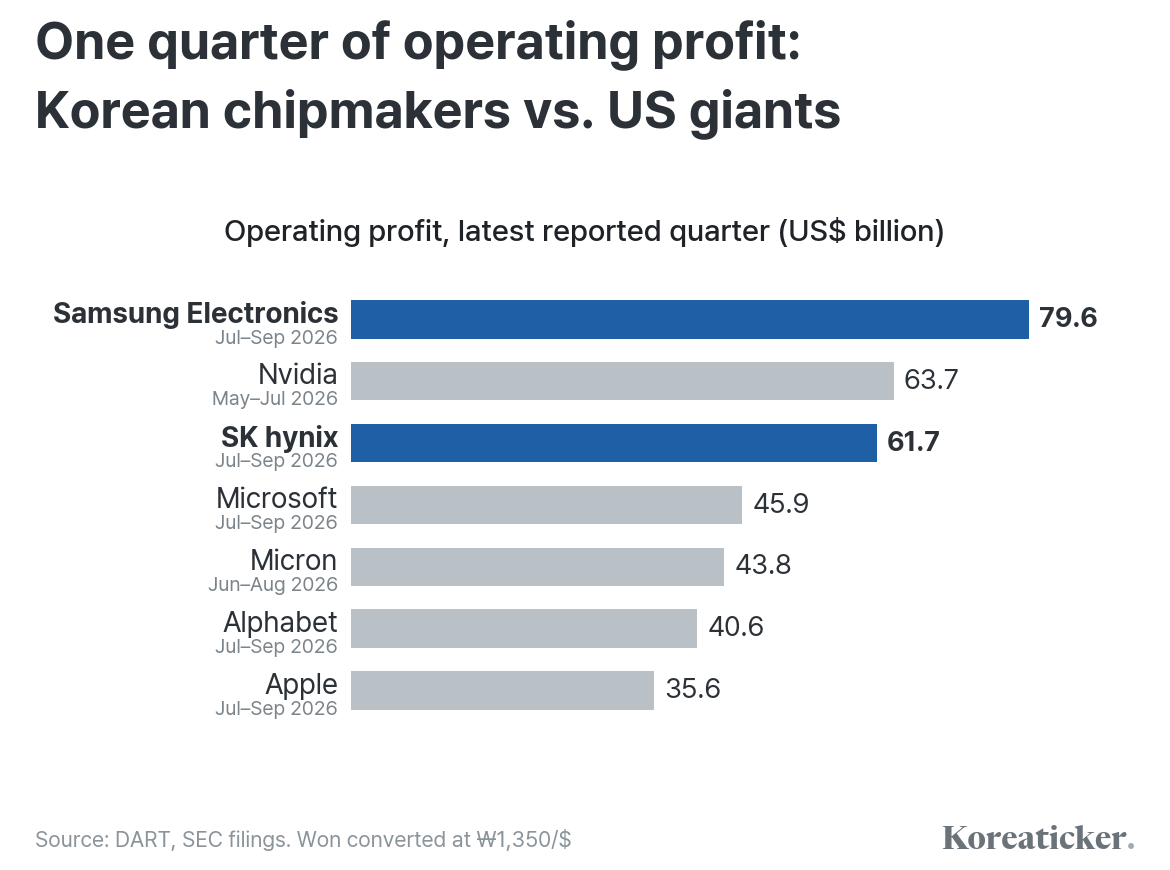
Both Korean companies out-earned Microsoft, Alphabet and Apple from July to September 2026.
Yet Nvidia and Microsoft are each worth more than $4 trillion and Apple about $5 trillion, five to six times Samsung's market value. If the market keeps pricing memory profit as a peak, as the low P/E ratios above suggest, how long the profit lasts will matter to holders as much as its size today.
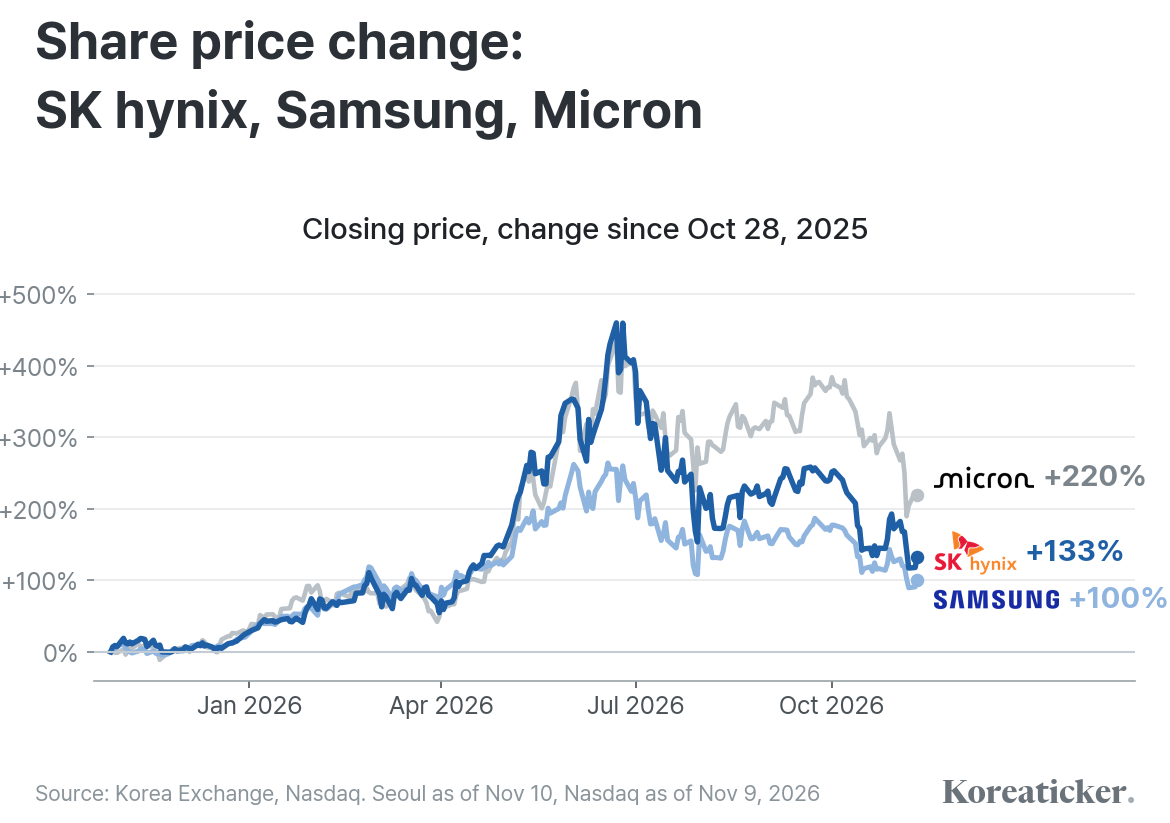
All three memory stocks at least doubled over the past year, then gave back much of the gain after June. SK hynix is 58% below its high, Samsung 45% and Micron 40%. Anyone who bought near the June peak is still well below their purchase price.
1. What is HBM, and how is it different from regular DRAM?
HBM stands for High Bandwidth Memory. The "bandwidth" is the width of the road data travels on. The difference matters to a holder because HBM and regular DRAM are made and priced differently, and the profit in this cycle came from both.
In practice, HBM is several DRAM dies stacked on top of each other, with holes drilled through each die to wire them together vertically. That lets far more data move at once. The vertical wires are called TSVs (through-silicon vias), and the number of dies in a stack is described as "8-high" or "12-high."
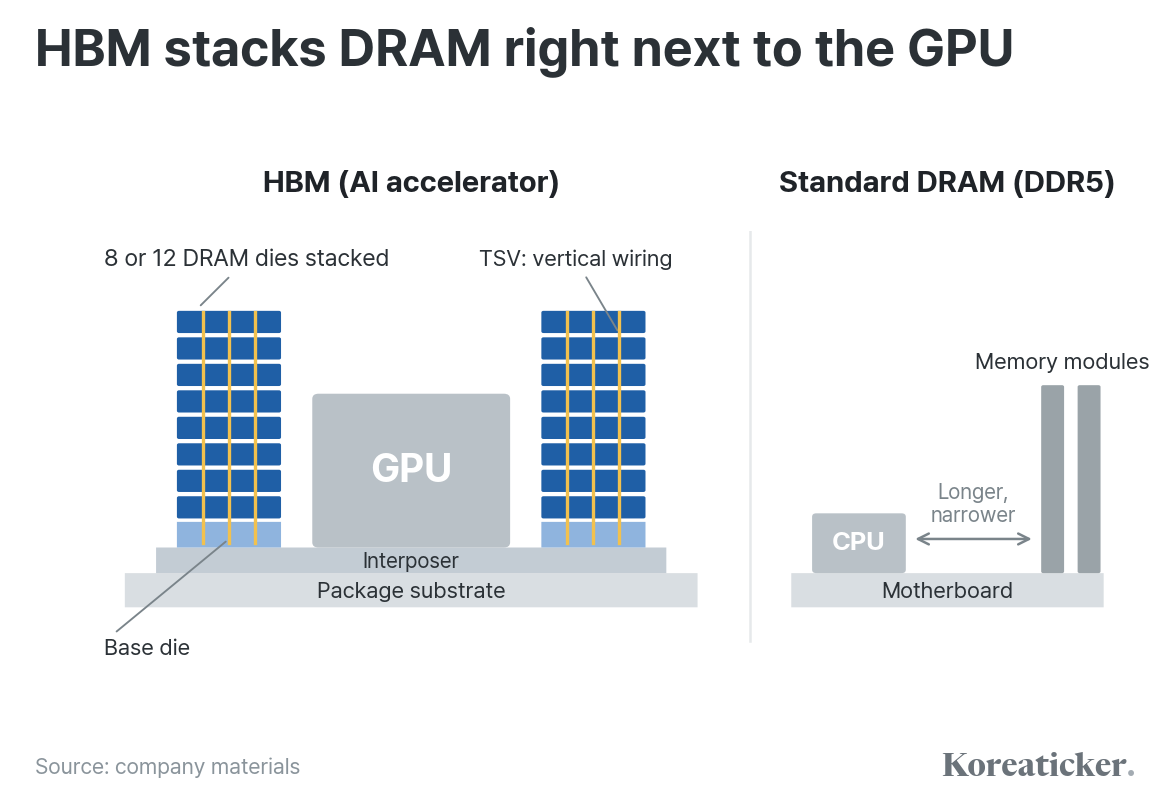
AI models need a constant flood of data fed to the GPU. If the road is narrow, an expensive GPU sits idle waiting for data. That is why HBM sales follow Nvidia GPU sales.
For memory makers, Nvidia's product plans therefore shape demand. Its next-generation Vera Rubin GPU (NVDA) carries 288GB of HBM4, so how many Rubin GPUs ship matters to all three suppliers.
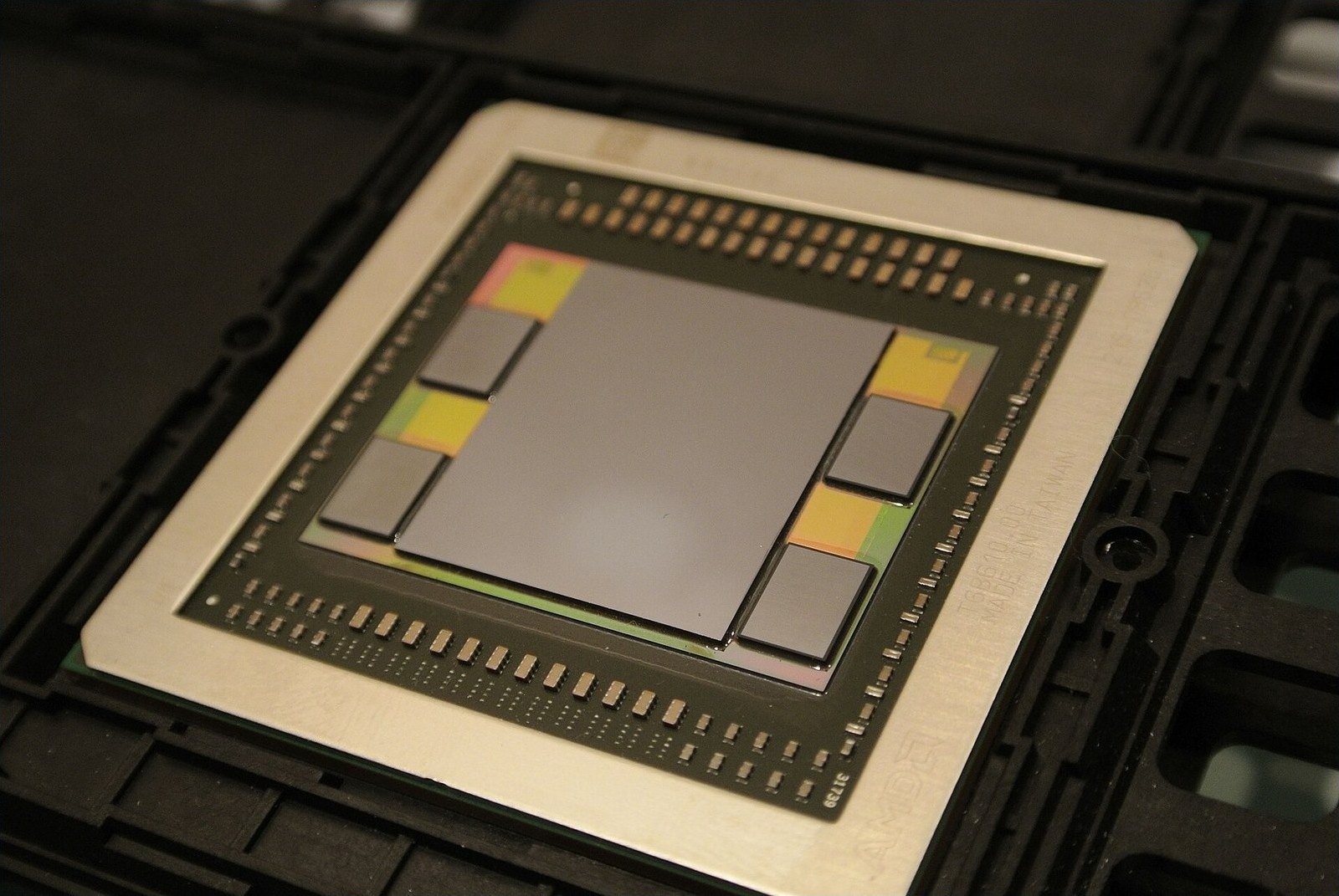
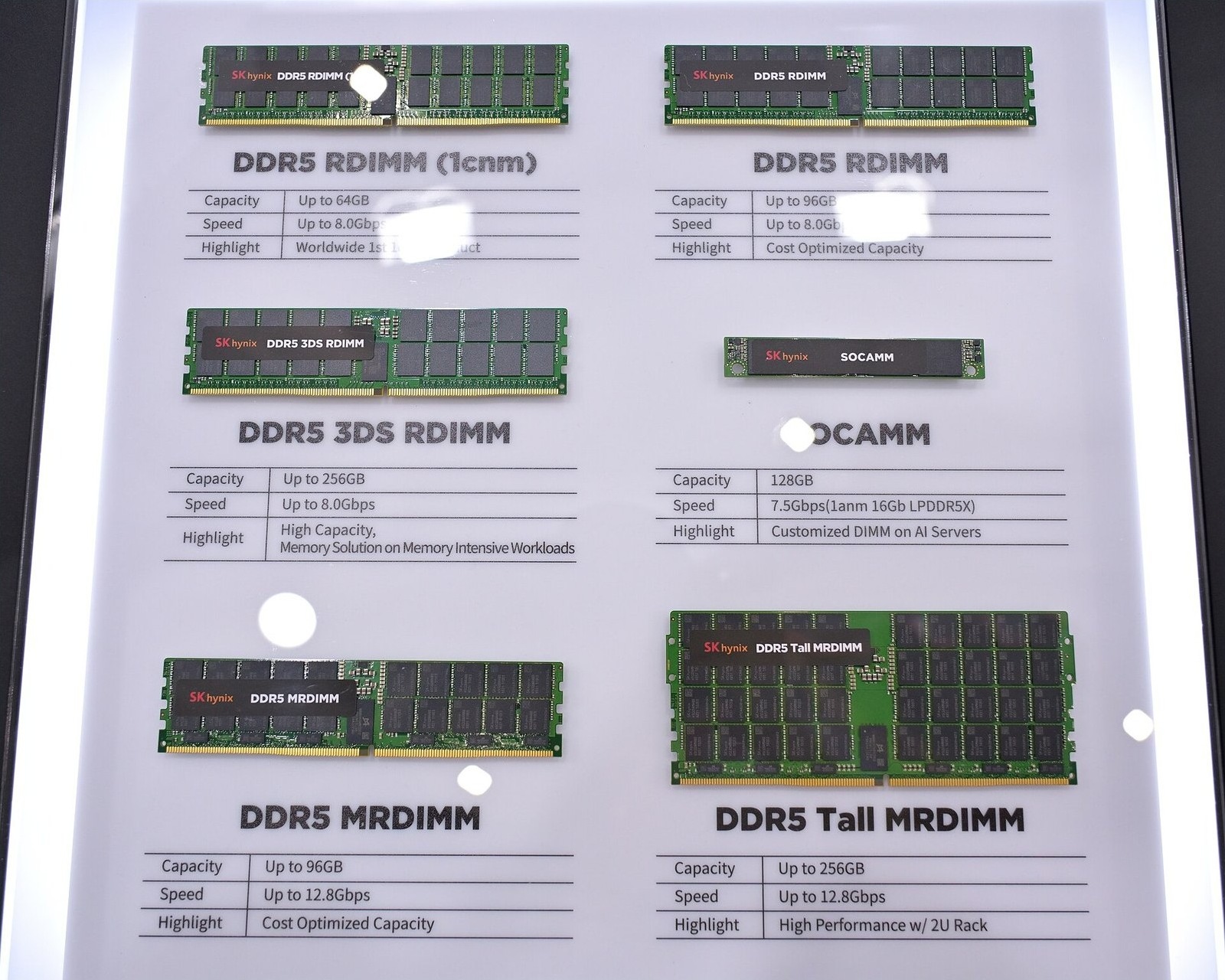
The catch is that HBM is hard to make. Goldman Sachs estimates HBM uses 3 to 4 times as many wafers as regular DRAM for the same amount of memory. Every wafer spent on HBM is one that does not become regular DRAM, which is how an HBM boom ends up raising regular DRAM prices.
2. HBM market size: why forecasts disagree
Estimates for 2025 sit between $30 billion and $35 billion, which Gartner puts at 23% of total DRAM revenue. For 2026, they range from $51 billion to $60 billion.
For 2027, Morgan Stanley sees about $72 billion and Goldman Sachs $116 billion. Further out, Goldman expects $168 billion in 2028, Bank of America $246 billion in 2030, and Yole about $98 billion in 2030.
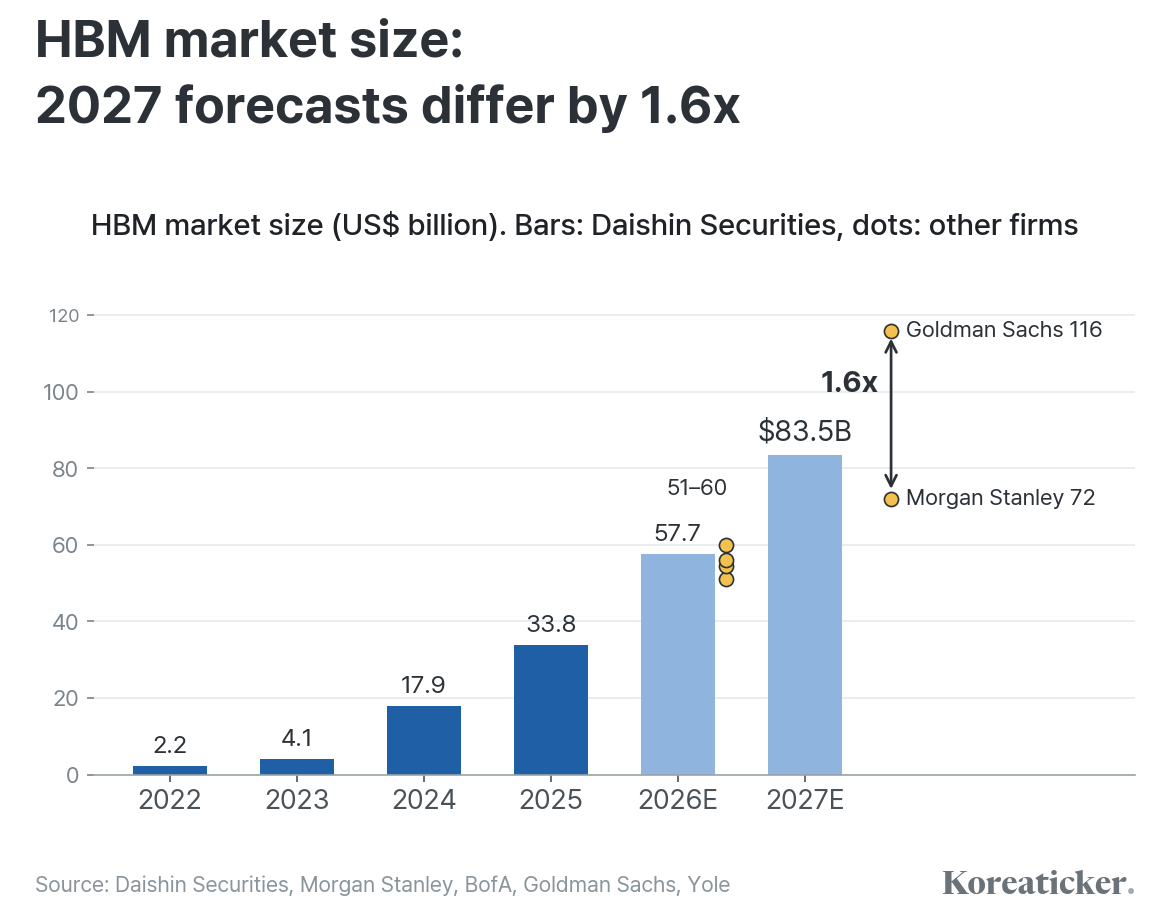
A holder using one of these forecasts to value SK hynix or Micron should know why they differ.
Part of it is timing. Goldman raised its 2026 forecast from $45 billion to $54 billion and then to $56 billion. Daishin Securities, a Korean broker, raised its own from about $53 billion to $57.7 billion within two months. Once DRAM prices surged in the second half of 2025, analysts kept lifting their HBM price and volume assumptions.
Price assumptions account for the rest. TrendForce expects the average selling price of HBM to rise 121% in 2027.
In my view, how much of the HBM4 price jump each firm has built in explains most of the spread. If that is right, picking a forecast is mostly picking a view on 2027 HBM prices, and the agreed prices have not been published (section 5).
HBM alone is now bigger than the entire DRAM market of three years ago. Daishin notes that its $57.7 billion estimate for 2026 exceeds total DRAM sales in 2023.
DRAM as a whole grew faster still. TrendForce puts 2026 DRAM revenue at close to $620 billion, up 303%. That makes HBM less than 10% of DRAM. Regular DRAM prices rose even faster, so by revenue, regular DRAM made up most of the 2026 DRAM market.
3. Market share: Samsung catches up
Samsung's share of HBM revenue nearly doubled in a year, to 33%. SK hynix still ships most of the HBM3E sold and most of the HBM Nvidia buys.
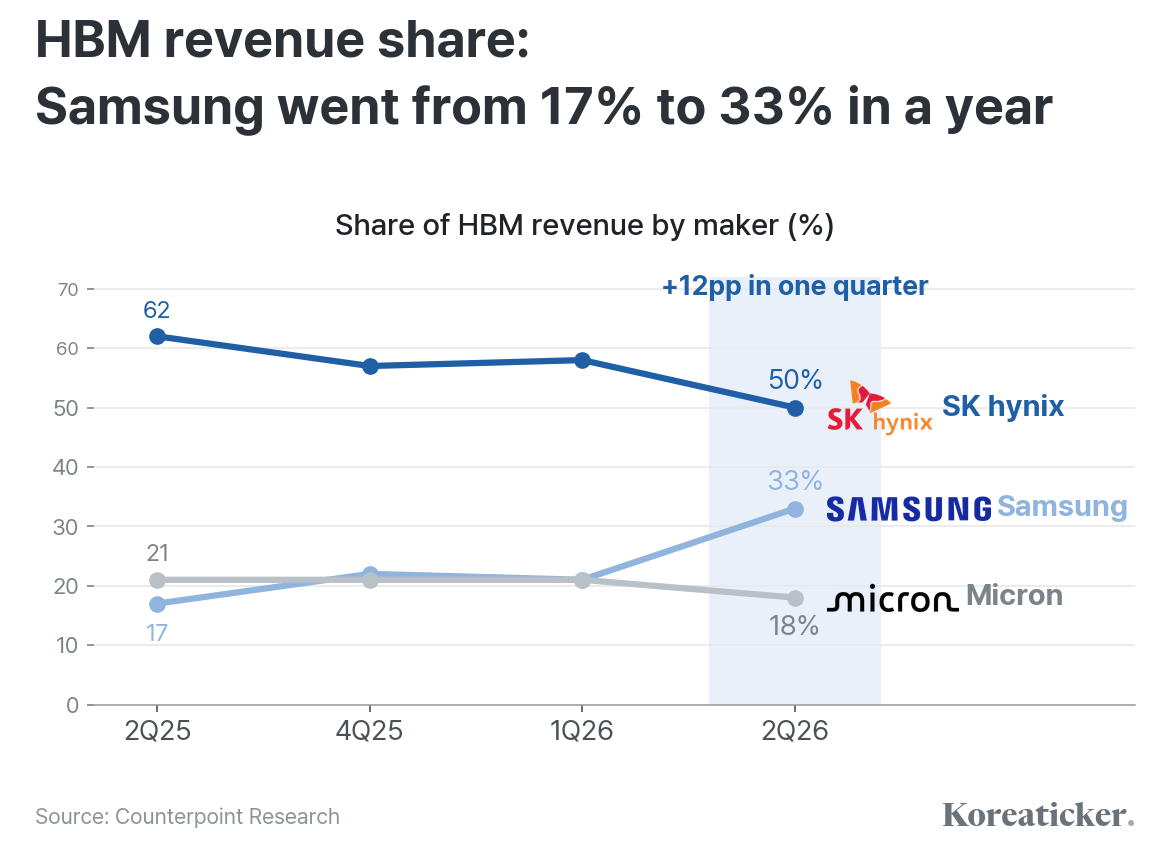
SK hynix's share of HBM revenue went from 62% to 50% between the second quarter of 2025 and the second quarter of 2026. Micron held around 20% before slipping to 18%.
Samsung may have passed SK hynix in the third quarter. There is no official tally yet, but Bernstein's estimates, as reported by the Korea Economic Daily in October, look like this:
- Samsung 3Q HBM revenue (Bernstein estimate): about $8.7 billion
- SK hynix 3Q HBM revenue (Bernstein estimate): about $7.6 billion
- Samsung 3Q HBM share (press reports): about 40%
KB Securities also expects Samsung's share to reach about 40% in the fourth quarter.
Samsung's comeback runs on HBM4. It began mass-production shipments of HBM4 in February, the first in the industry, and HBM4 made up 60% of its HBM revenue in the third quarter.
At the start of the year, Daishin expected Samsung's 2026 share to be 29%. For Samsung holders, the gain adds to a chip business that already earns almost all of the company's operating profit.
SK hynix still leads in HBM3E and in supply to Nvidia. Revenue share rewards whoever sold the pricier HBM4 first, while SK hynix shipped large amounts of HBM3E for longer.
In its January report, Daishin projected that SK hynix would supply 71% of all HBM3E shipped in 2026, and 63% of the HBM that Nvidia buys. There is no published volume share for the whole HBM market across generations and customers.
SK hynix lost revenue share mainly because Samsung sold the pricier HBM4 first. Its own HBM4 ramp in the fourth quarter will show whether that share comes back.
When you see a headline about HBM rankings, check whether it is by revenue or by volume, and for which quarter.
4. Generations and customers: the HBM4 era begins
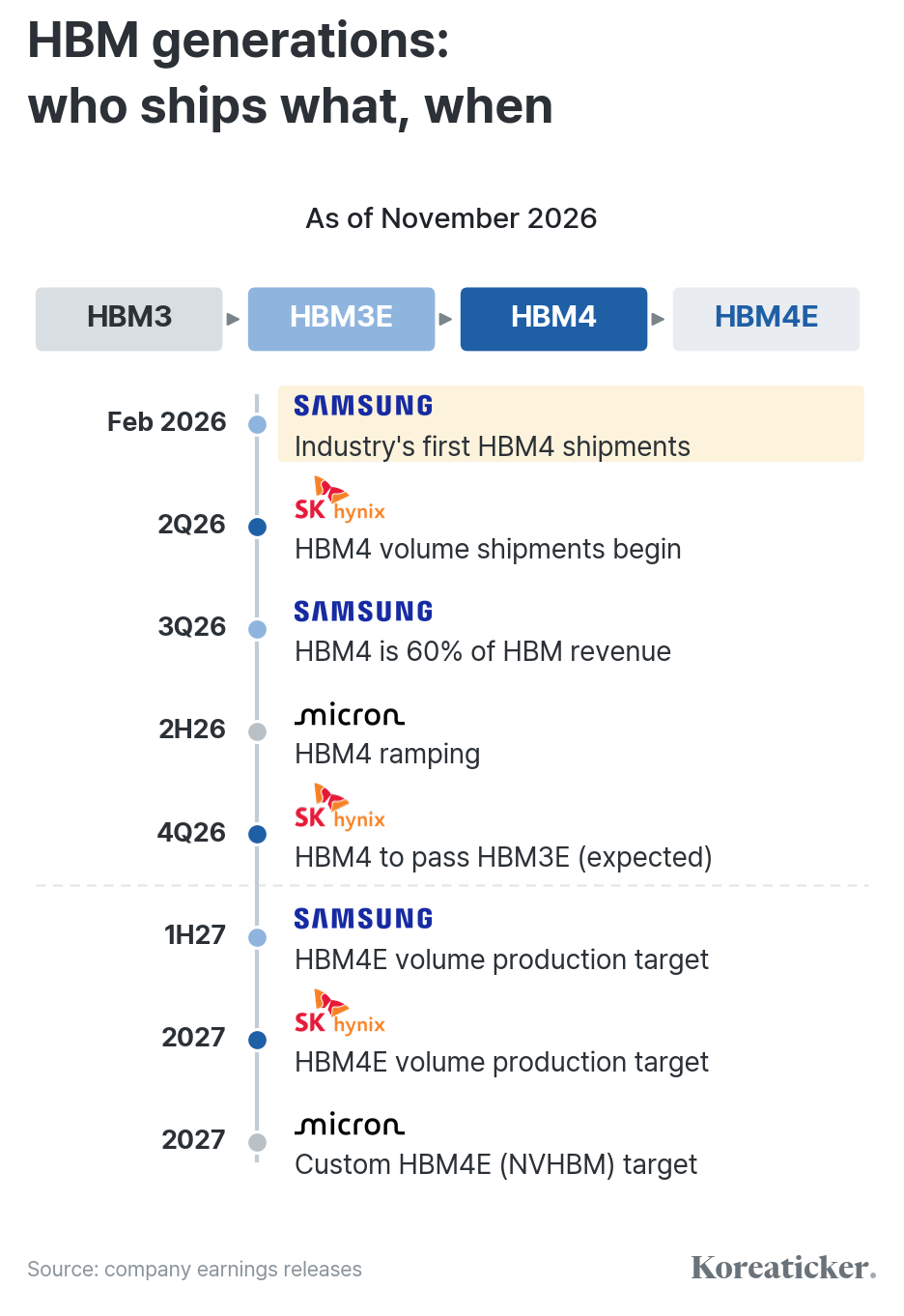
SK hynix's main product will shift to HBM4 before the year ends, which is when it starts selling the generation Samsung used to gain share. It began volume shipments in the second quarter and expects HBM4 to pass HBM3E in both units and revenue in the fourth quarter.
Samsung's HBM4 uses a base die made on a 4nm process and runs at 11.7Gbps per pin. The base die is the chip at the bottom of the stack that sorts the signals and hands them to the GPU.
Micron is co-developing a custom HBM4E with Nvidia, called NVHBM. All three are targeting HBM4E volume production in 2027.
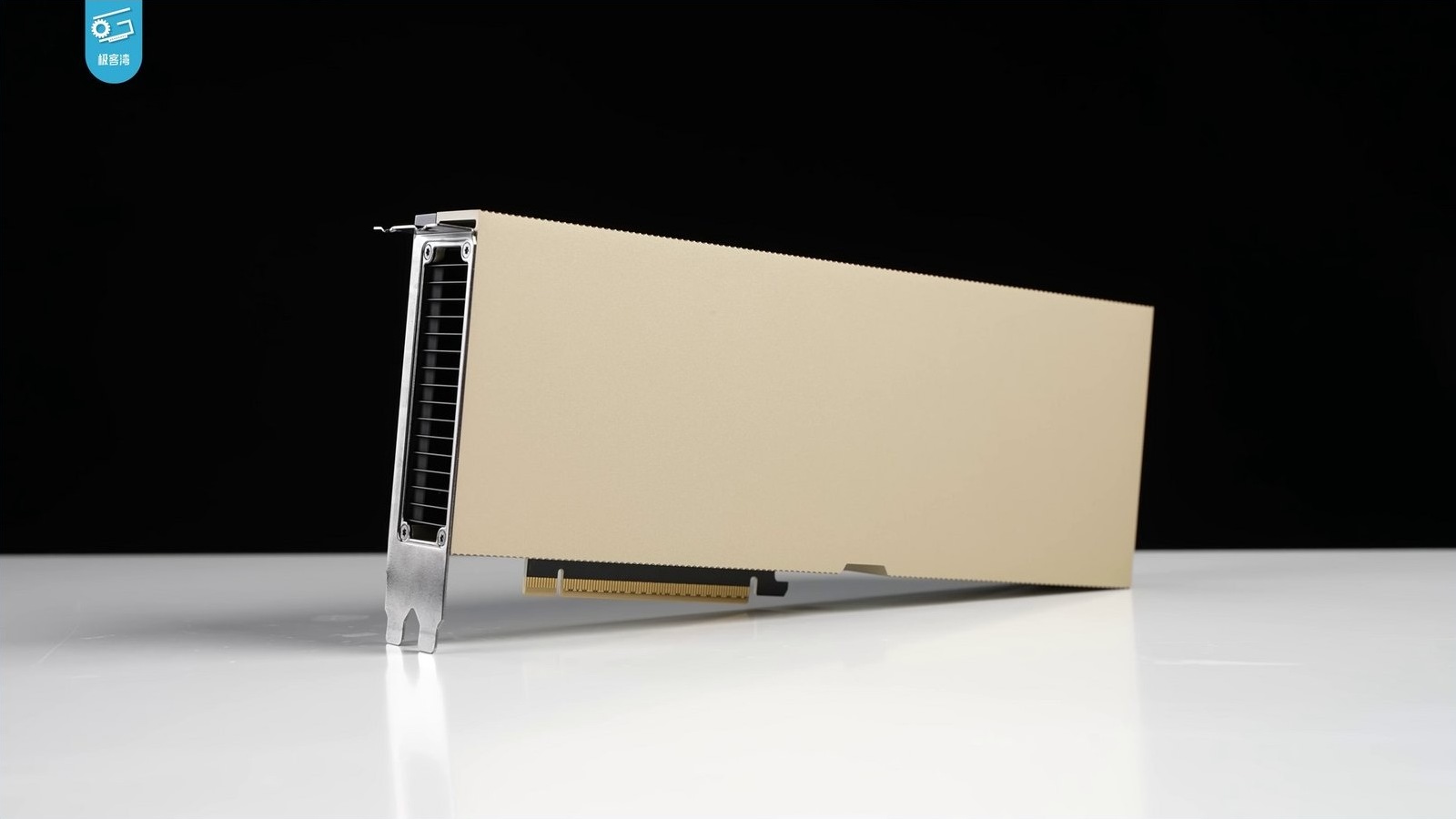
The biggest customer is still Nvidia. In June, Jensen Huang said of HBM4 for Vera Rubin: "All three have been qualified, and all three are in production."
That also means a spec change at Nvidia hits HBM demand right away. Rubin's HBM4 bandwidth spec was cut by about 13%, and TrendForce reported in October that Rubin Ultra may use 8-high HBM4 instead of 12-high HBM4E. The reported reasons are heat and yield problems at 12-high.
Customers beyond Nvidia are growing. In March, AMD signed a memorandum naming Samsung its preferred HBM4 supplier for the MI450.
Daishin projected in January that non-Nvidia customers would grow from 35% of HBM volume in 2025 to about 45% in 2026. If that holds, the makers depend a little less on any single Nvidia spec decision.
5. Where the profit comes from: HBM and regular DRAM
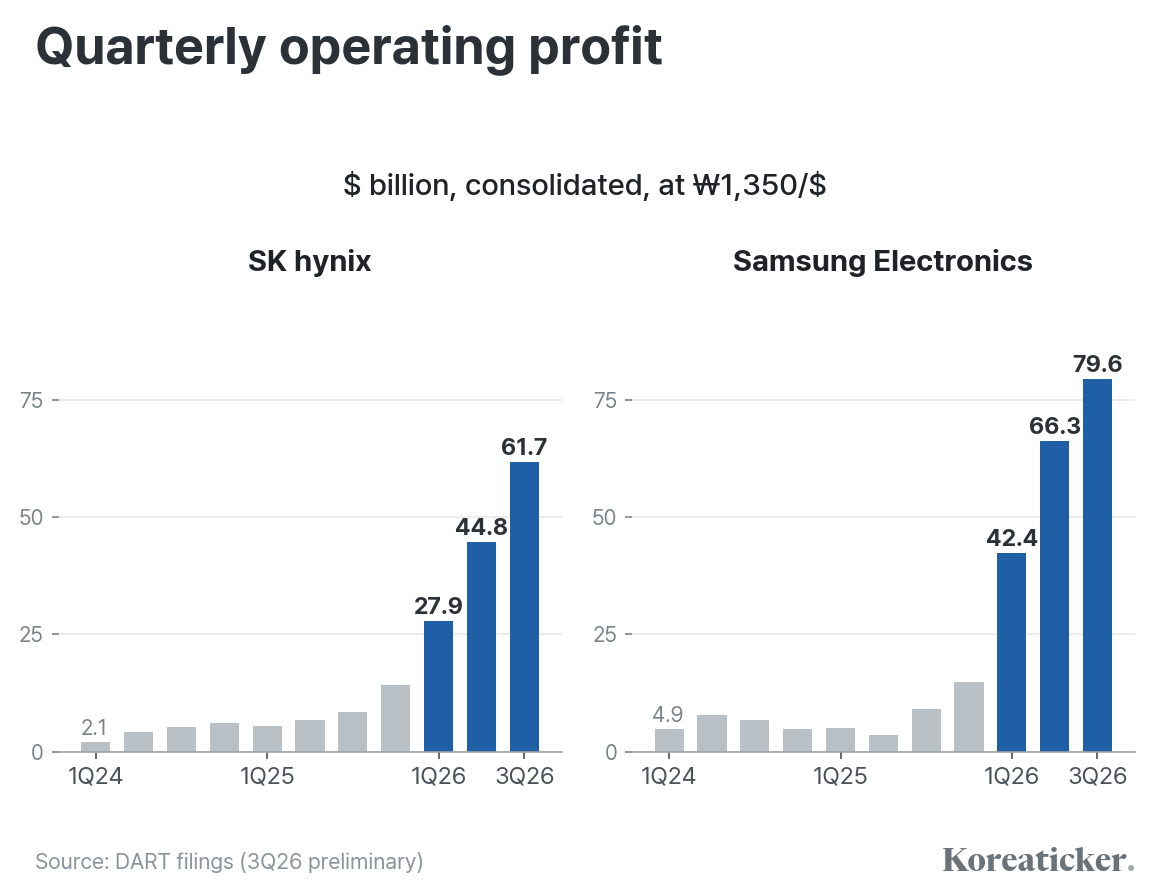
SK hynix's operating margin rose from 58% to 80% in three quarters.
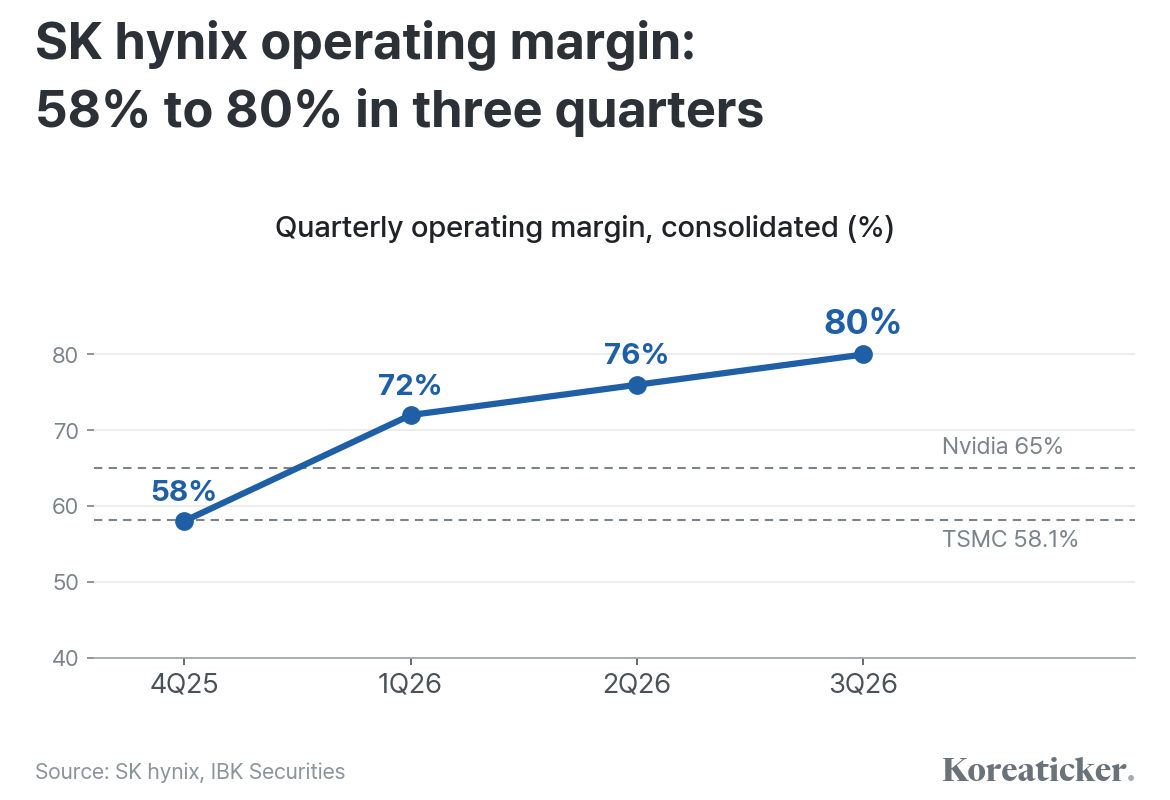
IBK Securities called SK hynix's 72% first-quarter margin "a level hard to find among any company in the world" and compared it with Nvidia and TSMC (TSM). It has risen for two more quarters since.
The HBM boom feeds these profits in two ways, and they are easy to mix up:
- Directly, through HBM's own sales. SK hynix doesn't break out HBM revenue. Bernstein's $7.6 billion estimate for its third-quarter HBM sales works out to about 10% of total revenue.
- Indirectly, through regular DRAM prices. Every wafer used for HBM is a wafer that doesn't become regular DRAM. The tighter supply helps hold up regular DRAM prices: SK hynix's average DRAM selling price rose about 30% in the second quarter and by just under 30% again in the third.
A small revenue share does not mean a small profit share. HBM could earn a higher or lower margin than the rest of the business, and SK hynix doesn't say.
The third quarter would not have looked like this without the jump in regular DRAM prices, and HBM is part of the reason for that jump.
The price gap between HBM and regular DRAM has also shrunk. In the second quarter of 2025, HBM3E sold for more than 4 times the price of DDR5 for the same amount of memory, according to TrendForce. KB Securities, as reported by the Korea Economic Daily, estimates the gap narrowed to about 2x in the second half of 2026.
TrendForce finds that since the first quarter of this year, a wafer turned into server DDR5 brings in more revenue than the same wafer turned into HBM.
That is because HBM needs 3 to 4 times the wafers for the same amount of memory, so once its price premium drops to 2x, it brings in less money per wafer. Profit per wafer also depends on yields and the extra cost of stacking and packaging HBM, which the companies don't publish.
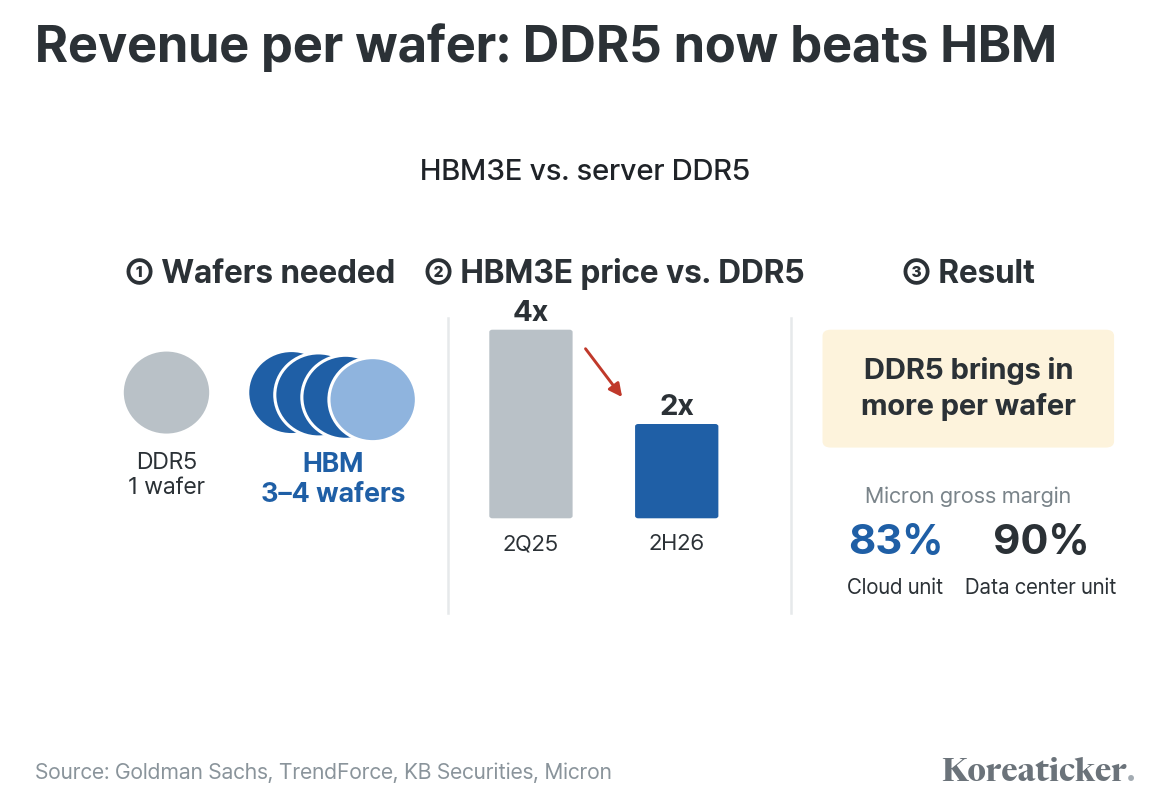
Micron's results point the same way, with a caveat. In its latest quarter, Micron's cloud memory unit, where most of its HBM sits, had a gross margin of 83%, flat from the quarter before. Its core data center unit, which sells mostly regular server DRAM, reached 90%.
Micron said prices rose but a larger HBM mix offset the gains. The two units are not pure HBM and pure DRAM, so treat this as a hint.
2027 should look different. HBM prices were locked in by contract ahead of time, and regular DRAM prices soared in the meantime.
All three makers have now finished negotiating 2027 HBM volumes and prices, and TrendForce expects HBM prices to more than double. Maeil Business Newspaper reported in October that Samsung quoted HBM4 in the mid-to-high $4 range per gigabit, more than three times the roughly $1.50 for HBM3E.
The agreed 2027 prices have not been published. Results in 2027 should offer clues to how much higher HBM prices contribute to earnings.
6. Supply: lots of wafers, few bits
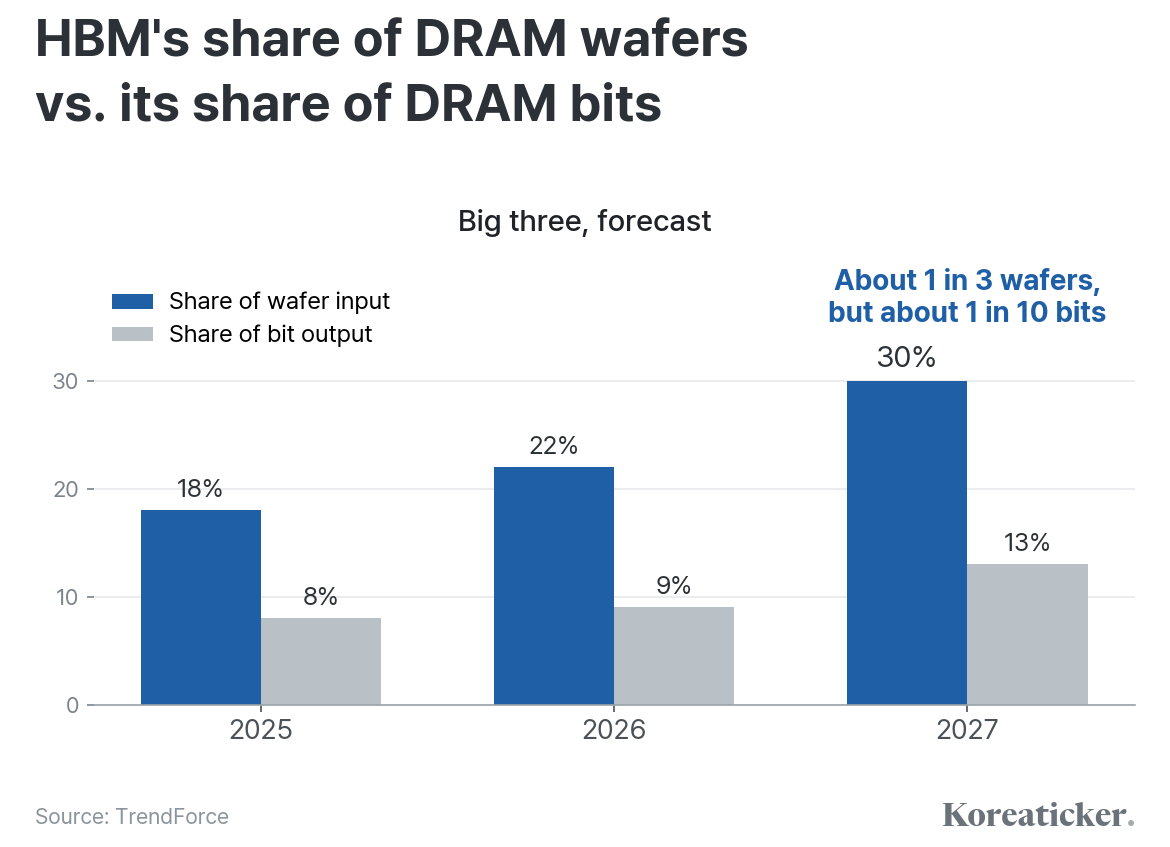
In 2027, HBM will take 30% of DRAM wafers but produce only 13% of DRAM bits.
TrendForce estimates HBM's share of the big three's DRAM wafers will go from 18% in 2025 to 22% in 2026 and 30% in 2027. Its share of total DRAM bits stays at 8%, 9% and 13%. So the more HBM gets made, the less regular DRAM is available, and the higher its price goes.
For holders, this is the link that runs in reverse too: if HBM demand slows and wafers go back to regular DRAM, that extra supply would weigh on the prices behind this year's profit.
Supply is being locked up in long-term contracts. SK hynix signed 5-year deals with 14 customers, took deposits, and has booked more than half of its production capacity for 2027 and 2028. Samsung aims to put 60% to 70% of its production capacity under long-term contracts through 2030.
For SK hynix shareholders, that means much of the 2027 and 2028 output already has a buyer, and Samsung's would too if it reaches its target. What those buyers pay, and whether they can walk away, has not been disclosed (section 7).
All three are adding production capacity. SK hynix is building in Cheongju (M15X) and Yongin, Samsung at Pyeongtaek P4 and P5, and Micron is preparing an HBM packaging plant in Singapore. Plants that start running by 2028 add to the supply that the bear case below turns on.
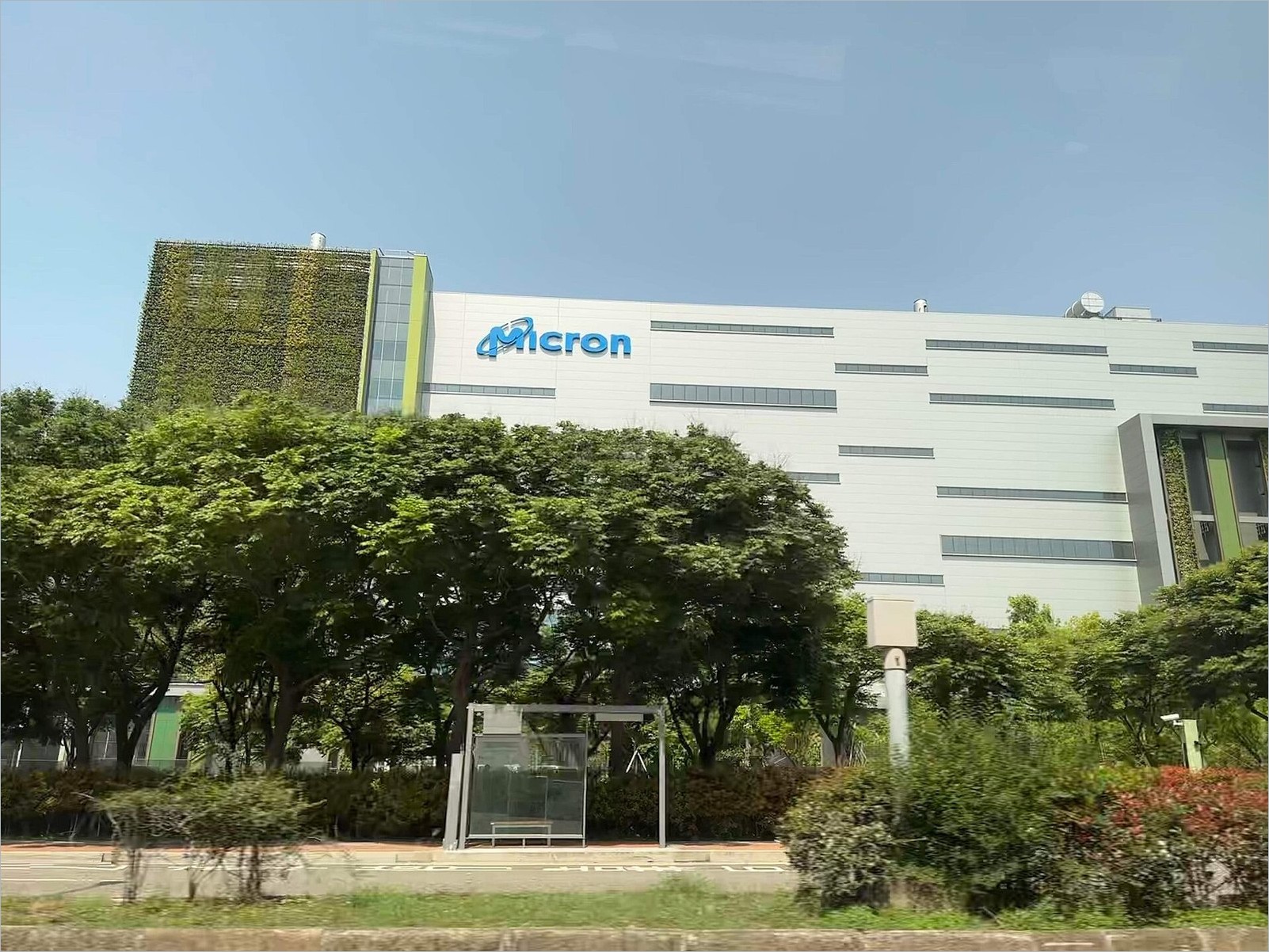
Bloomberg reported, however, that construction at Micron's Fab 11E in Taiwan has largely stalled over a labor dispute. If the delay lasts, it slows part of Micron's added capacity.
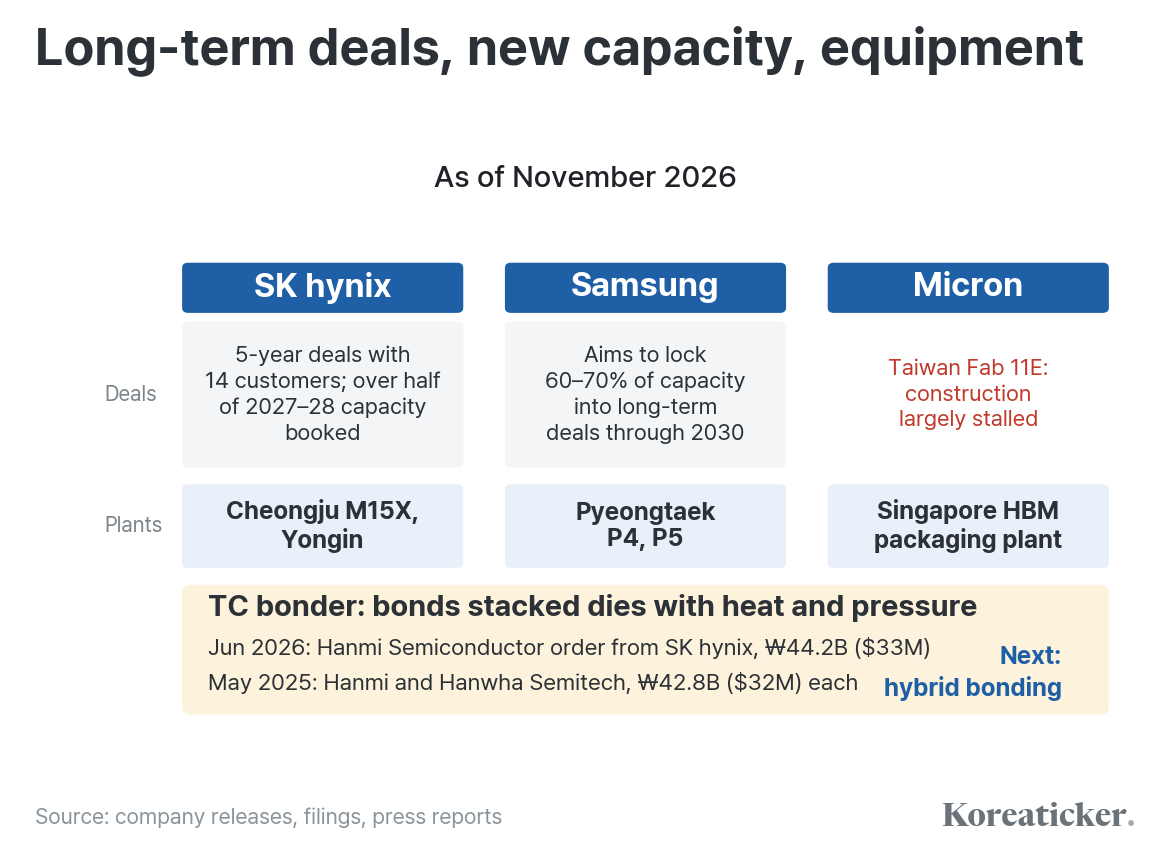

On the equipment side, the name that comes up most is the TC bonder, short for thermal compression bonder. It presses the stacked dies together with heat and pressure. Bonder orders are one early sign that the makers are adding stacking capacity.
7. The bear case: how "sold out" could turn into oversupply
"Sold out" and "oversupply in 2028" can both be true. SK hynix says its DRAM and HBM are effectively sold out through 2029.
The phrase alone does not tell investors whether the new fabs listed above are counted in that capacity, or how firm the contracts are on cancellation and price. Neither has been disclosed. If the new fabs end up adding more supply than customers take, the market could turn even with today's order books full.
Daishin says that if production bottlenecks clear suddenly, customers could cancel double orders they have been holding all at once. In a July report, Bloomberg Intelligence expected the memory shortage to peak in the second quarter of 2026 and saw possible oversupply in 2028.
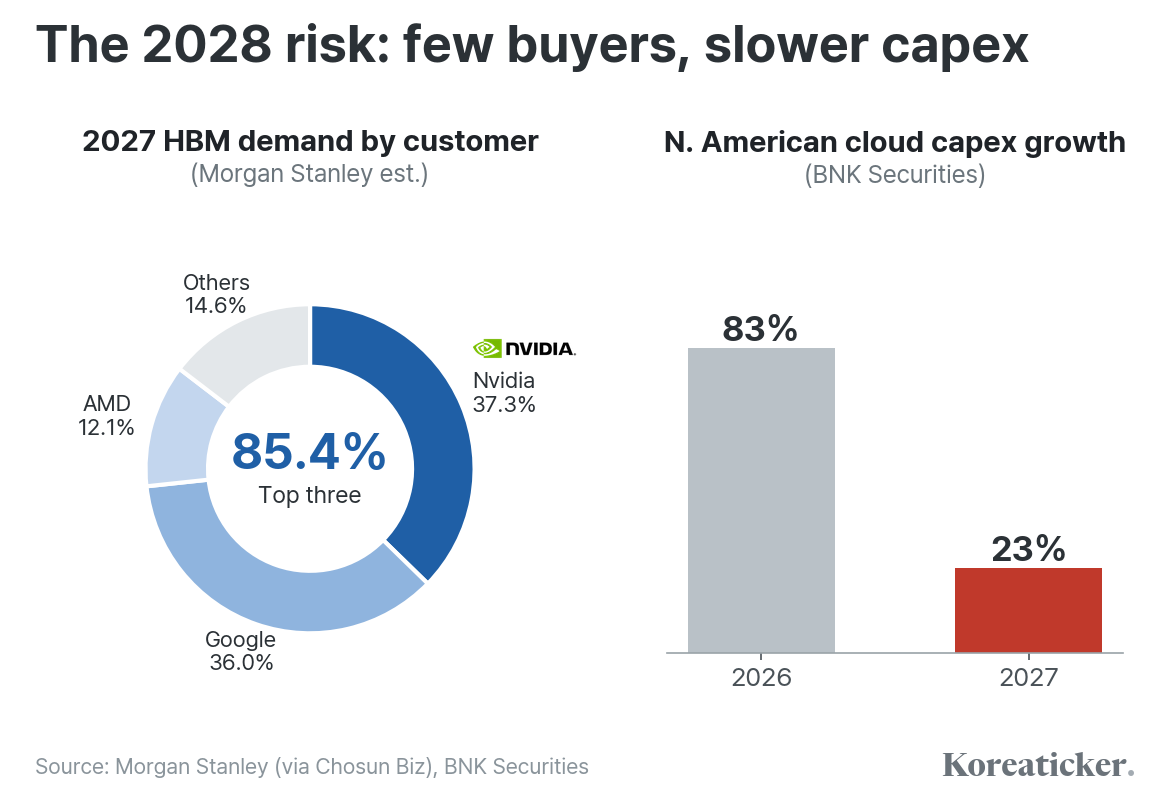
Slower growth in AI spending matters even if spending keeps rising. BNK Securities expects capex growth at North American cloud companies to slow from 83% in 2026 to 23% in 2027. That is still growth. The danger is that supply, boosted by the new fabs, grows faster than demand.
Customer concentration makes it worse. Morgan Stanley expects Nvidia, Google (GOOGL) and AMD (AMD) to take 85.4% of HBM demand in 2027, according to Chosun Biz.
China's CXMT is still far behind in HBM. Reuters reported that it plans HBM3E volume production by the end of the fourth quarter, but with yields of 20% to 30%, against about 70% at SK hynix. That leaves it about two generations behind the leaders.
In my view, the nearer risk from CXMT is in regular DRAM. CXMT already makes standard DRAM, and adding output there is much easier than reaching HBM-grade yields. More Chinese DRAM would hit the regular DRAM prices that drove this year's profits.
Some think the shortage will last longer. Goldman Sachs and JPMorgan expect it to run through at least 2028, and SK hynix's CEO said "2027 will be the tightest year for supply in the industry's history."
8. The bottom line: what the low P/E is pricing in
My read: through 2027, supply of both HBM and regular DRAM looks unlikely to catch up with demand. All three makers have sold their 2027 HBM output, and HBM keeps eating wafers that would otherwise become regular DRAM.
This year's record results leaned heavily on regular DRAM prices. If those prices cool in 2027, profits fall unless higher HBM4 prices fill the gap. That is what the market is pricing in with multiples of 5 to 9 times earnings.
The three companies are exposed in different ways:
- SK hynix is heavily exposed to memory prices in both directions, since memory is nearly all it sells.
- Samsung is gaining HBM share fastest through HBM4, and its phone, TV and appliance businesses soften a memory downturn, though they earn little right now.
- Micron trades at a higher multiple on similar margins. Korean stocks have long traded at lower valuations than US peers, a gap often called the Korea discount.
What would change the picture:
- Regular DRAM contract prices each quarter, from TrendForce and the companies' own results
- What the companies say about HBM pricing and margins in 2027 results
- Counterpoint's third-quarter HBM share figures, which will show whether Samsung passed SK hynix on revenue
- Cloud capex guidance from Microsoft, Alphabet, Amazon and Meta
- When the new fabs in Cheongju, Yongin and Pyeongtaek start producing
If new production capacity comes online just as AI spending growth slows, a market where three customers buy 85% of HBM could stop being sold out very quickly.
For US investors
How to buy these stocks from the US
Step-by-step guide: this guide. Every ticker for both companies and how the SKHY premium works: this guide.
Sources and notes
- SK hynix, 3Q 2026 earnings release (2026.10)
- Samsung Electronics, 3Q 2026 earnings call (2026.10)
- Micron, Q4 FY26 prepared remarks (2026.09)
- TrendForce, memory market outlook and HBM contract price forecasts (2026.05, 2026.06)
- TrendForce, report on Nvidia Rubin HBM spec changes (2026.10)
- Counterpoint Research, HBM revenue share (via Seoul Economic Daily, 2026.09)
- Daishin Securities, "Reasons It Can Go Higher" (2026.01)
- IBK Securities, SK hynix: "Highest operating margin in corporate history" (2026.04)
- Hana Securities, CXMT: HBM development and company history (2026.07)
- Bernstein, 3Q HBM revenue estimates (via Korea Economic Daily, 2026.10)
- Bloomberg Intelligence, memory oversupply outlook (via Yahoo Finance, 2026.07)
- Morgan Stanley, 2027 HBM demand by customer (via Chosun Biz)
Won converted at ₩1,350 per dollar. Results from DART (3Q26 preliminary) and SEC filings; Samsung's division profit from its 3Q26 release.
P/E and P/B use net profit and equity attributable to shareholders. Samsung's market value excludes preferred shares. Prices are closes on Nov 10, 2026 (Seoul) and Nov 9, 2026 (Nasdaq).
Photos from Wikimedia Commons: C. Spille/pcgameshardware.de (CC BY-SA 4.0), 4300streetcar (CC BY 4.0), 极客湾Geekerwan (CC BY 3.0), Thingreenline4546 (CC BY-SA 4.0), The White House (public domain).
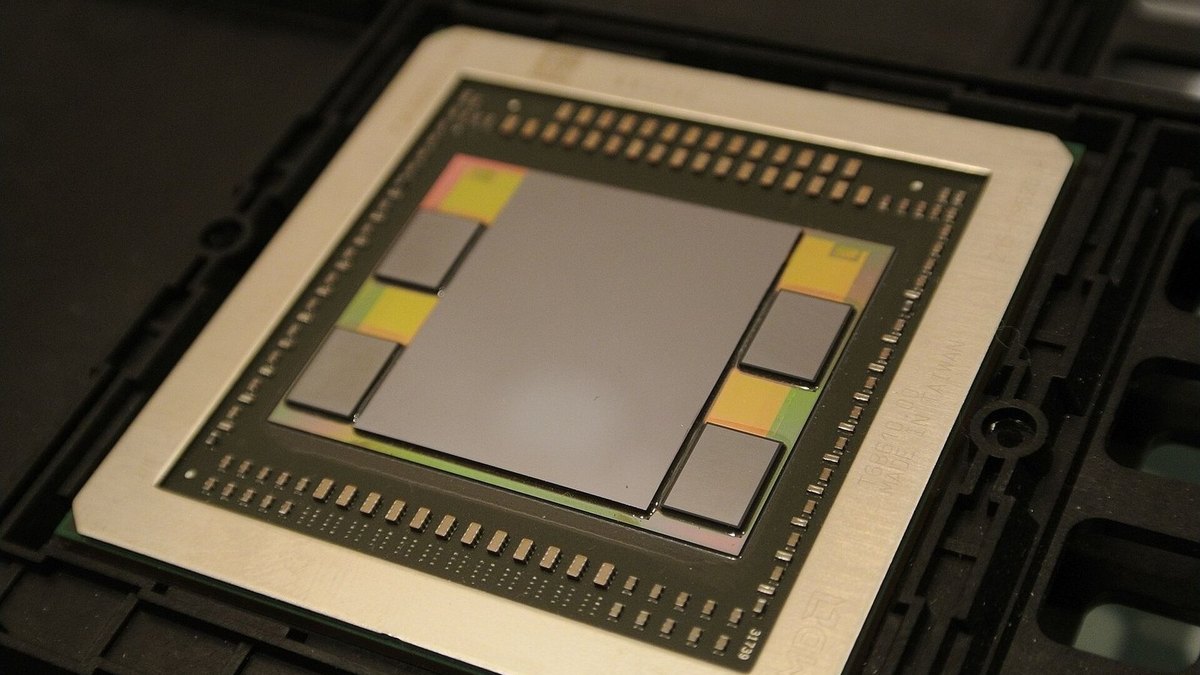
Cover photo: an AMD Fiji GPU package with four HBM stacks, by C. Spille/pcgameshardware.de, credited above.
For information only, not investment advice. See our full disclaimer.
Update history
- Nov 12, 2026 Removed a claim that oversupply worries caused Micron's October fall, and marked the HBM4 price explanation of the forecast spread as our view.
- Nov 13, 2026 Added what each section means for shareholders of the three memory makers: why the market prices this profit low, what the forecast spread and the share shift change for each company, and what long-term contracts do and do not lock in. Cut details without a shareholder angle: a Hanmi Semiconductor equipment order, the hybrid bonding note and Micron's October share move.
- Nov 14, 2026 Tied the HBM basics, forecast spread, generation shift and wafer sections more directly to what they mean for holders, and cut repeated 'for holders' lines, after a reader-impression review. No figures changed.
Corrections and changes to facts are listed here. See our editorial policy.