Korean HBM Equipment Stocks: 21 Suppliers Compared
SK hynix's operating profit in the first half of 2026 was about $60 billion higher than a year earlier. Over the same period, 21 listed Korean chip equipment and materials suppliers added about $56 million combined. The arithmetic gap is about a thousand times.
That is not a like-for-like measure of how much HBM money reached suppliers. It compares SK hynix's total profit with the total profit of 21 companies we selected, not all of which sell mainly to SK hynix or mainly into HBM.
It does show how differently the two groups' results moved. If you bought these suppliers as a cheaper way into SK hynix's boom, their first-half earnings gave you very little of it.
The three memory makers say their planned 2027 output of high-bandwidth memory (HBM), the memory inside AI servers, is effectively sold out. So why didn't the companies supplying the machines, parts and chemicals needed to make it earn more? And what would have to change?
The 21 listed Korean suppliers here include bonders, testers, inspection tools, cleaning tools, materials and front-end equipment. For the memory makers themselves, see our HBM market outlook. For the largest of the 21, see the Hanmi Semiconductor profile.
The short answer
- Memory makers earned from price and product mix. Suppliers earn from the number of machines and the volume of materials a customer buys, which grew far less. For most of them, memory prices matter through what customers buy.
- Some of the largest equipment orders go abroad. One SK hynix contract with ASML is larger than a full year of revenue at all 21 suppliers combined.
- Results inside the group differ widely. Test equipment makers roughly doubled their profit. Nine of the 21 had lower revenue.
- The highest margins are in narrow product categories. Three companies had operating margins of 46% to 57%; 13 were below 20%.
Contents
- 1The short answer
- 2Six of the 21 at a glance
- 3Why supplier profits lagged SK hynix
- 4Price for memory makers, machine counts for suppliers
- 5Korean companies across the HBM process
- 6Hanmi Semiconductor: 71% TC bonder share, uneven orders
- 7TC bonders and hybrid bonding
- 8Test equipment profits rose fastest; supplier margins varied widely
- 92026 share performance and global peers
- 10Orders, margins and capital spending to track
- 11How US investors can access these stocks
Six of the 21 at a glance
| What it makes | Code | Market cap (Nov 10, 2026) | 1H26 revenue vs 1H25 | 1H26 operating margin | Share price in 2026 | |
|---|---|---|---|---|---|---|
| Hanmi Semiconductor | TC bonders that stack HBM chips | 042700 | $12.2B | −8% | 46% | +36% |
| Jusung Engineering | Deposition tools for DRAM | 036930 | $5.2B | −43% | −5% | +450% |
| LEENO Industrial | Test pins and sockets | 058470 | $2.7B | +27% | 50% | −19% |
| HPSP | High-pressure annealing tools | 403870 | $2.2B | −12% | 57% | +9% |
| ISC | Test sockets | 095340 | $2.1B | +69% | 32% | +20% |
| DI Corp | Wafer and burn-in testers | 003160 | $0.5B | +20% | 21% | +22% |
Market cap uses the November 10, 2026 Korea Exchange close and shares outstanding less treasury shares, converted at ₩1,350 per dollar. Share price change is from the last close of 2025 to November 10, 2026.
Read across a row and the share price often went the other way from revenue. Jusung's revenue fell by almost half while its stock was the best performer in the table; LEENO grew revenue and its stock fell.
First-half results were a weak guide to the 2026 share price here, so the order and margin checks in section 8 are the better clues for a holder.
1. Why supplier profits lagged SK hynix
SK hynix's first-half operating profit rose from $12.3 billion to $72.7 billion. The 21 suppliers' combined figure rose from $594 million to $650 million, up 9%.
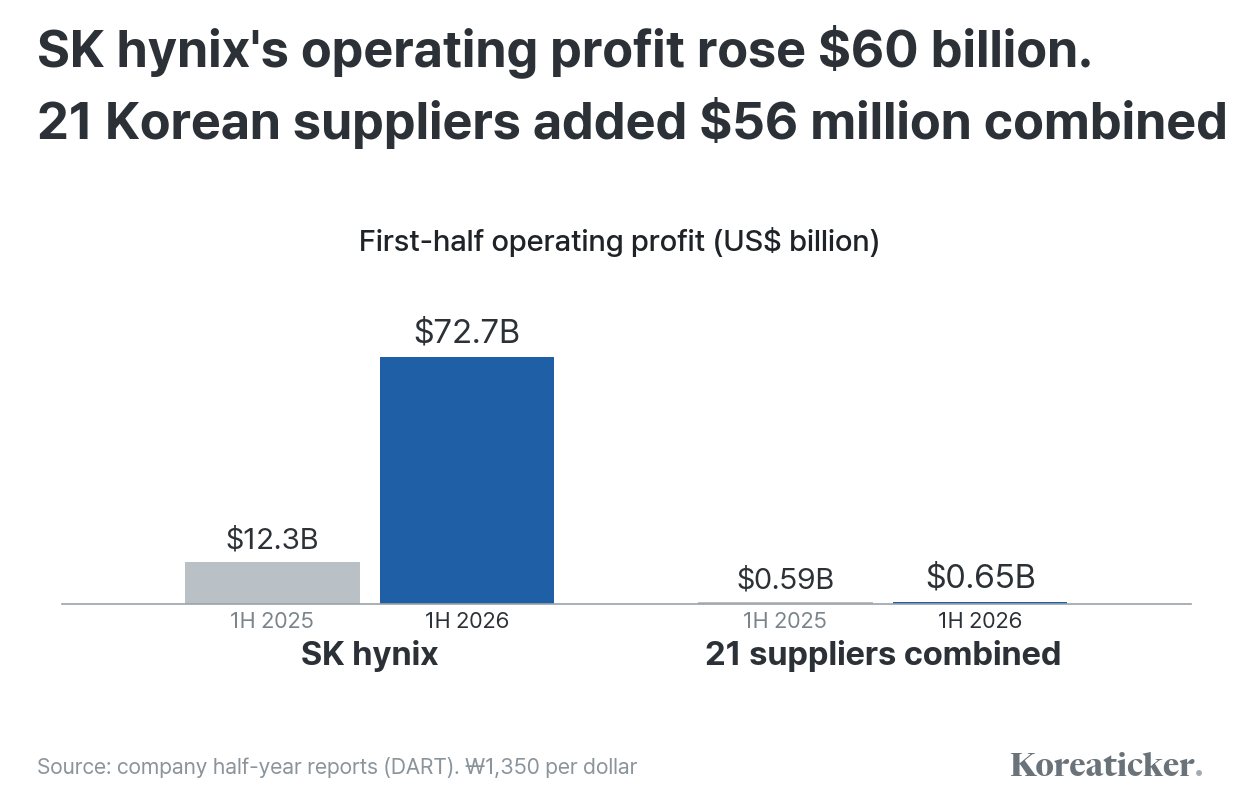
SK hynix's revenue went from $29.5 billion to $97.7 billion, 3.3 times, and its operating margin reached 74%. The suppliers' combined revenue rose 4%, from $3.19 billion to $3.32 billion.
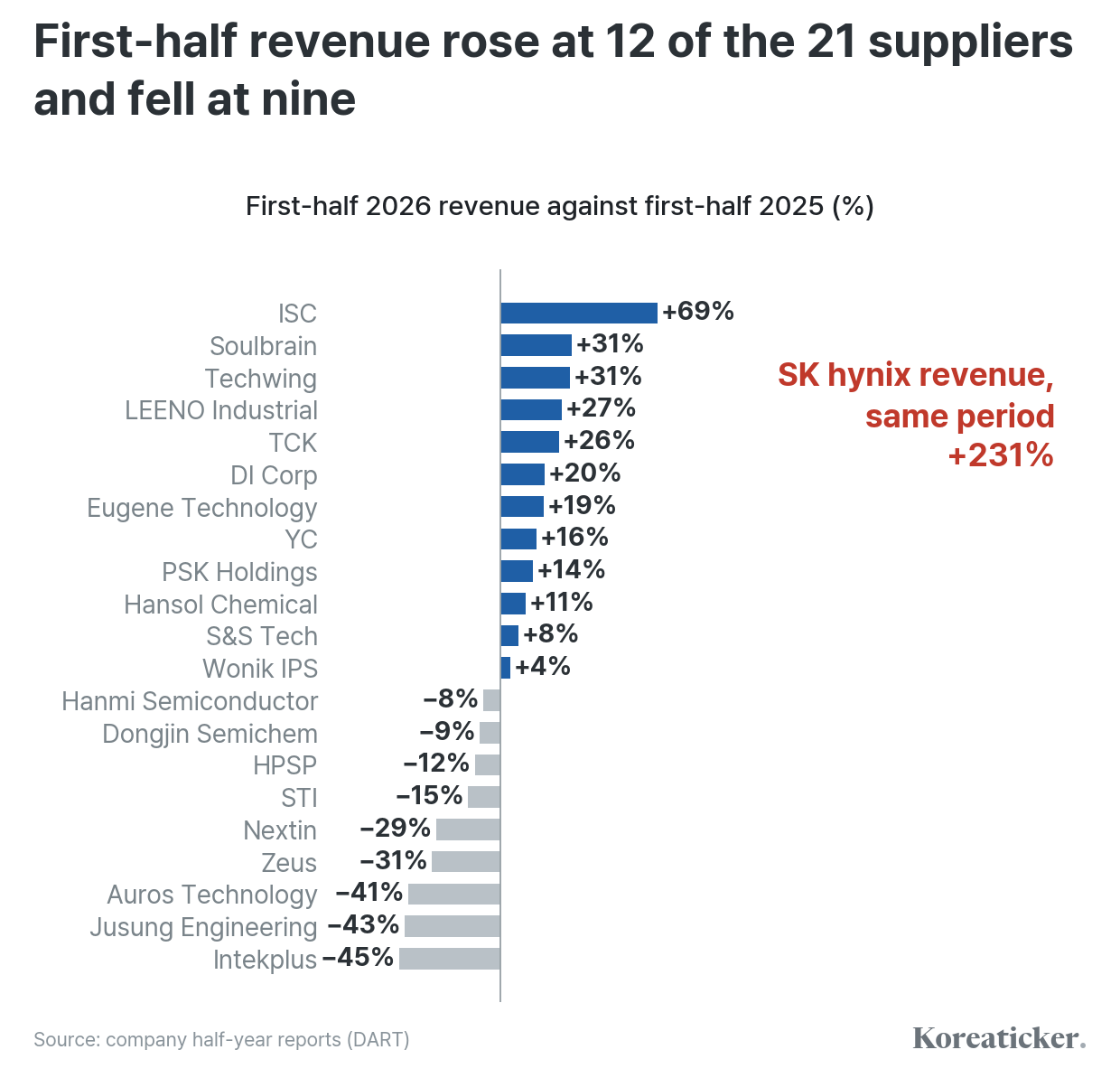
Twelve suppliers grew and nine shrank, while SK hynix's revenue rose 231% over the same half. In the first half of 2026, SK hynix's results were a poor guide to this group's: a tripling at SK hynix came with a 4% rise in their combined revenue.
2. Price for memory makers, machine counts for suppliers
Factories cannot triple in a year, so higher memory prices and a richer product mix were major drivers of SK hynix's $68 billion revenue increase. The sources used here do not split the increase between price and volume.
Suppliers do not share in price gains directly. An equipment maker is paid when a customer builds a new line, and a materials or parts maker is paid as the customer's factories run. So for an equipment maker's shareholder, the customer's capital spending is the more direct number to watch.
Capital spending did rise. SK hynix said its 2026 capital expenditure would be in the high ₩40 trillion range (roughly $33 billion to $37 billion), against ₩28 trillion in 2025. Samsung Electronics put its 2026 facilities investment at ₩84.4 trillion ($62.5 billion), of which ₩76.8 trillion is for chips.
Higher spending is the route by which supplier revenue can catch up, though for equipment makers the revenue arrives months after the order (section 6). How much of it reaches Korean suppliers is the next question.
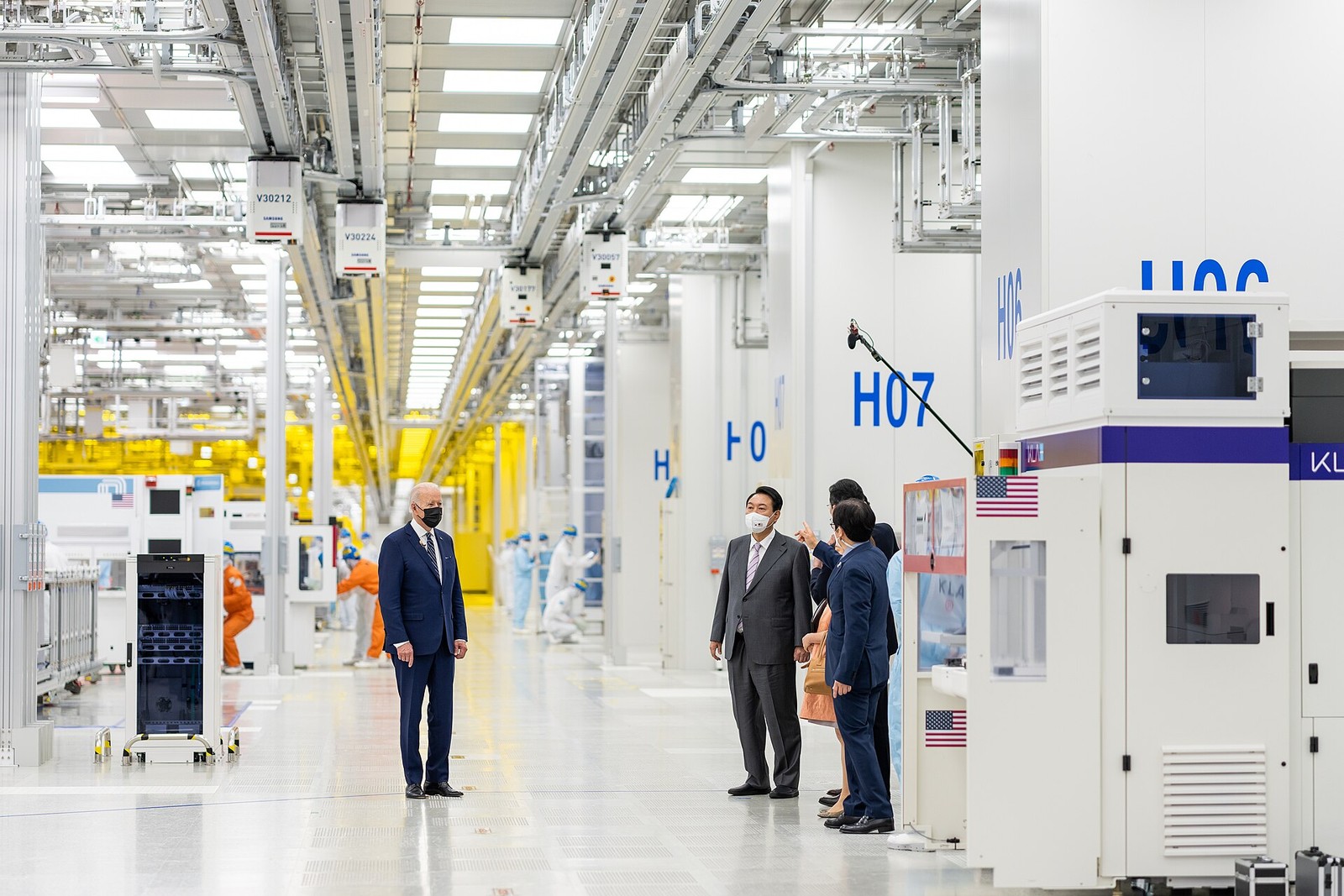
Some of the largest equipment orders go to foreign suppliers. In March 2026 SK hynix disclosed a single contract with ASML for EUV lithography machines worth about ₩11.9 trillion ($8.9 billion). All 21 suppliers together had 2025 revenue of $6.3 billion. Korea was 45% of ASML's revenue in the first quarter of 2026.
Some of that spending goes to foreign suppliers before any reaches these 21 companies, so a spending headline is not a supplier revenue forecast.
Korean press reports put the domestic share of chip equipment used in Korean fabs at about 20%. The reports do not name the underlying statistic, and the sources here do not establish the foreign share of total spending, so treat it as a rough figure.
3. Korean companies across the HBM process
Etching the holes, thinning the wafers and filling the gaps between chips are done mainly with foreign tools and materials. Korean suppliers are most visible in bonding, testing and inspection.
HBM is made by drilling holes through DRAM chips, thinning them, stacking and bonding them, then testing the stack.
| Step | What happens | Foreign suppliers | Korean suppliers |
|---|---|---|---|
| TSV etch | Holes are drilled through the chip | Lam Research | VM |
| Cleaning | Residue is washed out of the holes | Zeus | |
| Grinding and dicing | Wafers are thinned and cut | Disco | |
| Bumping and reflow | Connection bumps are formed | PSK Holdings, STI | |
| Bonding | Chips are stacked and joined | ASMPT | Hanmi Semiconductor, Hanwha Semitech, Semes |
| Underfill | Gaps between chips are filled | Namics | |
| Inspection | Defects in the stack are found | Camtek, Onto Innovation | Nextin, Intekplus, Auros Technology |
| Test | Electrical testing sorts out bad chips | Advantest | DI Corp, YC, Techwing |
The table lists suppliers named in company materials and Korean press reports. It is not a complete list, and it does not show each supplier's share.
Lam Research is described in Korean coverage as having no real substitute in deep-hole etching. Japan's Disco is reported to hold more than 90% of the wafer grinding and dicing market. The liquid underfill SK hynix uses in its stacking method comes from Japan's Namics under an exclusive arrangement.
Where Korean reports say a tool has no real rival, the maker is foreign. Korean suppliers show up where the stack is joined and checked. Their revenue depends on how many stacks are built and tested, and on how many rival suppliers the customer brings in.
4. Hanmi Semiconductor: 71% TC bonder share, uneven orders
Hanmi's first-half revenue fell 8% to $224 million. First-quarter revenue was $38 million; second-quarter revenue was $186 million.
Hanmi Semiconductor (042700.KS) makes thermal compression (TC) bonders, which press and heat stacked chips so they join. TechInsights put its share of HBM TC bonders at 71% in 2025, with Semes at 13% and Hanwha Semitech at 3%.
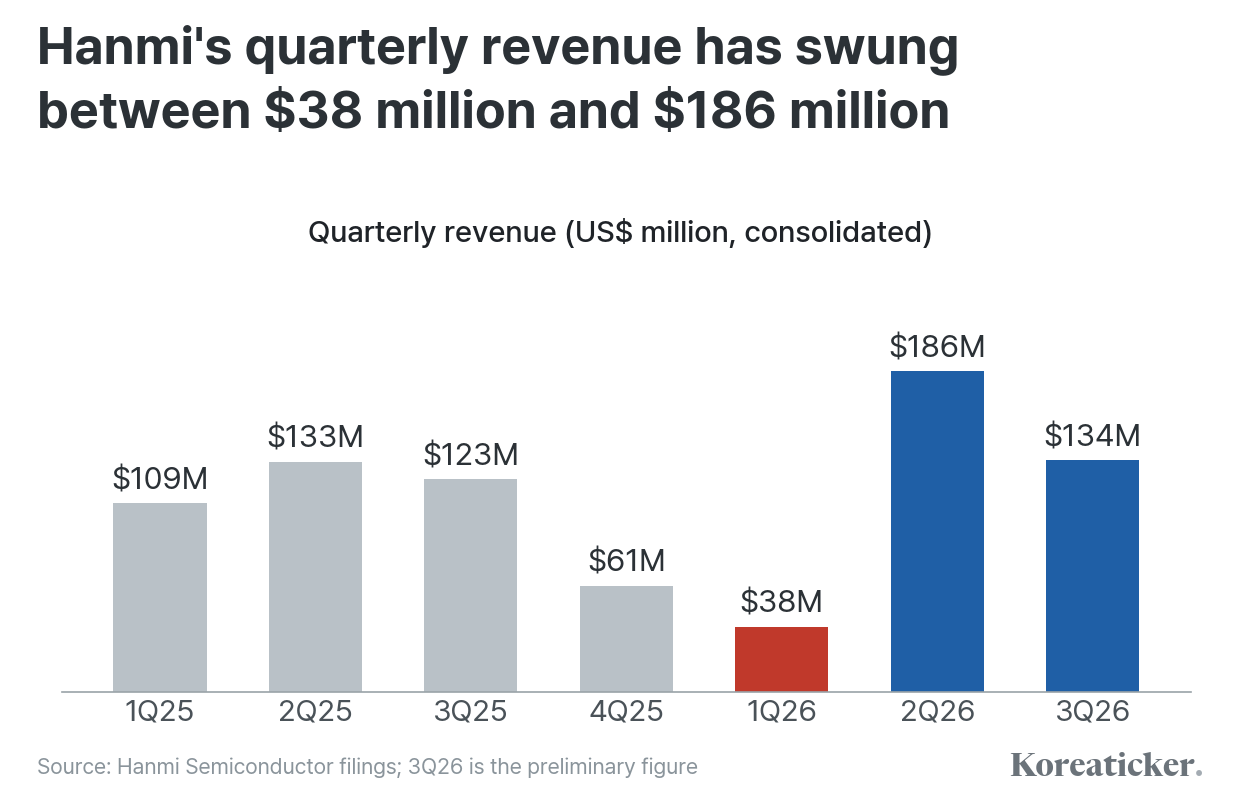
The first quarter of 2026 fell between two product generations. HBM3E investment had ended and HBM4 machine revenue was not yet booked. In the two trading days after the results, the share price fell more than 20%. The same gap could open at the next generation change, so one quarter says little about Hanmi's year.
HBM4 machines shipped in the second quarter, which was a record. Third-quarter revenue of $134 million was below the average of three brokerage forecasts, and the company said some machine revenue had moved into the fourth quarter.
Hanmi disclosed four orders in 2026, worth about $64 million in total. Two were from SK hynix, about $40 million together, which at roughly $2.2 million a machine is around 18 bonders. The other two were from UTAC and Samsung Electro-Mechanics. We found no disclosed 2026 order from Micron.
SK hynix has placed part of its TC bonder orders with a second Korean supplier since 2025, and ASMPT has also been reported in its supply chain. Hanmi raised its bonder price to SK hynix by 25% in April 2025, and the two Korean bonder makers are in a patent dispute with no ruling yet.
Hanwha Semitech, a unit of Hanwha Vision (489790.KS), won its first order in March 2025 and received orders alongside Hanmi in January and June 2026. Hanwha Vision's chip equipment revenue was about $63 million in the third quarter, more than double a year earlier.
SK hynix was about 54% of Hanmi's revenue in 2024 and Micron about 20%. With that much riding on one customer, every SK hynix bonder order that goes to Hanwha comes straight out of Hanmi's largest account, even if a growing market leaves room for both. The 71% share is a 2025 figure.
Brokerage estimates for 2026 point to Micron and exports to China as the main sources of growth, so in those estimates Hanmi's growth leans on customers other than SK hynix. The company has not published a 2026 customer breakdown.
5. TC bonders and hybrid bonding
All three memory makers build HBM4 with TC bonders. The reports and the brokerage forecast cited here place wide use of hybrid bonding at the 20-layer generation, around 2029 to 2030.
The main risk for bonder makers is a change of technology. Today chips are joined through small bumps. Hybrid bonding joins copper to copper with no bumps, which allows thinner and taller stacks. BE Semiconductor (BESI) of the Netherlands has about 70% of that market.
The change has come more slowly than once expected, for two reasons. First, the JEDEC standard raised the allowed height of an HBM4 stack from 720 to 775 micrometers, which lets 16 layers fit with the current method. Second, yield: in September 2026 an SK hynix executive said hybrid bonding would need yields of 90% to 98% before volume production.
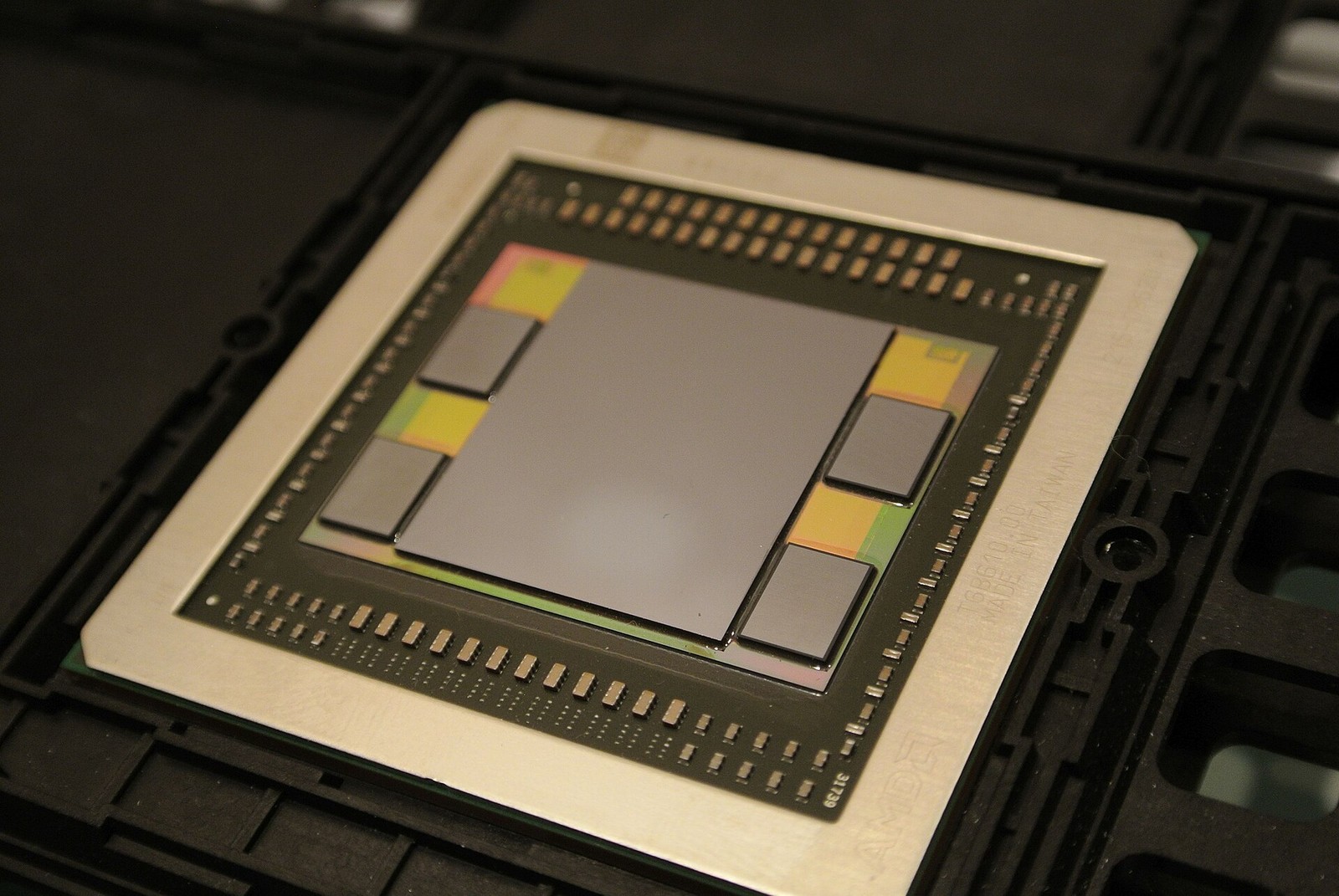
In a June 2026 report, iM Securities expected SK hynix to keep its current method through 16 layers and adopt hybrid bonding from 20 layers, and expected Samsung Electronics to apply it from 16 layers. Micron has stayed with its current method.
Korean bonder makers are preparing. Hanwha Semitech announced a second-generation hybrid bonder in February 2026. Hanmi is building a plant for hybrid bonders, due for completion in the first half of 2027. Whether today's TC bonder leaders keep their position at 20 layers is not yet known.
For Hanmi holders, the 16-layer allowance lets SK hynix stay with TC bonders for now, while Samsung Electronics may move earlier. In the forecasts cited here, the bigger switch comes at 20 layers, around 2029 to 2030.
6. Test equipment profits rose fastest; supplier margins varied widely
DI Corp's first-half operating profit was 2.6 times a year earlier, Techwing's 2.7 times and ISC's 2.2 times.
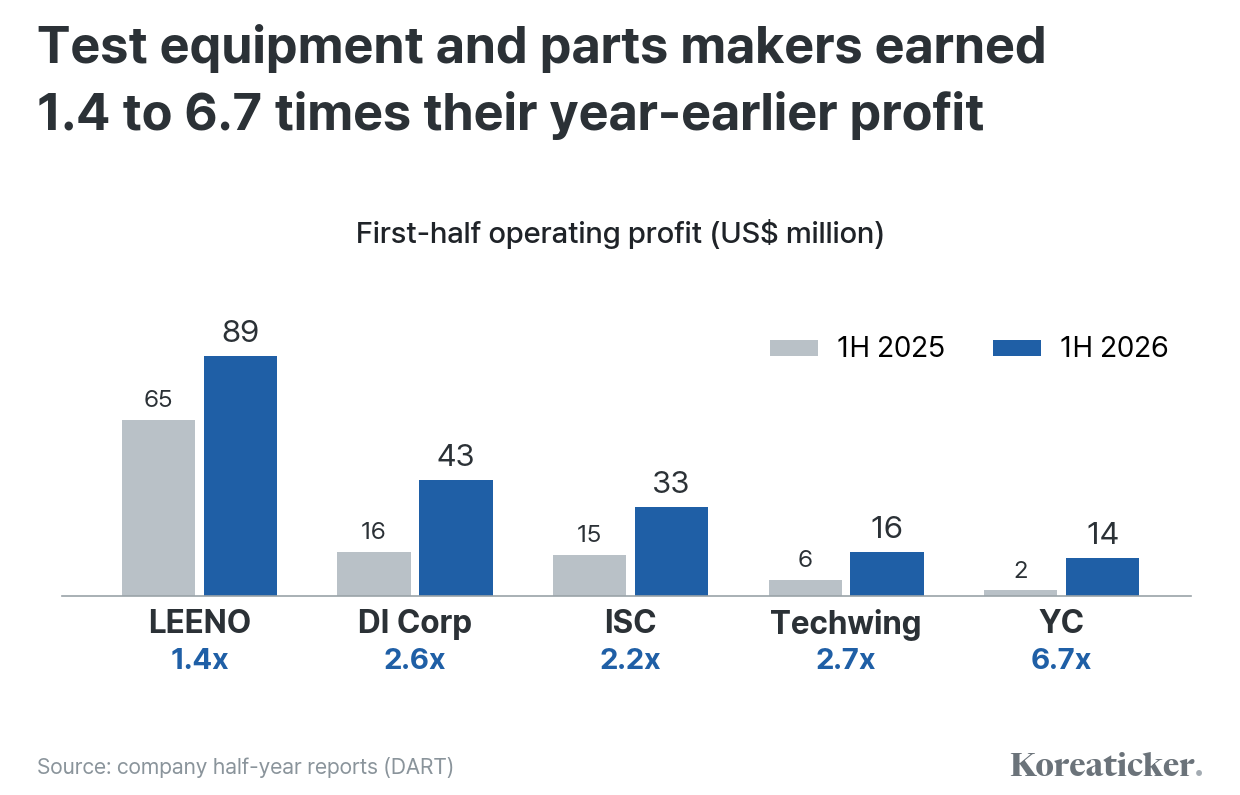
HBM stacks many chips, and one bad chip can spoil the stack, so chips are tested more often before and after stacking. DI Corp's subsidiary Digital Frontier supplies HBM4 wafer testers to SK hynix and won about $145 million of orders in January and March 2026, close to half of DI's 2025 revenue.
YC supplies memory wafer testers to Samsung Electronics, which owned 11.7% of YC as of March 2026. Customers keep two suppliers here: Samsung Electronics buys from Advantest and YC, SK hynix from Digital Frontier and UniTest.
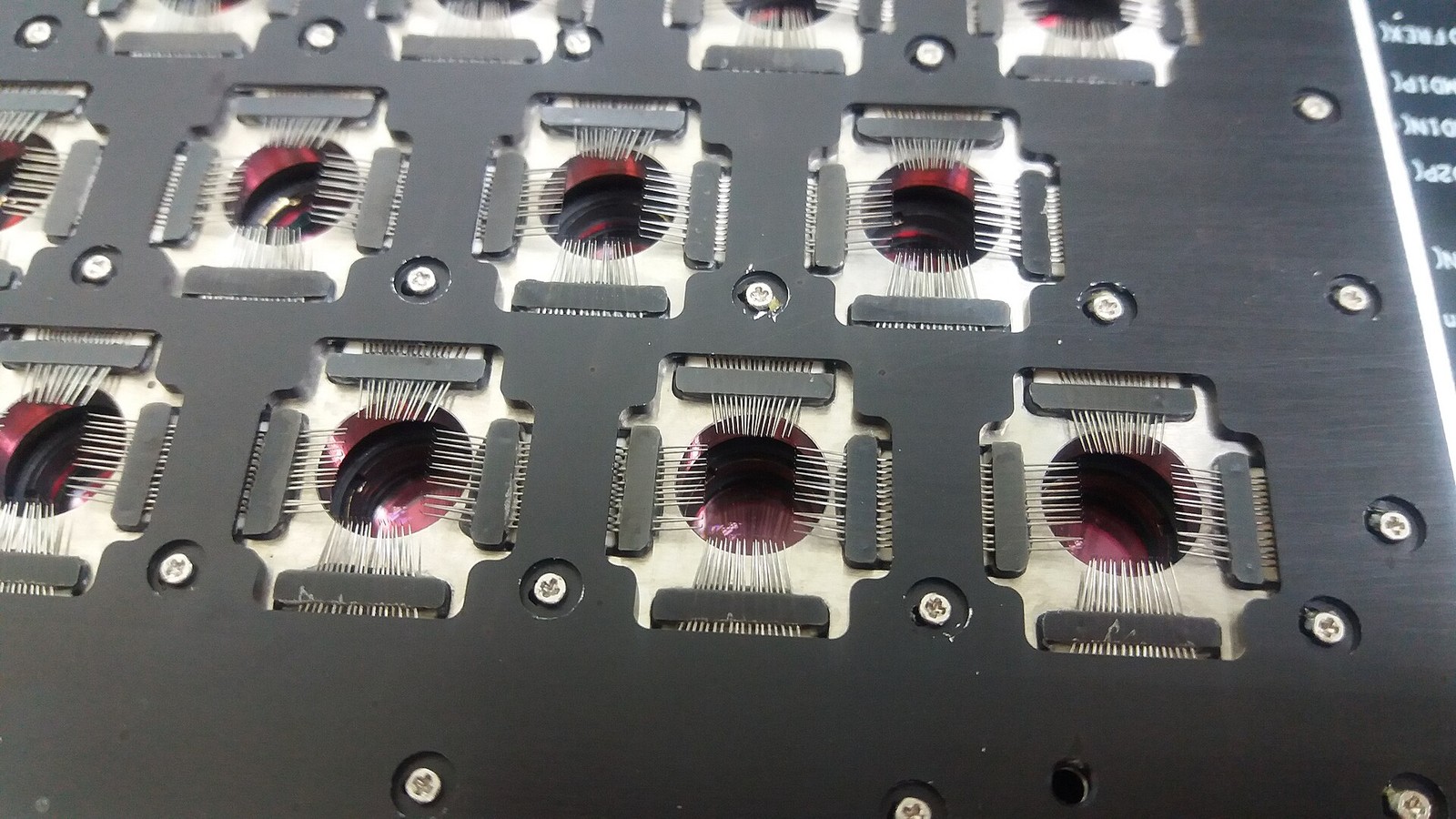
ISC and LEENO Industrial make the sockets and pins that hold a chip during testing, which are replaced as chip designs change. These businesses earn as chips are tested and designs change, a source of revenue that does not wait for new factory lines.
Testing has its own gaps between orders, so DI holders face the same timing risk as Hanmi holders. DI's share price fell more than 10% in a single day in early November, after its third-quarter results. A Hana Securities analyst had said in August that orders could pause once early-2026 deliveries were complete.
The nine suppliers with lower revenue were mostly equipment makers, where revenue trails orders by six months to a year. Jusung Engineering's first-half revenue fell 43% and it had an operating loss, while its order backlog roughly tripled between March and June. If that backlog is delivered on the usual lag, it would reach revenue within a year.
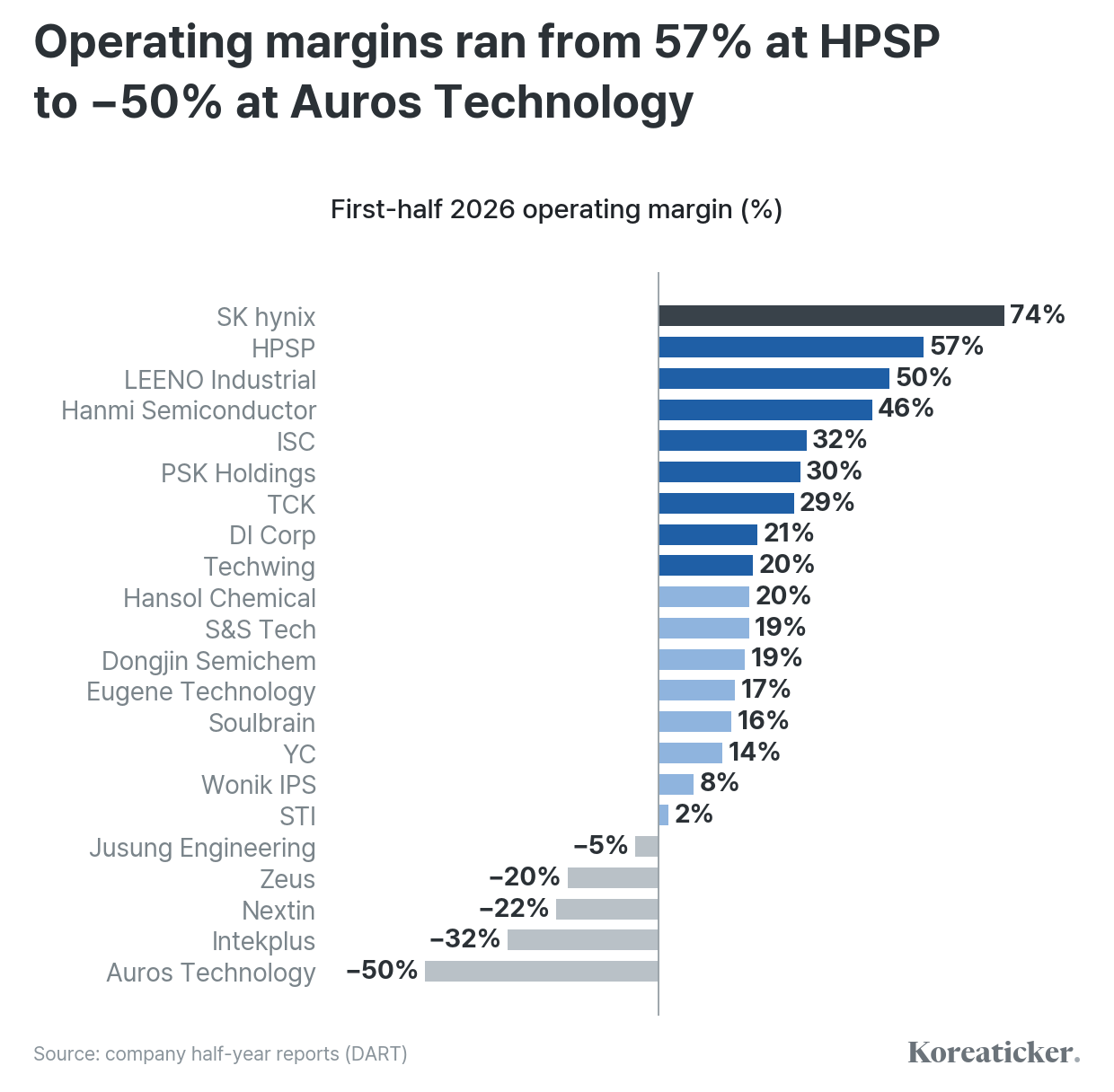
HPSP (57%), LEENO Industrial (50%) and Hanmi (46%) each lead a narrow product category. Three cases do not prove that this is the cause of their margins, but the pattern is consistent.
A Korea Economic Daily survey of 84 equipment and materials suppliers with a market value above ₩500 billion found an average operating margin of 9.4% in the first quarter of 2026, against 47% at Samsung Electronics and 72% at SK hynix.
One equipment company chief executive told the paper that the two customers' purchasing teams are measured on how far they cut equipment prices. If that holds, higher customer spending could lift supplier revenue more than supplier margins.
7. 2026 share performance and global peers
As of the November 10 close, 18 of the 21 suppliers were more than 45% below their 2026 highs. Three had risen more than SK hynix in 2026.
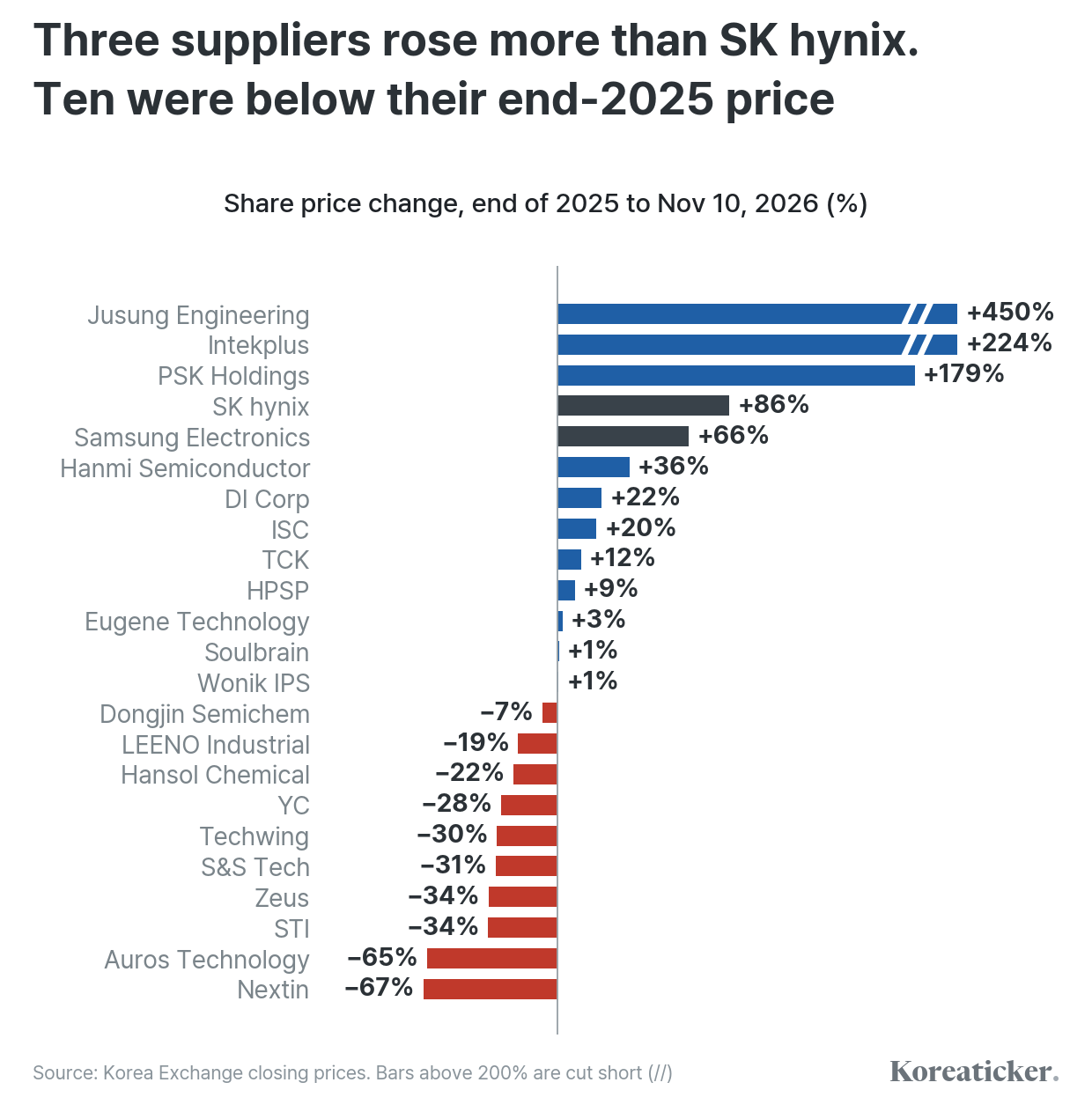
SK hynix was up 86% in 2026 and Samsung Electronics 66%. Ten of the 21 suppliers were below their end-2025 price.
The three that outperformed SK hynix were Jusung Engineering, Intekplus and PSK Holdings. For all three the share price moved ahead of reported first-half results: Jusung and Intekplus had first-half operating losses. For those two, the share price rose without first-half operating profit behind it.
SK hynix itself was 58% below its 2026 high on November 10, and the suppliers were 34% to 80% below theirs.
| Peer | Listing | What it does in this chain | Market cap | Trailing P/E |
|---|---|---|---|---|
| BE Semiconductor (BESI) | Amsterdam | Hybrid bonding | €12.2B | 41.4x |
| ASMPT | Hong Kong | TC bonders | HK$41.5B | 20.0x |
| Kulicke & Soffa | Nasdaq: KLIC | Bonders | $3.7B | 31.9x |
| Onto Innovation | NYSE: ONTO | Inspection | $9.7B | 64.9x |
| Camtek | Nasdaq: CAMT | Inspection | $4.8B | 38.6x |
| FormFactor | Nasdaq: FORM | Probe cards | $6.7B | 39.4x |
| Teradyne | Nasdaq: TER | Memory testers | $38.3B | 28.2x |
| Lam Research | Nasdaq: LRCX | Etch | $277.8B | 33.1x |
Figures are from StockAnalysis.com at the November 10, 2026 close. The same site showed Hanmi Semiconductor at a trailing P/E of 77.9x on a delayed November 11 quote. Earnings periods differ between companies, so the multiples are not strictly comparable.
Even so, Hanmi's multiple was above every peer in the table, so its buyers paid more for each dollar of past profit than buyers of any peer here.
Hanmi expects record fourth-quarter revenue. At 77.9x past profit, buyers are already paying for growth. If the record quarter comes with a lower margin, earnings will do little to bring that multiple down.
8. Orders, margins and capital spending to track
Both customers raised spending in 2026. SK hynix said in October that 2027 capital expenditure would be "considerably" higher than 2026, without giving a figure. Its Yongin fab is scheduled for partial operation in February 2027. Samsung Electronics' fifth Pyeongtaek fab is due to take equipment from July 2027 and start operating in 2028.
- Order disclosures. Orders move before revenue. Hanmi has said it expects record revenue in the fourth quarter. The size and timing of SK hynix's bonder orders for the next HBM generation will show how the split with Hanwha Semitech develops.
- Margins. Revenue can rise while selling prices fall. The 21 suppliers' combined operating margin was 20% in the first half. Whether that rises in 2027 is the measure of how much customer spending reaches them.
- 2028. Samsung Electronics has said that added investment takes time to become output, and the fabs now under construction ramp from 2028. That is the same period in which our HBM report places the oversupply risk.
For US investors
How US investors can access these stocks
Sources and notes
- DART (Korea's electronic disclosure system), half-year and annual reports and supply contract disclosures of each company (checked 2026.11)
- Korea Exchange daily closing prices (to 2026.11.10)
- SK hynix, second- and third-quarter 2026 earnings calls, as reported by Asia Economy and Bizwatch (2026.07, 2026.10)
- Samsung Electronics, third-quarter 2026 results (2026.10)
- Herald Business, foreign equipment makers' revenue in Korea and the SK hynix EUV contract (2026.04)
- Money Today, TechInsights TC bonder market share (2026.01)
- Bizwatch, Hanmi Semiconductor third-quarter results (2026.10)
- ZDNet Korea, SK hynix TC bonder orders (2026.06)
- MTN, hybrid bonding timing (2026.09); iM Securities, HBM stacking outlook (2026.06)
- Dealsite, wafer tester orders and suppliers (2026.07, 2026.08)
- Korea Economic Daily, operating margins of 84 suppliers (2026.05)
- StockAnalysis.com, peer market caps and P/E ratios (as of 2026.11.10)
Financial figures are consolidated first-half results (January to June) from DART filings; three companies with no consolidated statements report on a separate basis. Third-quarter filings were not yet available for most of the 21 companies. Won amounts are converted at ₩1,350 per dollar. The 21 companies are our own selection across the chip supply chain; some sell mainly to Samsung Electronics or into NAND and logic, so the group is not a measure of SK hynix's HBM suppliers alone.
Photos: The White House (public domain); Jasycheng, C. Spille/pcgameshardware.de (CC BY-SA 4.0), via Wikimedia Commons. Cover photo: a 300mm silicon wafer, by Ehsanshahoseini (CC BY-SA 4.0), via Wikimedia Commons.
For information only, not investment advice. See our full disclaimer.
Update history
- Nov 13, 2026 Rewrote each section to explain what the facts mean for shareholders of the suppliers: why customer profits are a poor guide, how capital spending reaches them, what the bonder competition and hybrid bonding mean for Hanmi holders, and what the peer multiples say. No figures were changed.
- Nov 14, 2026 Reworded several shareholder lines and added a note on what the six-company table shows, after a reader-impression review. No figures were changed.
- Nov 12, 2026 Removed an unsourced line saying equipment orders are usually cut first when customers cut spending.
Corrections and changes to facts are listed here. See our editorial policy.