McKinsey's Korea Reports and the Stocks Behind Them: Chips, Ships and the Korea Discount
In December 2023, McKinsey published a 68-page report, led by partners in its Seoul office, arguing that South Korea's growth model had run out of road.
For someone who owns Korean memory makers, shipbuilders or carmakers today, the useful question is which of those 2023 problems look different in today's profits and which still show in share prices. We use McKinsey's words as a record of how the firm saw Korea at the time. They do not explain why any stock moved.
The short answer
- Memory chips. McKinsey called memory "a commodity in nature." SK hynix went from a −24% operating margin in 2023 to 68% in the 12 months to June 2026. The same price cycle can push those earnings down again.
- Shipbuilding. McKinsey put the industry's operating profit ratio "below 1 percent." Three large listed shipbuilders now make about 10% to 14% each, yet their shares fell 38% to 62% in the year to November 11.
- The Korea discount. Hyundai Motor, Kia and POSCO Holdings trade at 0.36 to 0.58 times book value. For their holders, the change to watch is share cancellations, which grew fast in 2026.
- Population. A 2025 McKinsey Global Institute study put Korea among the countries with a harder task than Germany in keeping GDP per person growing. That risk moves slowly and does not show up in the quarterly numbers below.
Contents
The companies at a glance
| Company | Code | Share price (Nov 11, 2026) | Market value | Operating margin (Jul 2025–Jun 2026) | P/E | P/B |
|---|---|---|---|---|---|---|
| SK hynix (memory) | 000660 | ₩1,277,000 ($946) | $673B | 68.0% | 5.6x | 3.46x |
| Samsung Electronics (memory, phones) | 005930 | ₩206,000 ($153) | $880B | 36.9% | 9.0x | 2.39x |
| HD Hyundai Heavy (ships) | 329180 | ₩262,500 ($194) | $20B | 14.1% | 10.9x | 2.61x |
| Hanwha Ocean (ships) | 042660 | ₩48,350 ($36) | $11B | 11.4% | 7.1x | 1.97x |
| Samsung Heavy (ships) | 010140 | ₩16,490 ($12) | $10B | 9.8% | 24.9x | 2.95x |
| Hyundai Motor (autos) | 005380 | ₩272,500 ($202) | $41B | 5.1% | 8.8x | 0.58x |
| POSCO Holdings (steel) | 005490 | ₩276,500 ($205) | $15B | 3.1% | 15.5x | 0.36x |
Prices are Korea Exchange closes on November 11, 2026, converted at ₩1,350 per dollar. Market value counts common shares only.
P/E uses net profit attributable to shareholders for July 2025 to June 2026; P/B uses shareholders' equity at June 30, 2026. Both divide by common and preferred shares together, valuing preferred shares at the common price, so they are approximate for companies with preferred stock. We chose these companies; McKinsey did not.
SK hynix and Samsung Electronics are the two Korean memory makers. SK hynix sells almost nothing but memory, so its holders get the full memory swing. Samsung also makes phones, TVs and chips for other companies, so its company-wide margin mixes memory with those other businesses.
HD Hyundai Heavy, Hanwha Ocean and Samsung Heavy are three large listed Korean shipbuilders selected for this comparison. All three build large commercial ships such as LNG carriers. HD Hyundai Heavy's listed parent, HD Korea Shipbuilding & Offshore Engineering, also owns other yards, so a holder of the parent owns a different mix and is not covered here.
1. What McKinsey said in 2023
The 2023 report blamed slow growth on three things: a shrinking workforce with low productivity, an unattractive stock market, and core industries losing ground.
The report, "Korea's next S-curve: A new economic growth model for 2040," came from McKinsey's Seoul office, separate from its economics arm, the McKinsey Global Institute. It traced growth from 9% to 10% a year in the 1970s and 1980s down to 3% in the 2010s and less than 1% in the first half of 2023.
Its labor numbers explain where McKinsey thought growth had to come from. South Koreans worked 36.9 hours a week in 2023, more than Americans (34.6), but produced $52.4 per hour against $87.2 in the United States, at purchasing-power parity. With hours already long, the report looked to output per hour, through higher-value products and AI.
On industry, the report sorted Korea's pillars into three groups, and the sorting works as a map for the stocks below. Refining, petrochemicals, steel and construction were candidates for restructuring, which puts POSCO Holdings in the first group. Autos, shipbuilding and home appliances needed new business models, which covers Hyundai Motor and the three shipbuilders.
It also set goals for 2040: GDP per person of $70,000, average growth of 4% a year instead of the 2% it projected, and five more companies with annual revenue above $100 billion. In 2022, it said, Korea had three.
The Global Institute's January 2025 study, "Dependency and depopulation?", put the labor problem in hours. To keep GDP per person growing through 2050 at its target rate, South Koreans would need to work 3.4 more hours per person each week. The US figure was 0.7 hours.
That estimate assumes Korean productivity grows 2.0% a year, which MGI described as the fastest rate any advanced economy achieved over the previous 25 years. MGI put Korea among the countries facing "an even harder task than Germany."
If productivity falls short, the gap would show up as slower growth at home, which would matter more for companies that rely on Korean demand than for exporters.
2. Memory: the "commodity" business
The report described memory as "essentially a high-volume industry with cycles of demand, supply, and price, and a product that is a commodity in nature." For a holder, that means earnings follow memory prices, in both directions.
In 2023 the swing was down: SK hynix's operating margin for the year was −24%, and Samsung Electronics earned 2.5% across the whole company.
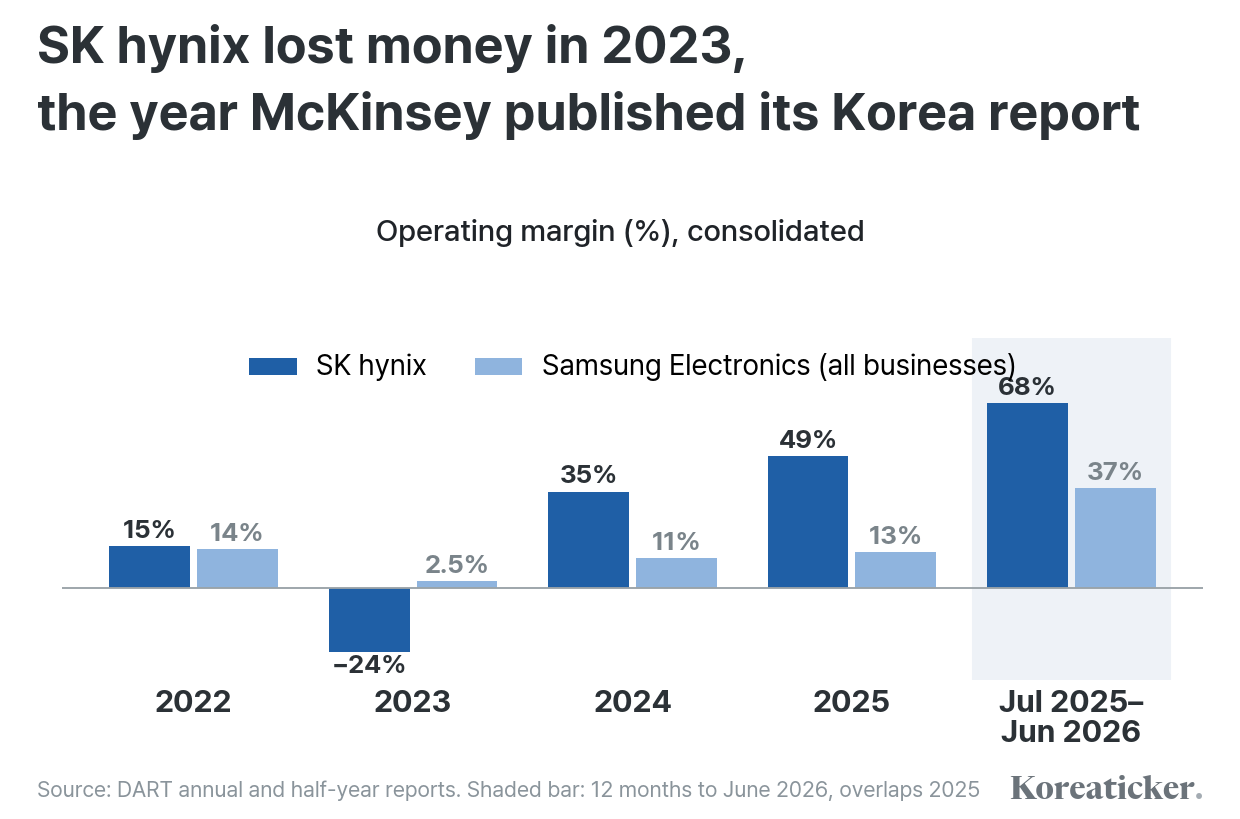
For the 12 months to June 2026, the margins were 68.0% and 36.9%. Demand for HBM, the stacked memory used next to AI processors, and higher prices for regular DRAM drove the change; our HBM market outlook covers that in detail.
The commodity label matters most when reading the P/E. SK hynix traded at 5.6 times trailing earnings, measured on a 68% margin year. Micron (MU), the closest US peer, traded at 9.9 times on November 9 and reported an 81% operating margin for June to August 2026, over different periods.
If the cycle turns and profits shrink, the same share price would mean a much higher P/E. Nothing in the 2023 report suggests the cycle has ended.
By one of McKinsey's 2040 yardsticks, SK hynix is now the kind of company Korea wanted: revenue of ₩189.2 trillion in the 12 months to June 2026, about $140 billion at our rate. McKinsey named neither its three 2022 companies nor its exchange rate, so we cannot say the count has gone from three to four.
Outside memory, in logic, foundry and packaging, the report put Korean companies' market share at only 3%. TechInsights put Hanmi Semiconductor's share of HBM TC bonders, the machines that stack HBM chips, at 71% in 2025.
That is a share of one type of equipment, not of the packaging market McKinsey measured, and the machines serve HBM production. For an investor looking beyond the memory makers themselves, Hanmi is still tied to HBM spending. Our report on Korean chip equipment stocks covers the suppliers.
3. Shipbuilding: from under 1% to about 10% to 14%
The report's diagnosis was specific. Korean yards had "only a small presence" in high-value design and solutions such as LNG technology and floating production units, "and as a result, their operating profit ratio is below 1 percent."
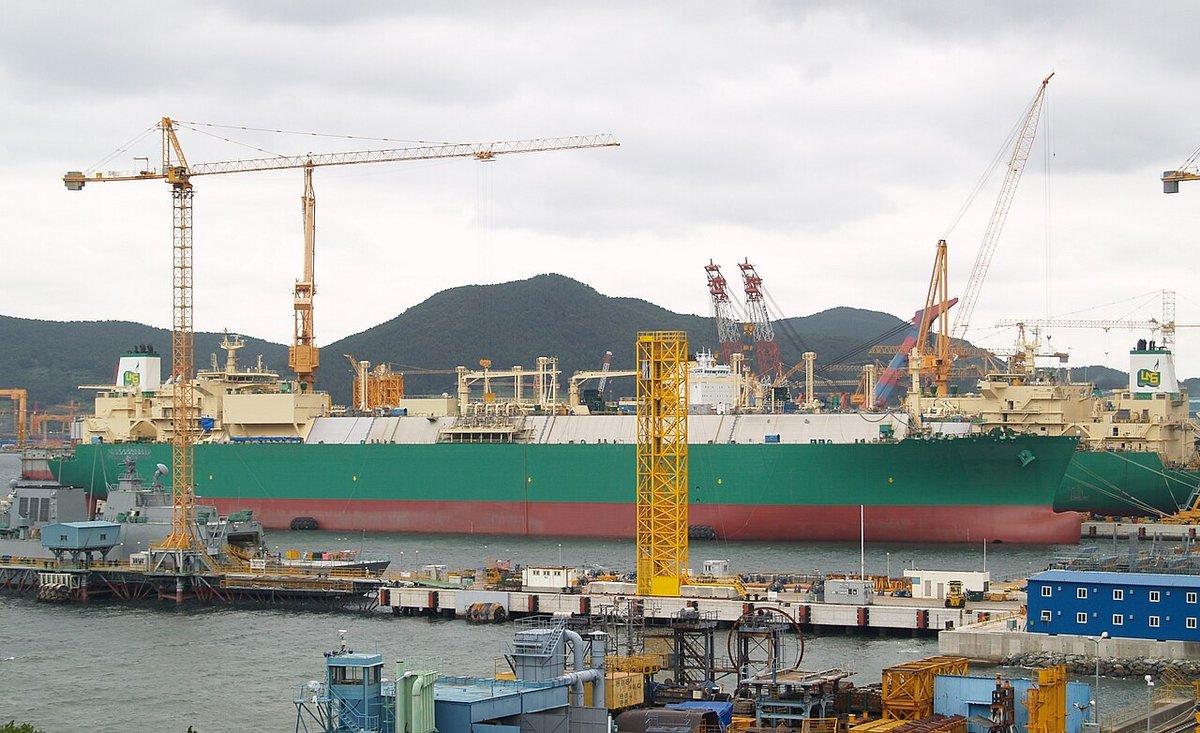
It contrasted this with the "nearly 50 percent" margins of companies that own the original LNG cargo tank designs, without naming them. It also noted that China's technology gap with Korea in high-value ships had narrowed from 6.8 years in 2012 to one year in 2020, a much thinner lead for Korean yards.
McKinsey did not say which companies or which year its 1% figure covered. The filings of the three companies we tracked point the same way. In 2023, HD Hyundai Heavy, Hanwha Ocean and Samsung Heavy together earned an operating margin of 0.8% on ₩27.4 trillion of revenue. In 2022, all three lost money.
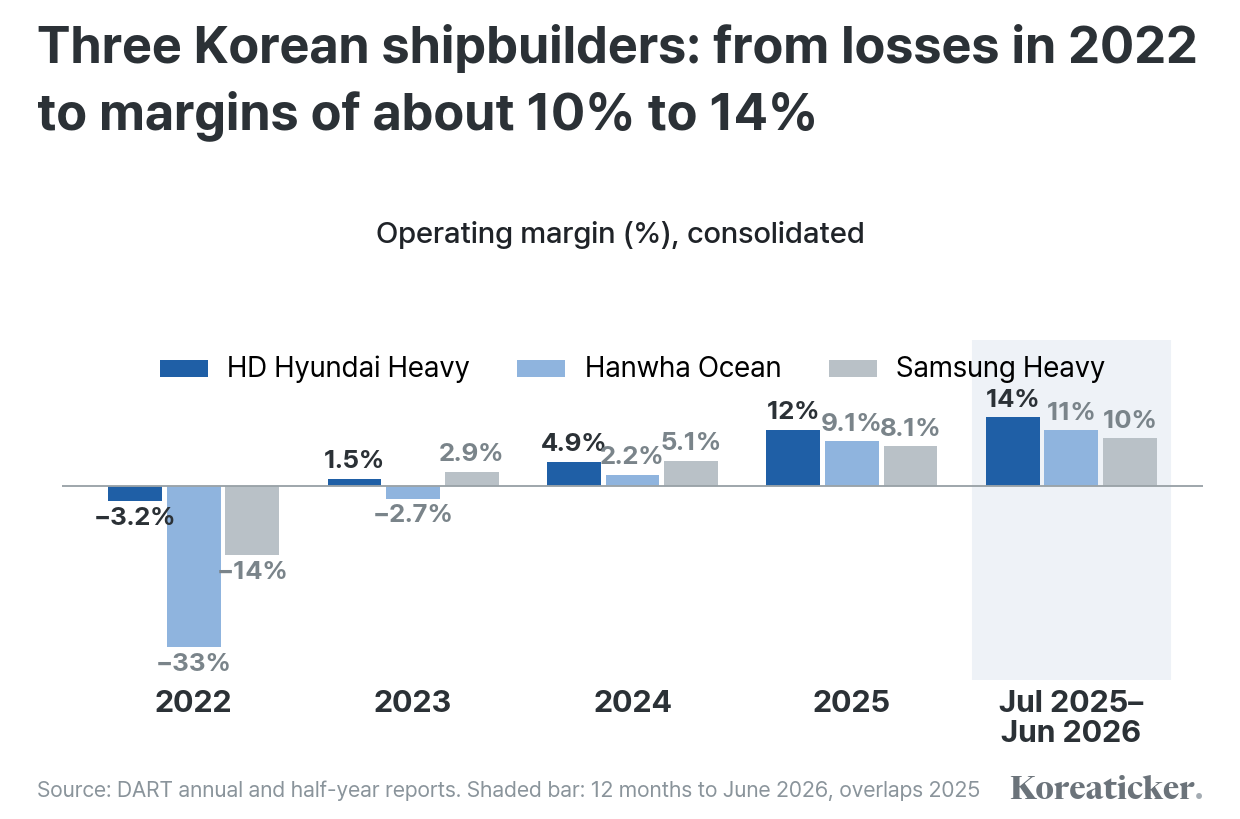
For the 12 months to June 2026, the margins were 14.1%, 11.4% and 9.8%. The filings do not show how much of that came from the design and solutions work McKinsey recommended and how much from ordinary ships sold at better prices. For holders that split matters, even though the filings do not show it.
Margin that comes from ship prices could shrink if prices soften. Margin that comes from design and technology would, by McKinsey's argument, be harder for Chinese yards to compete away. The report named one move in that direction: HD Hyundai Heavy's ventures into autonomous ships, small nuclear reactors and offshore wind.
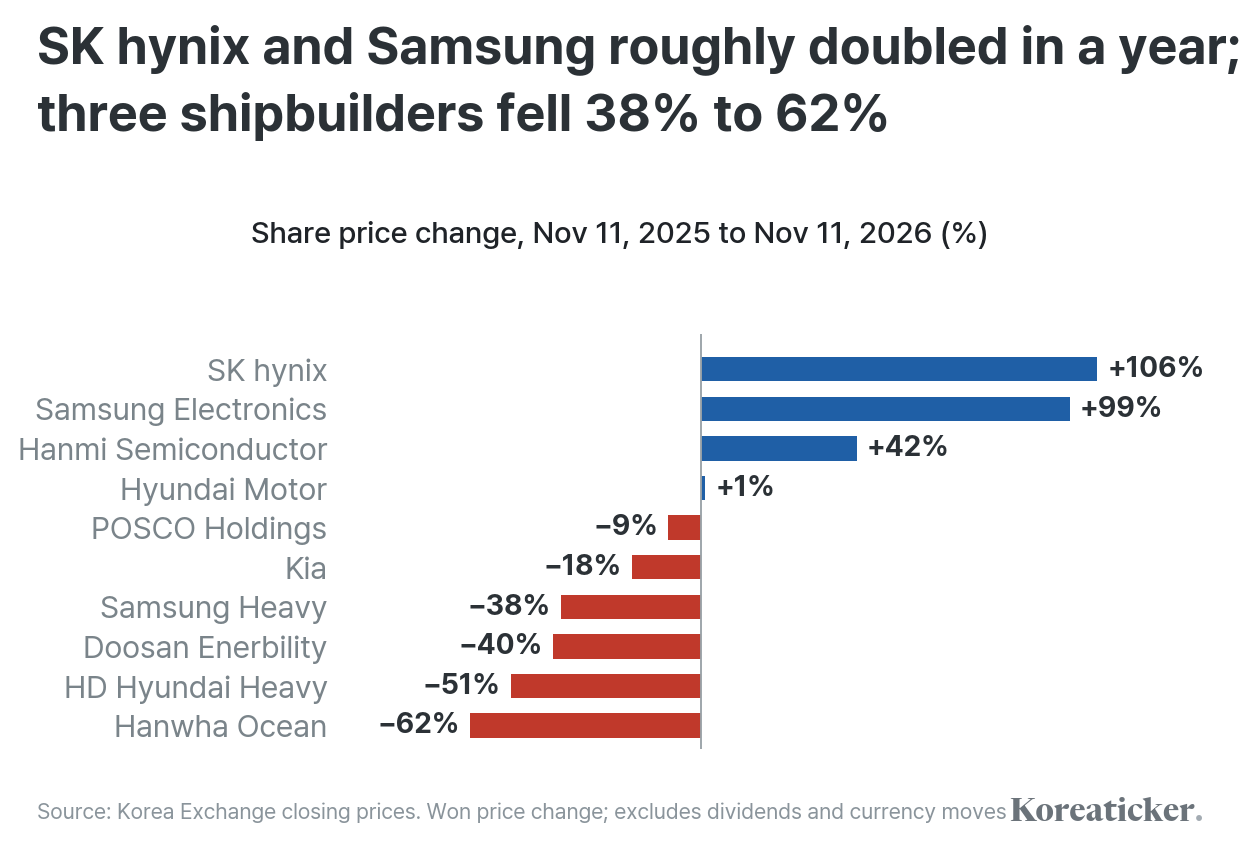
Did the higher margins lift the shares over the past year? They did not. HD Hyundai Heavy fell 51%, Hanwha Ocean 62% and Samsung Heavy 38% between November 11, 2025 and November 11, 2026. Our margin figures end in June 2026, so they say nothing about July to November.
Even after the fall, all three traded at about two to three times book value, well above the Korea discount levels in the next section. Buyers at that price own businesses that now earn double-digit margins, and the next margin reports show whether that holds.
McKinsey's maritime team added a naval angle in November 2024. Its analysis put the global naval shipbuilding market at about €78 billion in 2024, growing to more than €100 billion by 2033. It noted Korea's plan to raise defense spending by about 7% a year from 2024 to 2028.
It also noted Korean shipbuilders' push into the Americas and Europe, where some European countries chose Korean designs for supply ships. If those orders grow, naval work would become a larger part of the yards' business next to commercial shipping. Our Korean defense stocks report covers the export side.
4. The Korea discount in 2026 numbers
The report gave the "Korea discount" its own section. Citing the Korea Capital Market Institute, it said Korea's price-to-book ratio averaged 1.2 from 2012 to 2021, against 2.2 for advanced countries. For a holder, a lower ratio means the market pays less for each won of a company's equity.
On shareholder returns, it compared 2022 share buybacks: nearly $943 billion by S&P 500 companies, about $3 billion in Korea. Buybacks pay cash to the holders who sell and can lift per-share figures for those who stay, and Korean companies did far less of it.
The report also cited a 2021 governance score for Korean companies 26.4 points below the global average.
A like-for-like update of the KCMI figure is not available to us. The nearest number is MSCI's: its Korea index traded at 1.91 times book value on October 30, 2026, against 4.06 for MSCI World and 2.20 for emerging markets.
Samsung Electronics and SK hynix made up about 62% of that index, so it mostly reflects two memory companies. A holder of a Korea index fund gets an average dominated by them, which can hide the discount on carmakers and steel.
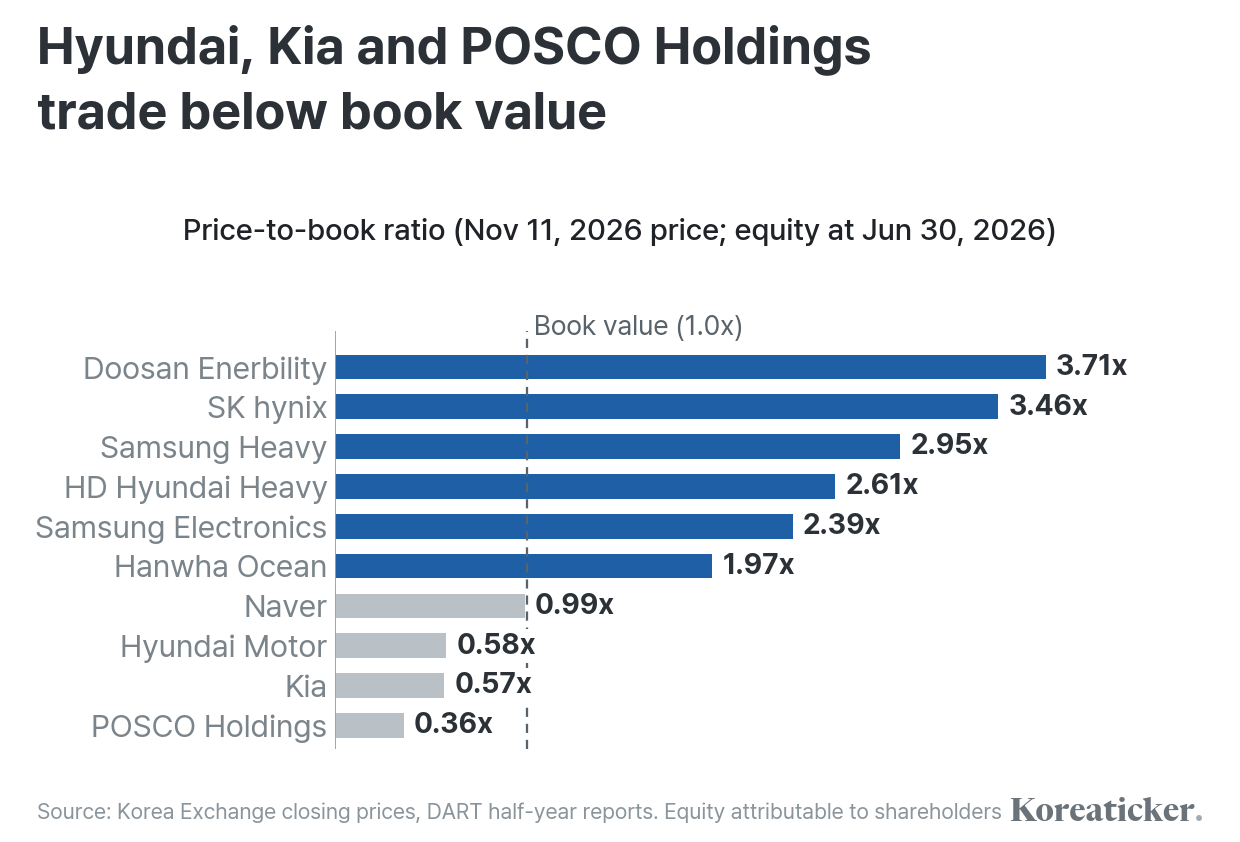
Company by company, two of the industries McKinsey said had to change trade below book value. Hyundai Motor is at 0.58 times, Kia 0.57 and POSCO Holdings 0.36, so the market values each below the equity on its balance sheet. We have not compared these with their 2023 ratios.
The report put Hyundai Motor Group third in global vehicle sales in 2022, facing harder competition in electric cars. It estimated that about 30% of Korea's combustion-engine parts makers could disappear by 2030, and named steel among industries facing Chinese overcapacity. Holders are still exposed to those pressures. Our Hyundai Motor report looks at the carmaker in detail.
Share cancellations have grown. In the first nine months of 2026, 591 listed companies tracked by CEO Score cancelled ₩61.8 trillion (about $46 billion) of their own shares. A March 2026 amendment to the Commercial Act requires companies to cancel treasury shares instead of holding them.
For a company trading below book value, buying back shares raises the book value behind each remaining share. Cancelling them makes that permanent, because cancelled shares cannot be sold back into the market, which is why cancellations matter most at the three companies above. About half of the 2026 total came from Samsung Electronics and SK hynix.
Cancellation and buyback figures measure different things, so the ₩61.8 trillion does not update McKinsey's $3 billion directly. Our Value-up index guide explains the program behind it.
5. Small reactors: a theme priced ahead of profits
The report cited a UK National Nuclear Laboratory estimate of a $480 billion market for small modular reactors by 2035. Doosan Enerbility, a Korean maker of nuclear reactor equipment, had a 5.1% operating margin over the 12 months to June 2026.
It traded at 167 times earnings and 3.71 times book value on November 11. At that multiple, a year's profit equals about 0.6% of the share price, so buyers at this price are paying for profits that have not shown up in the results yet.
The report also put AI adoption at 22% of Korean companies, against 58% in China. That ties back to the productivity gap in section 1, the part of McKinsey's diagnosis with the least change visible in company numbers.
6. What to watch
- SK hynix and Samsung operating margins each quarter. A sustained fall could be one sign that memory prices have turned, though costs and product mix also move margins, and it would raise the P/E at today's prices.
- Shipbuilder margins over the next year: whether they hold at about 10% to 14%, and whether naval export orders grow.
- Share cancellations at companies below book value, such as Hyundai Motor, Kia and POSCO Holdings.
For US investors
How US investors can buy these stocks
Sources and notes
- McKinsey & Company (report led by partners in its Seoul office), "Korea's next S-curve: A new economic growth model for 2040" (2023.12), mckinsey.com
- McKinsey Global Institute, "Dependency and depopulation? Confronting the consequences of a new demographic reality" (2025.01), Exhibit 18, mckinsey.com
- McKinsey & Company, "McKinsey on the Maritime Industry," naval market article (2024.11), mckinsey.com
- DART (Korea's electronic disclosure system), annual reports for 2022 to 2025 and half-year reports for 2025 and 2026 of each company (checked 2026.11)
- Korea Exchange daily closing prices (to 2026.11.11)
- MSCI, Korea, World and Emerging Markets index factsheets (2026.10.30)
- CEO Score, treasury share cancellations by 591 listed companies, as reported by EBN (2026.10)
- TechInsights, HBM TC bonder market share, as reported by Money Today (2026.01)
- Micron figures: company results and StockAnalysis.com (as of 2026.11.09)
McKinsey quotations are from the report PDFs; page numbers are logged in our research notes. McKinsey's Korea discount figures are its citation of the Korea Capital Market Institute. Won converted at ₩1,350 per dollar; operating margins and the 2023 combined shipbuilding margin are our calculations from consolidated DART figures. We are not affiliated with McKinsey.
Photos from Wikimedia Commons: Towel401 (public domain), *Youngjin (CC BY-SA 4.0).
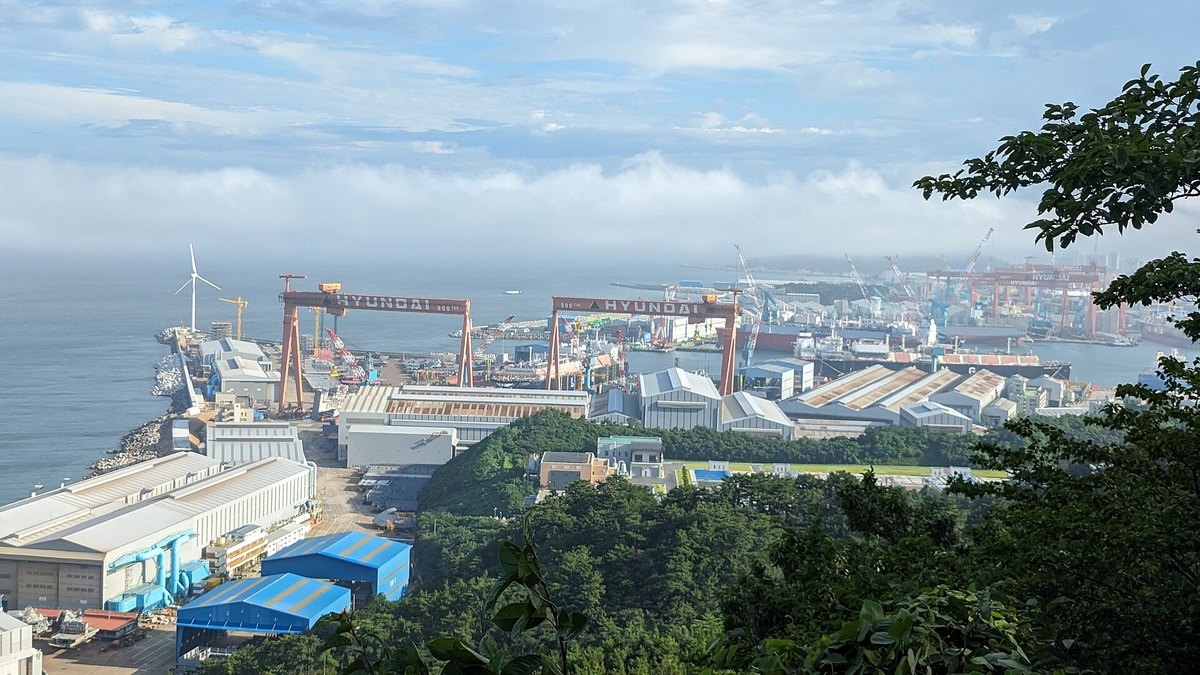
Cover photo: HD Hyundai Heavy Industries' Ulsan shipyard, July 2023, by Wvdp, via Wikimedia Commons (CC0).
For information only, not investment advice. See our full disclaimer.
Update history
- Nov 13, 2026 Rewrote each section around what McKinsey's points mean for holders of the stocks: how cyclical memory earnings affect the P/E, why the shipbuilders' margins matter more than their past diagnosis, and what cancelling shares below book value does for remaining holders. Cut the battery and K-content items and the duplicated growth paragraph in the introduction.
Corrections and changes to facts are listed here. See our editorial policy.