What Trump Has Actually Said About Korean Industry, and How the Stocks Moved
On November 7, 2024, two days after the US election, Hanwha Ocean shares rose 21.8% in Seoul.
If you hold a Korean shipbuilder, carmaker or chipmaker, what you need to know is which of Trump's words turned into a signed tariff or contract that could change what these companies earn, and which stayed words.
The short answer
- Shipbuilding is the industry he has praised from the start. "We're going to be buying ships from South Korea," he said at the White House in August 2025. He keeps asking for some of those ships to be built in the US, which could favor yards with a US foothold, such as Hanwha's in Philadelphia.
- For cars and steel, the offer is a trade: build in America, pay no tariff. He said so at Hyundai's investment event in March 2025 and in his July 2025 tariff letter. For Hyundai Motor and Kia, the 15% car tariff now in force is the rate on cars they ship from Korea.
- On chips, we found no Trump remark naming Samsung or SK hynix. His chip tariff remarks have covered every country. No memory-chip rate has been set, so for Samsung and SK hynix holders the open question is whether building in the US becomes the way to avoid one.
- On defense, his number is far above the actual payment. He has said South Korea should pay $10 billion a year for US troops. The 2026 payment under the current agreement is ₩1.52 trillion, about $1.1 billion. The gap has no direct line to any company's earnings, but Trump raised it in the same April 2025 call as tariffs.
- Our chart shows moves in both directions. Of the eight company moves we picked, three were gains and five were declines in the first Seoul session after the remark, including after remarks praising Korean shipbuilding. A hand-picked sample like this cannot test whether a broader pattern exists, so this chart gives no basis for trading on a post alone.
Contents
On the morning of November 7, 2024, a South Korean official had briefed reporters on a 12-minute call between President Yoon Suk Yeol and President-elect Donald Trump. According to the official, Trump said he knew about Korea's "world-class ability to build naval and commercial vessels" and wanted close cooperation on ship repair and exports.
The KOSPI index was flat that day, while shipbuilders jumped. Since then, Trump has talked about Korean ships, cars, chips, batteries, gas and troops. Some of those remarks became signed tariff orders and investment deals. Others did not.
We checked each quotation against an official transcript or an archived copy of the post. The one exception is the July 2025 tariff letter, where we used the English text reproduced by a Korean news agency. Where only Seoul's account exists, we say so.
The stock moves are one-day changes in the first Seoul trading session after each remark. They show what the shares did. Other news landed on most of those days, so they cannot rank the causes.
The companies at a glance
Shipbuilders and carmakers are where his words have landed most often.
| Company | Ticker | Where it shows up in Trump's remarks | Seoul close | Price date |
|---|---|---|---|---|
| Hanwha Ocean | 042660.KS | Shipbuilding; owns Philly Shipyard in Philadelphia | ₩48,350 (about $36) | Nov 11, 2026 |
| HD Hyundai Heavy Industries | 329180.KS | Shipbuilding | ₩262,500 (about $194) | Nov 11, 2026 |
| Hyundai Motor | 005380.KS | Cars, steel; the March 2025 investment event | ₩272,500 (about $202) | Nov 11, 2026 |
| Kia | 000270.KS | Cars; tariff rates | ₩94,600 (about $70) | Nov 11, 2026 |
| Samsung Electronics | 005930.KS | Chips; covered by his chip tariffs but not named | ₩206,000 (about $153) | Nov 11, 2026 |
| SK hynix | 000660.KS; SKHY on Nasdaq | Chips; covered by his chip tariffs but not named | ₩1,277,000 (about $946) | Nov 11, 2026 |
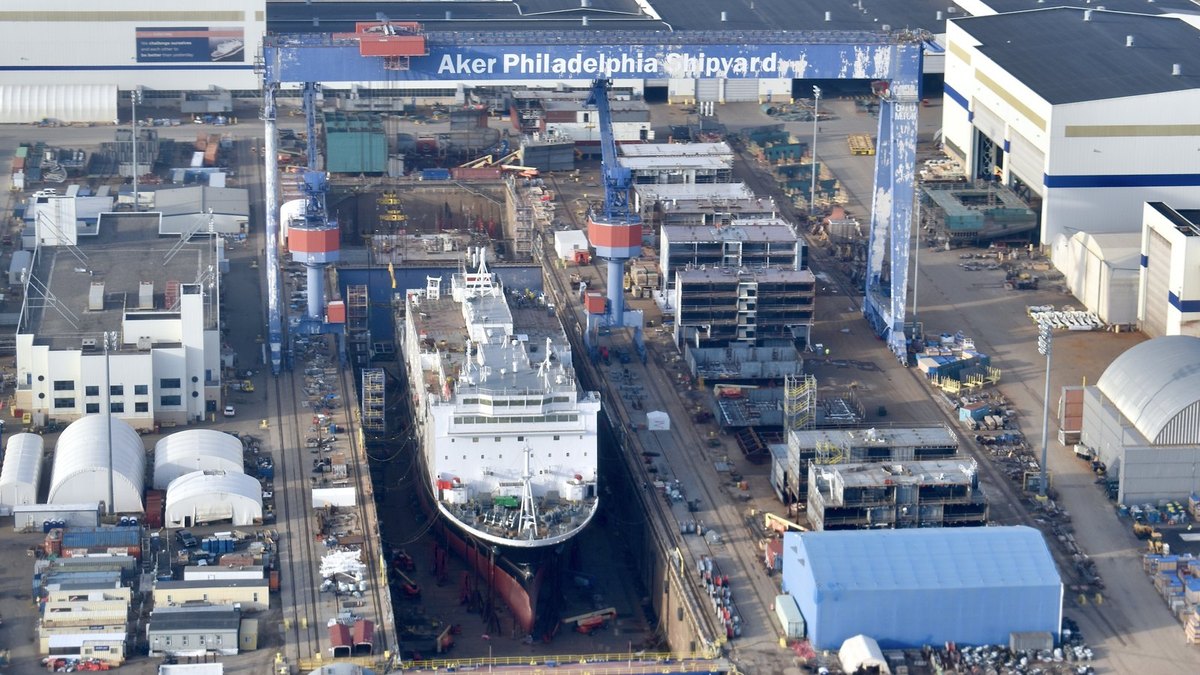
Hanwha Ocean is the shipbuilder most tied to Trump's plans. Hanwha Ocean and Hanwha Systems agreed in June 2024 to buy Philly Shipyard in Philadelphia, the yard Trump later named for South Korea's nuclear-powered submarine.
HD Hyundai Heavy Industries is one of Korea's three big listed shipbuilders, along with Hanwha Ocean and Samsung Heavy Industries. Without a US yard named in Trump's remarks, its link to his plans runs through the $150 billion shipbuilding pledge rather than a single site.
Hyundai Motor and Kia export cars to the US and also build them at plants in Alabama and Georgia, so the US tariff on Korean-made cars bears directly on them.
Samsung Electronics and SK hynix are Korea's two memory chipmakers, so a US chip tariff would reach them unless they qualify as building in the US.
Read down the table and the exposure differs by company. The carmakers already pay a signed tariff, Hanwha Ocean owns a US yard, and the chipmakers wait on a decision that has not been made.
1. What Trump said, in order
| Date (US) | Where | What he said | First Seoul session after |
|---|---|---|---|
| Oct 15, 2024 | Economic Club of Chicago, as a candidate | "If I were there now, they'd be paying us $10 billion a year… It's a money machine, South Korea." | Oct 16: Samsung Electronics −2.5%, KOSPI −0.9% |
| Nov 7, 2024 (Seoul time) | Call with President Yoon, as described by Seoul | Korea's shipbuilding ability; cooperation on ship repair and exports | Nov 7: Hanwha Ocean +21.8%, HD Hyundai Heavy +15.1%, KOSPI 0.0% |
| Mar 4, 2025 | Address to Congress | "South Korea's average tariff is four times higher." Alaska gas pipeline partners with "investments of trillions of dollars each" | Mar 5: SK hynix +3.8%, Samsung −0.9%, KOSPI +1.2% |
| Mar 24, 2025 | White House, Hyundai's $21 billion US plan | "This investment is a clear demonstration that tariffs very strongly work" | Mar 25: Hyundai Motor +3.3%, Hyundai Steel −7.0%, KOSPI −0.6% |
| Jul 30, 2025 | Truth Social | "$350 Billion Dollars for Investments owned and controlled by the United States, and selected by myself"; a 15% tariff | Jul 31: Kia −7.3%, Hyundai Motor −4.5%, Hanwha Ocean +13.4%, KOSPI −0.3% |
| Aug 6, 2025 | Oval Office | About 100% on chips. "But if you're building in the United States of America, there's no charge" | Aug 7: Samsung +2.5%, SK hynix +1.4%, KOSPI +0.9% |
| Aug 25, 2025 | Truth Social, then the White House meeting with Lee | "WHAT IS GOING ON IN SOUTH KOREA? Seems like a Purge or Revolution." Hours later: "we're going to be buying ships from South Korea" | Aug 26: Hanwha Ocean −6.2%, KOSPI −1.0% |
| Oct 29, 2025 | Truth Social, during his state visit to Korea | "I have given them approval to build a Nuclear Powered Submarine." It would be built "in the Philadelphia Shipyards" | Oct 30: Hanwha Ocean +6.9%, KOSPI +0.1% |
| Jan 26, 2026 | Truth Social | Korea's legislature had not passed the deal, so tariffs on cars and other goods would rise "from 15% to 25%" | Jan 27: Hyundai Motor −0.8%, KOSPI +2.7% |
| Mar 14, 2026 | Truth Social, during the Iran war | Hoped China, France, Japan, South Korea, the UK and others "will send Ships" to the Strait of Hormuz | Mar 16: Samsung Heavy −6.3%, KOSPI +1.1% |
| Sep 30, 2026 | White House energy event | Three Korean-funded projects: "The colossal package of investments we are announcing today is a major step toward securing our critical energy supply chain" | Oct 1: KEPCO E&C +2.6%, KOSPI +2.0% |
Read the right-hand column with care: a post and a move in Seoul the next day do not show that one caused the other.
The "four times higher" tariff claim compares average tariffs that apply when there is no trade deal: Korea's is 13.4% and the US rate is 3.3%, according to Korea's trade ministry. Under the US-Korea free trade agreement, the ministry said, tariffs on US goods entering Korea are close to zero.
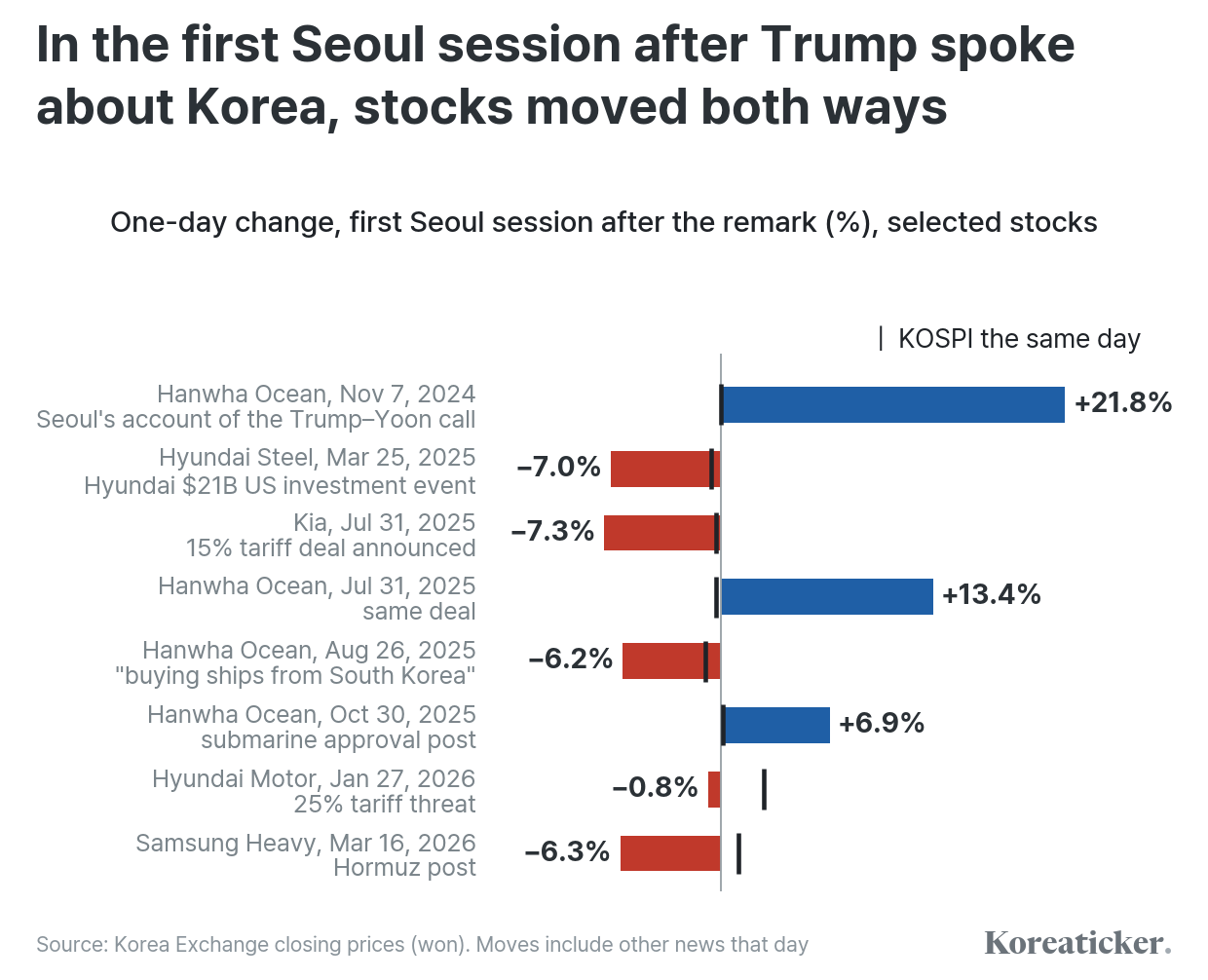
We picked these eight company moves; four are Hanwha Ocean, and the July 2025 deal appears twice, so the bars are not eight independent events. Each bar is the first Seoul session after the remark (for the November 2024 call, the same day). The black tick is the KOSPI that day. Most of these days also had other market news.
2. Shipbuilding: the one industry he keeps praising
None of the Trump remarks on Korean shipbuilding that we found was critical. Several also ask for ships, or shipyards, in the US.
The first sign came from Seoul's account of the November 2024 call.
In April 2025, after a call with acting President Han Duck-soo, he listed "shipbuilding" among the topics, along with Korea's trade surplus, tariffs, LNG purchases, "their joint venture in an Alaska pipeline" and "payment for the big-time military protection we provide to South Korea."
His clearest statement came at the White House on August 25, 2025, with President Lee Jae Myung beside him: "They build them very well in South Korea… And now we buy ships, but we're going to be buying ships from South Korea. But we're also going to have them make ships here with our people, using our people."
The trade deal put money behind it. The November 2025 joint fact sheet includes "$150 billion of Korean investment in the shipbuilding sector approved by the United States."
Under the words "approved by the United States," Washington, not the yards, signs off on where that money goes. What any one shipbuilder gets depends on project lists that have not been published.
Korean officials call this program MASGA, short for "Make American Shipbuilding Great Again."
Then came the submarine. On October 29, 2025, Trump posted that he had approved a Korean nuclear-powered submarine and that "South Korea will be building its Nuclear Powered Submarine in the Philadelphia Shipyards, right here in the good ol' U.S.A."
Philly Shipyard, now owned by the Hanwha group, has built commercial ships and never a submarine. South Korea's prime minister told lawmakers the yard did not have that capability yet, gCaptain reported. For Hanwha holders, that makes any submarine work depend on investment the yard has yet to make.
In the chart above, Hanwha Ocean rose after three of these remarks and fell after the August 2025 meeting, the one where Trump said the most about buying Korean ships. These are four days we picked, too few to explain the moves, and the stock fell on one of the four.
3. Cars, steel and batteries
For Hyundai and Kia, Trump's message has been one sentence repeated: invest in US factories and the tariff does not apply. For the battery plant, it was about who does the work.
At the March 24, 2025 White House event, Hyundai Motor Group announced a US investment plan of $21 billion by Korean counts ($20 billion in the White House release), including a steel mill in Louisiana.
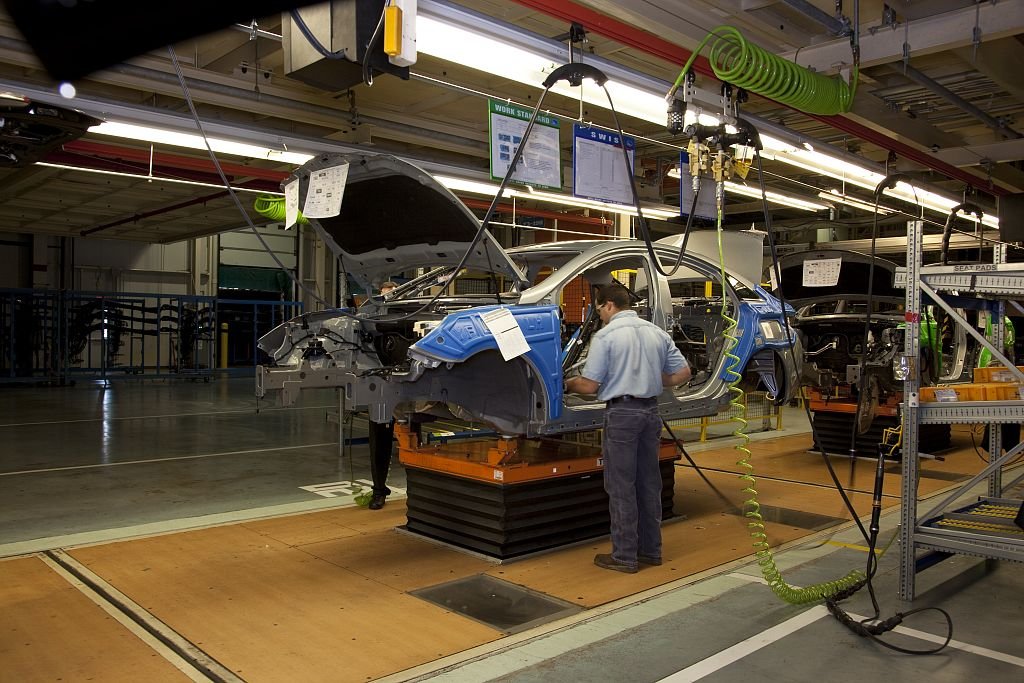
Trump said: "Hyundai will be producing steel in America and making its cars in America, and as a result, they'll not have to pay any tariffs."
For Hyundai and Kia, the cars they build in Alabama and Georgia avoid the import tariff, while cars shipped from Korea pay it, so the split between the two decides how much tariff they pay.
The tariff number then moved several times:
- July 7, 2025: a letter set 25% on Korean goods from August 1, on top of sector tariffs such as the one on cars.
- July 30, 2025: "We have agreed to a Tariff for South Korea of 15%." Korean cars were to pay 15%, the same as Japanese cars, and both carmakers fell the next day. Reuters noted that this removed the 2.5-point tariff edge Korean-made cars had over Japanese imports under the free trade agreement; some analysts pointed to profit-taking instead.
- November 2025: the joint fact sheet set the Section 232 tariff on Korean cars and parts at 15%. A Federal Register notice published December 4, 2025 put it into effect, backdated to cars entered from November 1, 2025.
- January 26, 2026: Trump posted that he was "increasing South Korean TARIFFS on Autos, Lumber, Pharma, and all other Reciprocal TARIFFS, from 15% to 25%," because Korea's legislature had not passed the deal. Korea's National Assembly passed the investment law on March 12, 2026, by 226 votes to 8.
In between, on February 20, 2026, the US Supreme Court struck down the broad tariffs Trump had set under an emergency-powers law. The car tariff rests on a different law, Section 232, and was not part of that ruling. We did not find an official notice putting the threatened 25% rate into effect.
The last confirmed state we found: an analysis by the Korea Economic Institute of America dated September 3, 2026 says Korean cars and parts face a 15% Section 232 tariff, and most other Korean goods a 12.5% tariff under a Section 301 action published in the Federal Register in July 2026.
That 15% rate, untouched by the court ruling, is the one now in force on cars Hyundai and Kia ship from Korea. Rates can change again; check the latest notice before relying on these numbers.
Batteries entered the story through an immigration raid. On September 4, 2025, US agents raided the Hyundai-LG Energy Solution battery plant under construction in Georgia.
Three days later Trump wrote: "Your Investments are welcome, and we encourage you to LEGALLY bring your very smart people… What we ask in return is that you hire and train American Workers."
A week after that he added: "I don't want to frighten off or disincentivize Investment into America by outside Countries or Companies." LG Energy Solution fell 2.3% the day after the raid and was flat after both posts.
The posts welcomed the battery investment but asked for Americans to be hired and trained in return. If that request shapes how the plants are staffed, it could raise the cost and time of building them.
4. Chips: tariffs for every country
In his March 2025 address to Congress, Trump called the CHIPS Act, the subsidy law passed under President Biden, "a horrible, horrible thing." On August 6, 2025 he said: "we'll be putting a tariff on of approximately 100 percent on chips and semiconductors. But if you're building in the United States of America, there's no charge."
In January 2026, Trump signed a proclamation putting a 25% tariff on certain advanced chips imported into the US and then sent abroad again, including Nvidia's H200.
For Korea, the November 2025 fact sheet promises chip tariff terms "no less favorable than terms that may be offered in a future agreement" covering at least as much chip trade. That sets a floor tied to terms in a future chip agreement, but it does not set a rate for Samsung and SK hynix.
In September 2026, Commerce Secretary Howard Lutnick told CNBC: "What you're going to see is targeted, thoughtful tariff policy that basically says, if you build here, you don't pay."
He did not name a company in the excerpts CNBC published. Korean media, including the Seoul Economic Daily, read it as pressure on Samsung and SK hynix to build memory plants in the US.
No memory-chip rate has been set. If "build here, you don't pay" becomes the rule, holders would need two numbers that are not public yet: the tariff on chips shipped from Korea and the cost of building more in the US.
5. Troops and energy
On defense, Trump's $10 billion a year compares with the roughly $1.1 billion Korea agreed to pay for 2026 under the five-year deal signed in November 2024. The payment comes from Korea's budget, not from listed companies. Trump mentioned it in the same April 2025 call as tariffs, so it could touch shareholders if the two are negotiated together.
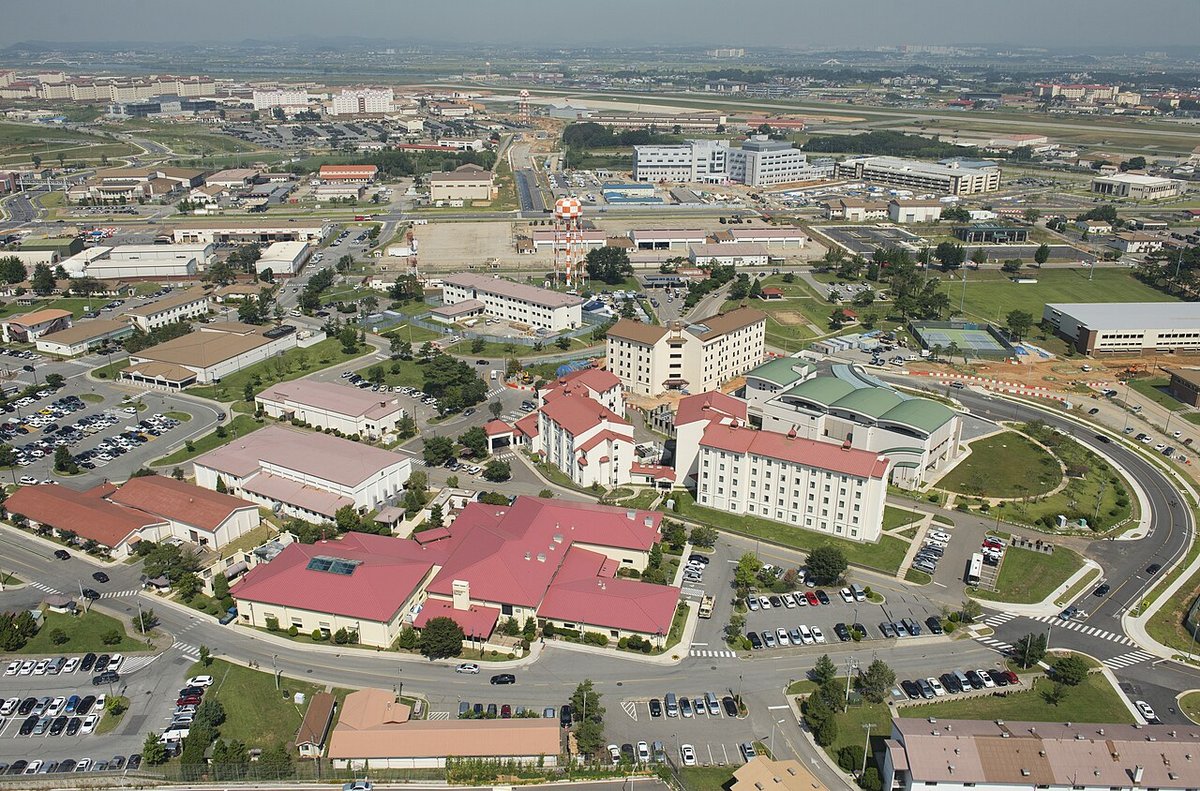
In March 2026, during the war with Iran, he named South Korea among the countries he hoped would send ships to the Strait of Hormuz. Seoul's presidential office said the request needed careful review, and the defense ministry said no formal request had arrived.
On energy, his March 2025 talk of "investments of trillions of dollars each" in the Alaska gas pipeline has not become a signed Korean amount. On September 30, 2026, Trump announced the first projects under Korea's $200 billion strategic investment pledge, which the fact sheet caps at $20 billion a year.
The largest is a framework for up to eight nuclear reactors, six Westinghouse AP1000s and two Korean-designed APR1400s. Seoul said each reactor still needs its own approval, and that it had not decided on Alaska.
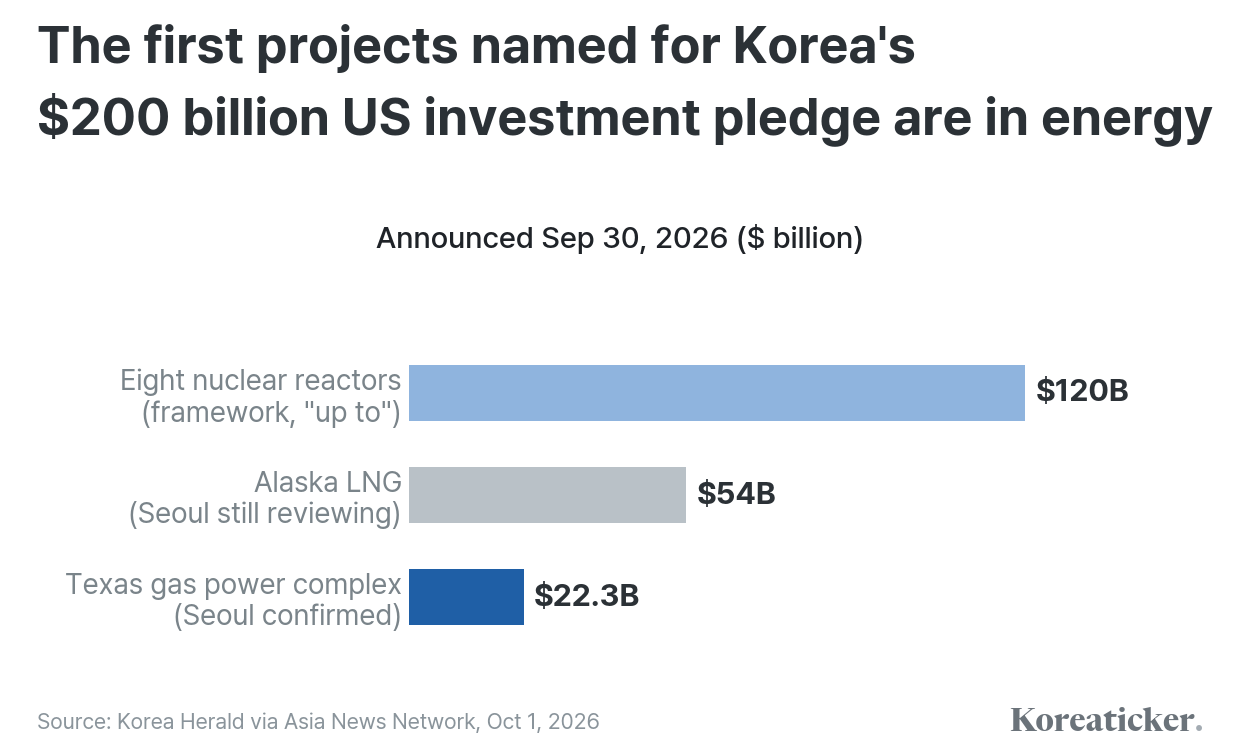
Seoul confirmed only the Texas project. On the day after the announcement, Doosan Enerbility gained 0.6% and KEPCO 0.7%, less than the KOSPI's 2.0%, while KEPCO E&C rose 2.6%. With each reactor still awaiting approval, the reactor framework is not yet an order for any Korean supplier.
6. What to watch
What a company actually pays is set by signed documents. The 15% car rate was announced in July 2025, but it took legal effect only through a Federal Register notice in December 2025, backdated to November 1.
A Korean stock can react to a post on the day, but the tariff a carmaker pays starts with the notice. We have not measured which moved share prices more.
The next documents are the project lists under the $350 billion package, which name the shipyards and power projects that get the money and on what terms, and the Commerce Department's decision on whether memory chips get a tariff and what counts as "building in the United States."
Also in this series, Korea explained for investors:
- McKinsey's Korea reports and the stocks behind them this guide
- Korea's political map for investors this guide
For US investors
How US investors can buy these stocks
Step by step, with fees and trading hours: How to Buy Korean Stocks from the US.
Sources and notes
- The American Presidency Project (UC Santa Barbara): Address before a Joint Session of Congress (2025.03.04); statement on the call with Acting President Han Duck-soo (2025.04.08); remarks before the meeting with President Lee (2025.08.25); Truth Social posts of 2025.07.30, 2025.08.25, 2025.09.07, 2025.09.14, 2025.10.29, 2026.01.26 and 2026.03.14
- Daily Compilation of Presidential Documents, govinfo.gov: Remarks on Manufacturing Investment (2025.03.24); Remarks on Domestic Investment by Apple (2025.08.06); Remarks on Domestic Energy Production (2026.09.30)
- CNN transcript, Economic Club of Chicago (2024.10.15)
- The White House, Joint Fact Sheet on President Trump's meeting with President Lee Jae Myung (2025.11); Federal Register 2025-21940 (2025.12.04) and 2026-15181 (2026.07.28)
- Tariff letter to President Lee (2025.07.07), English text as published by Newsis
- Korea Times, account of the Trump-Yoon call (2024.11.07); trade ministry on Korea's tariff rates (2025.03.05); 2026 troop cost-sharing (2024.11.04); National Assembly vote (2026.03.12); presidential office on Hormuz (2026.03.16)
- Korea JoongAng Daily and Korea Times on shipbuilding and car stock moves (2024.11.08, 2025.07.31)
- Al Jazeera, the Supreme Court tariff ruling (2026.02.21); Reuters via BusinessDay, car stocks (2025.07.31); gCaptain, Philly Shipyard (2025.10); Aju Press, chip proclamation (2026.01.15)
- Korea Economic Institute of America, "Tariffs on Korean Imports" (2026.09.03); CNBC excerpts of Lutnick on Squawk Box (2026.09) and Seoul Economic Daily (2026.09.03)
- Korea Herald via Asia News Network (2026.10.01) and The National News Desk (2026.09.30), energy projects
- Korea Exchange daily closing prices (to 2026.11.11)
Stock moves are close-to-close changes in won in the first Seoul session after each remark, from Korea Exchange prices; we checked several against figures published by Korean media. Quotations keep the capitalization of the original posts. Won converted at ₩1,350 per dollar.
Photos from Wikimedia Commons: Carol M. Highsmith (public domain), USAG-Humphreys (CC BY 2.0).
Cover photo: Philly Shipyard, Philadelphia, February 2024, before the Hanwha group bought it, by MastersHall, via Wikimedia Commons (CC BY-SA 4.0).
For information only, not investment advice. See our full disclaimer.
Update history
- Nov 14, 2026 Said what the remark timeline and the company table mean for a holder, noted that the chart's eight bars are not independent events, softened the line on signed documents against posts, and reworded several shareholder lines after a reader-impression review. No figures changed.
- Nov 13, 2026 Rewrote each section around what Trump's words mean for holders of the companies named: which remarks became signed tariffs or contracts, what the 15% car tariff and the lost edge over Japanese imports mean for Hyundai and Kia, what an unset chip tariff leaves open for Samsung and SK hynix, and why the shipbuilding and reactor announcements are not yet company orders.
Corrections and changes to facts are listed here. See our editorial policy.