North Korea and Korean Stocks: What 34 Events Over 20 Years Show
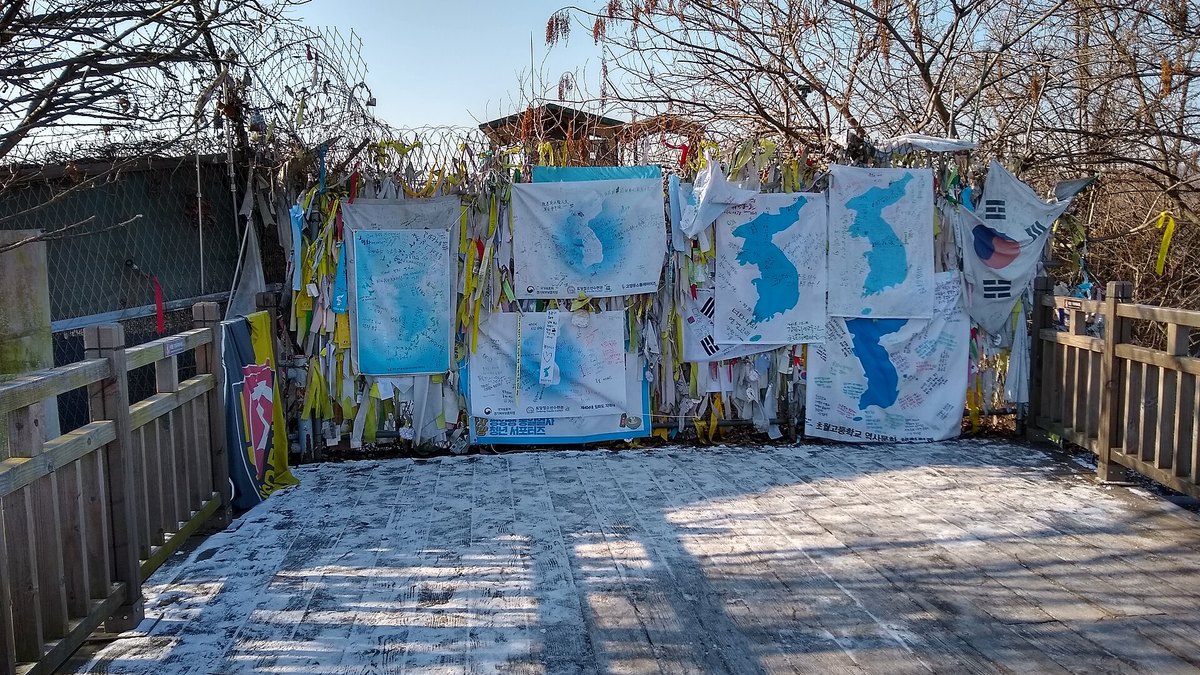
South Korea's capital sits within range of North Korean artillery, and the North has tested nuclear weapons six times. If headlines alone moved prices, a US holder of Korean shares would pay for every launch.
The question for a holder of EWY or Seoul shares: when North Korea makes the news, how far does the position move, and if it falls, how long does it take to come back?
The short answer
- Day one. Across 31 hostile events, the median KOSPI change on the first close after the event was −0.34%. But event days were choppier than ordinary days: the typical size of the move, up or down, was 1.10%, against 0.63% on all trading days since 2006.
- Where the risk was. On the 14 events with no other big event nearby, the KOSPI's typical move was 0.39%, no more than on an ordinary day. The larger moves came in the 17 that overlapped with something else, including the largest drop, on an October 2026 day of a wider tech sell-off.
- Recovery. Of the 20 events where the KOSPI fell on day one, 13 regained the pre-event level within 10 trading days.
- In dollars. EWY, the fund US investors buy, did worse than the KOSPI on day one in 21 of the 31 events, so a US holder usually took a bigger first-day hit than the index headline suggests. On the six nuclear test days, the won fell 0.91% on average, about as much as the KOSPI.
Contents
- 1The short answer
- 2How we measured
- 3Day one: small on average, choppier than usual
- 4A week and a month later
- 5What a dollar investor saw: the won and EWY
- 6Bigger shocks than North Korea
- 7Defense stocks on North Korea days
- 8The research and the Korea discount
- 9What the data cannot tell you
- 10How US investors can buy Korean stocks
We picked 34 North Korea events from October 2006 to October 2026, from the first nuclear test to a missile launch last month, and measured what the KOSPI, the won and EWY, the main US-listed Korea ETF, did on the day, after a week and after a month.
How we measured
We chose the events ourselves, and we flagged every one where we found something else big happening around the same time.
The 34 events include:
- all six nuclear tests
- attacks that killed people or involved shelling (the Cheonan sinking, Yeonpyeong Island, the 2015 DMZ mine and artillery exchange)
- the first launches of new long-range missile types
- breaks in North-South ties
- Kim Jong-il's death
- Trump's "fire and fury" remarks
- the 2024 report that North Korean troops had gone to Russia
- a selection of launches from 2022 to 2026
North Korea fires missiles many times a year, so this is not every launch. What follows describes the kinds of events Korea has actually had, chosen by us, and none of them was a war. Use it to judge an ordinary North Korea headline, not the worst case.
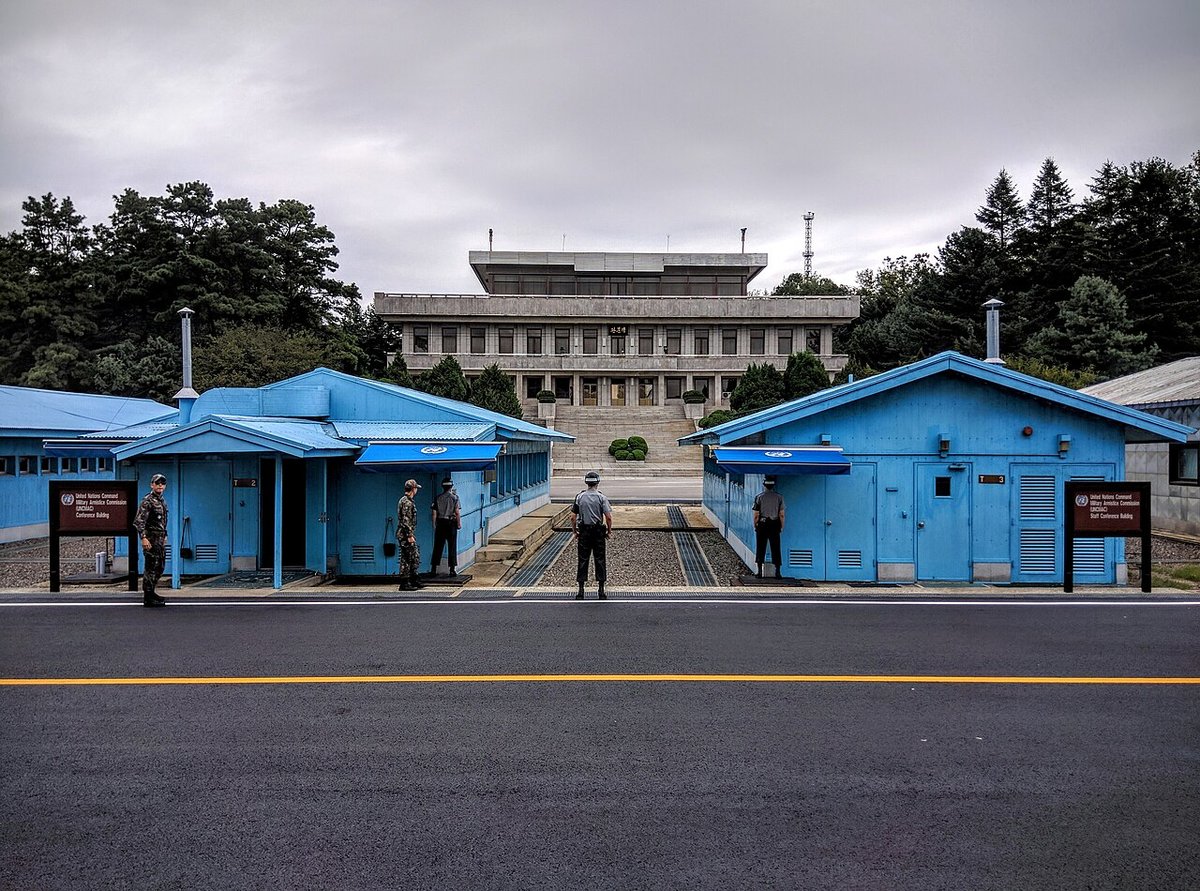
Three diplomatic events (the 2018 Panmunjom and Singapore summits and the failed 2019 Hanoi summit) are in our files but left out of the averages, which cover the 31 hostile events.
For each event we took the last close before the announcement, in that market's own time zone, and compared it with:
- Day one: the first close after the event. A launch at 7 a.m. Seoul time counts on that day's Seoul close; a nighttime attack counts the next day.
- One week and one month: 5 and 21 trading days later.
- Recovery: the number of trading days until the KOSPI first closed at or above its pre-event level. It can fall again afterward.
The won is the Federal Reserve's noon New York rate, shown as the won's change against the dollar (minus means a weaker won). EWY is the New York close. All figures are price changes without dividends.
For three launches in 2025 and 2026 we could not confirm the exact time from an official source and assumed it came before the Seoul close.
North Korea's April 8, 2013 Kaesong announcement came around the 3:00 p.m. close; we counted it that day, and counting it the next day would move the median day-one change for all 31 events from −0.34% to −0.26%.
Seventeen of the 31 hostile events overlapped with another big event, such as the European debt crisis, China's 2015 and 2016 sell-offs, the 2020 pandemic rebound, the 2024 US election and the chip-led KOSPI rally of 2025 and 2026.
We marked these ourselves, after the fact, and the windows range from the same day to the following month. That leaves 14 with no overlap we could find. We show both groups, and we do not say North Korea caused any move.
Some events are close together, such as three in October 2024, so their windows overlap and they are not fully independent.
Day one: small on average, choppier than usual
From 2006 to 2026, the KOSPI's daily moves had a standard deviation of 1.44%, and 82% of all trading days stayed inside that range.
On event days the share was lower: 18 of 31, or 58%. The KOSPI fell on 20 of the events and rose on 11, so large moves went both ways, and a holder could not count on a North Korea day being a down day.
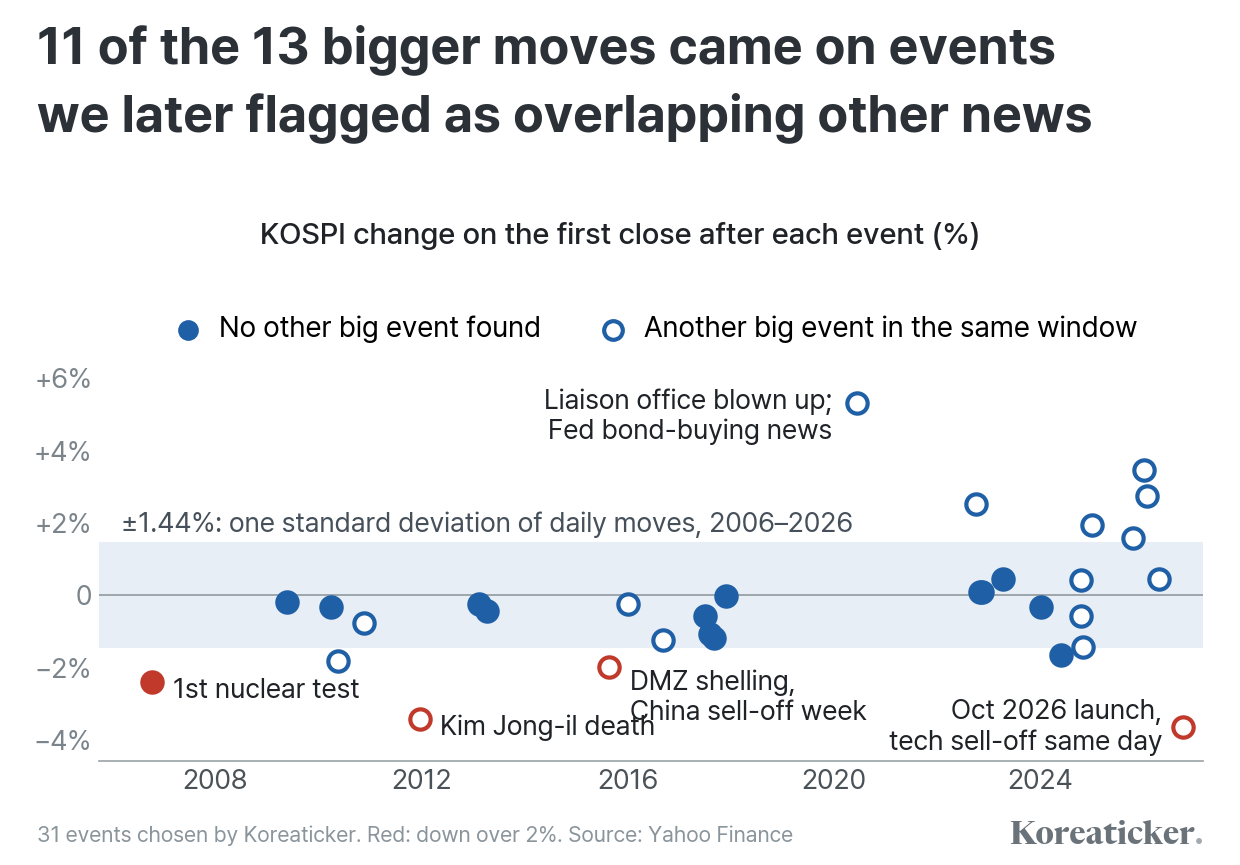
For the 14 with no overlap, the median day-one change was −0.34% and the median size of the move was 0.39%; 12 of the 14 stayed inside the normal range, close to the 82% of ordinary days.
The largest fall among them was the first nuclear test in October 2006, at −2.41%. On events where we found no other big news, a holder's day-one move looked much like an ordinary day's.
For the 17 events that overlapped with something else, the median size of the move was 1.83%, and only 6 stayed inside the range. Of the 13 moves outside the range, 11 came on overlapping events.
The four days with a fall of more than 2%:
| Event | Reaction day | KOSPI | What else was happening |
|---|---|---|---|
| Two ballistic missiles, Oct 12, 2026 | Oct 12, 2026 | −3.65% | A tech sell-off, Middle East tension and inflation worries, as reported by JoongAng Daily. The KOSPI had already fallen 4.5% from Oct 6 to Oct 8 |
| Kim Jong-il's death announced | Dec 19, 2011 | −3.43% | European debt crisis |
| First nuclear test | Oct 9, 2006 | −2.41% | No overlap we found |
| DMZ artillery exchange | Aug 21, 2015 | −2.01% | China's currency devaluation on Aug 11 and the global sell-off of Aug 21 to 24 |
The October 2026 launch is the largest drop in our list, and it is the hardest to read.
Seoul's market has been unusually volatile this year: the KOSPI's daily standard deviation in 2026 so far is 3.82%, against 1.24% from 2006 to 2025.
By that measure, a 3.65% fall was within one standard deviation of a 2026 day. Three days later, on October 15, the KOSPI fell 7.57% in one session, a bigger loss for holders than the launch day.
The biggest gain in the list, +5.28% on June 16, 2020, is just as misleading. North Korea blew up the inter-Korean liaison office at 2:49 p.m., less than an hour before the close. It came hours after the US Federal Reserve said it would buy corporate bonds, during the 2020 rebound.
A week and a month later
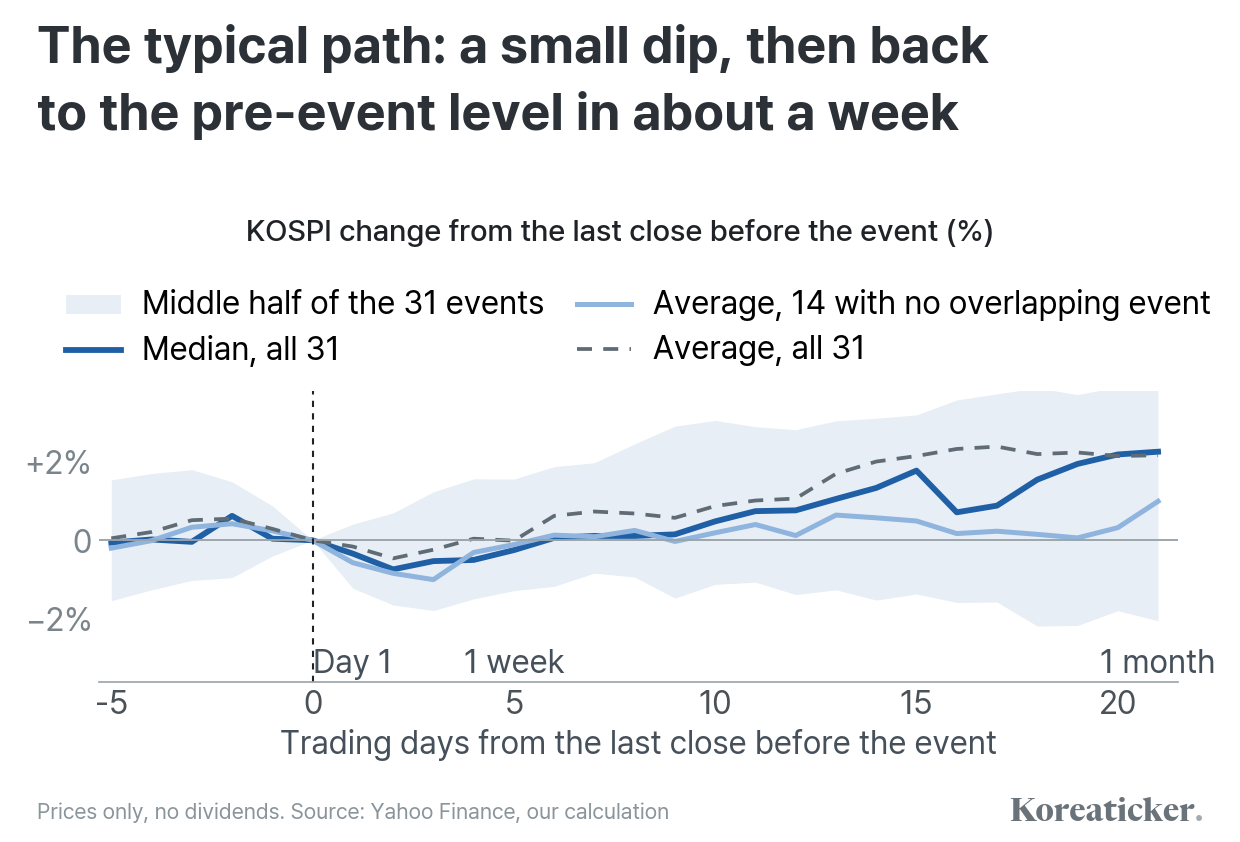
For the 20 events where the KOSPI fell on day one, the median time back to the pre-event level was six trading days, so for a holder the typical drop was gone in a little over a week.
Eight were below it on the 21st trading day, and five never closed back above it within those 21 days. An investor who bought just before one of those events waited about a month or more to get back to even, and most of those cases overlap with something else.
The longest: 36 trading days after the fourth nuclear test in January 2016, when China's market hit circuit breakers twice in a week, and 70 after the Hwasong-19 launch on October 31, 2024, days before the US election. The October 2026 launch had not recovered by our last data point, November 10.
Three slow recoveries had no overlap we could find: Trump's "fire and fury" remarks in August 2017 (27 trading days), the Hwasong-15 launch in November 2017 (30), and North Korean shelling near Yeonpyeong Island in January 2024 (20).
A month later, the KOSPI was higher than before the event in 20 of 31 cases, or 65%.
Across all 21-trading-day periods from 2006 to 2026, the share was 57%. For the 14 events with no overlap, the figure was 9 of 14.
That is too few events to say North Korea days were followed by better-than-usual returns; the 2026 events, which fell in a strong rally, lift the overall average. What the data does show is that the typical event was not followed by a long decline.
Hostile events before 2018 averaged −1.08% on day one; those since averaged +0.69%. We would not read much into that. Fifteen of the 16 later events are launches and incidents from 2022 onward that we selected, many during strong markets, and a different selection could change the result.
What a dollar investor saw: the won and EWY
On the 31 hostile events, the won's median day-one change against the dollar was −0.15%. On the six nuclear test days it averaged −0.91%, close to the KOSPI's average of −0.93% on the same days.
The won's biggest one-day fall in our list was −3.10% after the Yeonpyeong Island shelling in November 2010, a week when Ireland was negotiating a bailout.
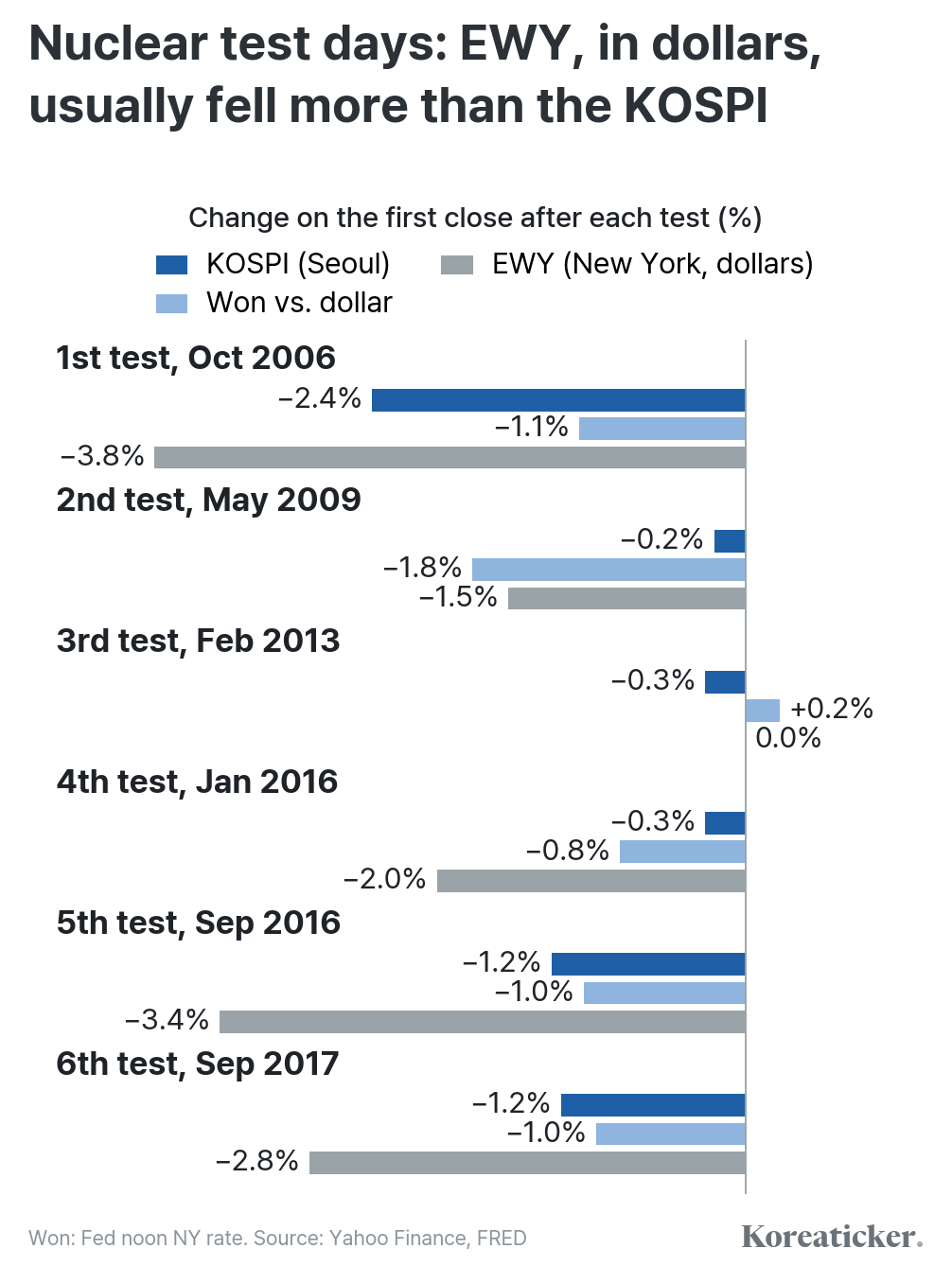
EWY, which US investors buy in dollars, fell more than the KOSPI on most nuclear test days. Across all 31 hostile events, EWY's median day-one change was −0.85%, against −0.34% for the KOSPI.
Some of that gap is the currency, and some is timing, since EWY's first close comes later and can pick up news from other markets. A US investor owns the won as well as the stocks, and on nuclear test days the won fell about as much as the KOSPI.
To strip out global moves, we compared EWY with the iShares MSCI Emerging Markets ETF (EEM) over the same New York session.
EWY's median day-one change was 0.69 percentage point below EEM's.
That gap mixes several things: the won, the funds' different sector weights and the New York trading hours. It does not isolate a North Korea effect. It is still a quick way to see whether Korea moved differently from other emerging markets that day.
Academic work points the same way. Byung-Yeon Kim and Gérard Roland studied 26 events from 2000 to 2008 and found the won/dollar rate the most sensitive of the markets they tested. On the day of the first nuclear test, they measured a statistically significant 1.58% fall in the won, while the stock market's drop was not statistically significant.
So North Korea news can hit a dollar investor through the won as well as through share prices, and in their data the won was where it showed more clearly.
Bigger shocks than North Korea
None of the KOSPI's 25 worst days since 2006 fell on one of our event days.
The largest North Korea-day drop in our list was −3.65%. On 79 of about 5,100 KOSPI trading days since 2006, the fall was bigger. Fourteen of the 25 worst came in 2026. If you are deciding how much Korea to own, the worst days in this record were not on our North Korea list.
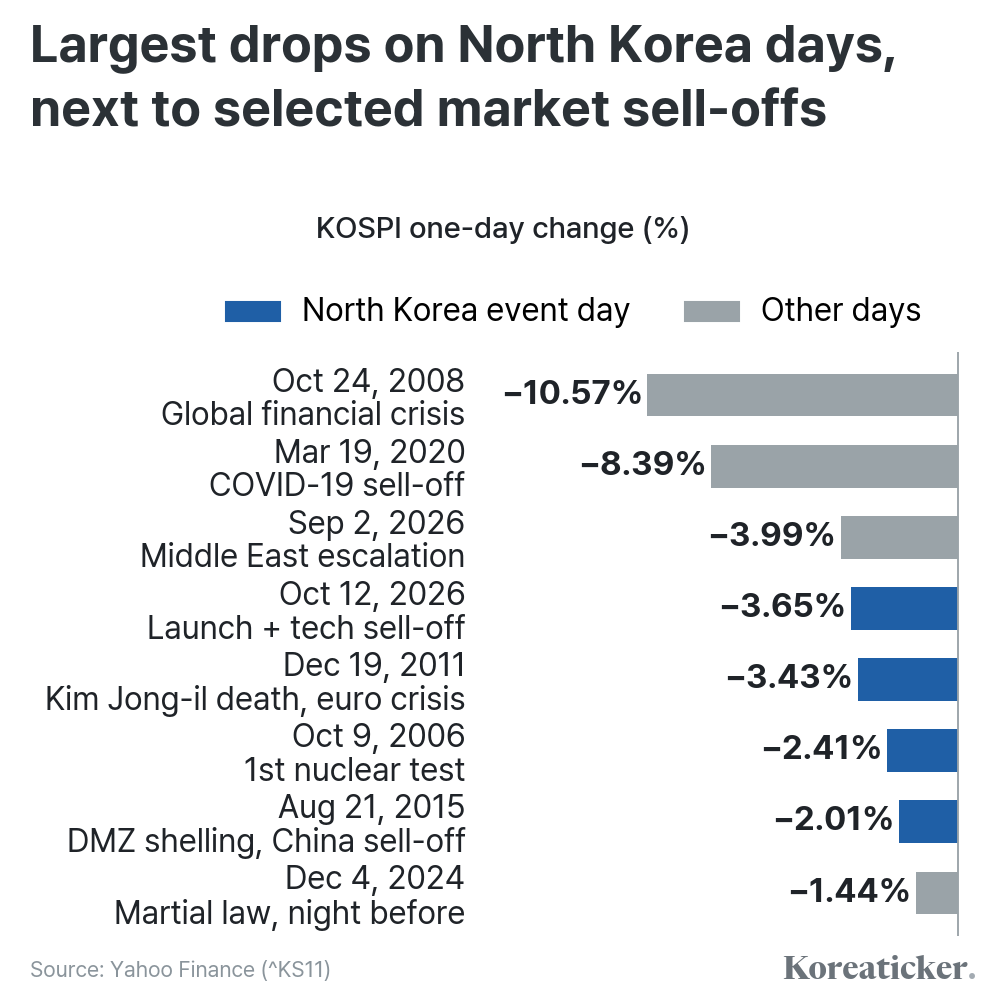
Two other shocks are useful for comparison. After President Yoon Suk Yeol declared martial law on the night of December 3, 2024, the KOSPI fell 1.44% the next day, and the won fell 1.52% against the dollar.
A month later, the won was down 4.5%, a larger one-month fall than after any of the six nuclear tests. For a dollar holder, the martial law crisis was followed by a bigger one-month fall in the won than any of the six tests.
The other came from abroad. On September 2, 2026, a Middle East escalation came with a 3.99% fall in the KOSPI.
Our guide to this guide covers martial law and what followed.
Defense stocks on North Korea days
The four large defense companies mostly moved with the market. A small theme stock jumped, and most of the jump faded within a month.
Korean defense stocks have been among the market's biggest gainers since 2022, but not on North Korea days. On hostile event days, Hanwha Aerospace, Hyundai Rotem and Korea Aerospace Industries beat the KOSPI in fewer than half the cases, and their median gap against the index was slightly negative.
LIG Defense & Aerospace beat it in 13 of 22 events, by a median of 0.24 percentage point. Hanwha Aerospace was Samsung Techwin, a maker of cameras and engines among other things, until 2015, so its early figures say little about defense.
Their large gains since 2022 line up with export orders from countries such as Poland, covered in our Korean defense stocks report. On the 20 event days when the KOSPI fell, Hanwha Aerospace closed higher on only 4, so in this sample the large defense names did not offset a falling market.
A small KOSDAQ-listed military electronics maker, known among Korean traders as a "North Korea theme stock," behaved differently. Its median day-one gain was 4.4%.
A month later, its median gain from the pre-event close was 1.8%. A buyer at the day-one close who held for a month lost money in 22 of the 31 events.
The research and the Korea discount
The studies we read found small effects, or effects limited to the first nuclear test. A Korea Capital Market Institute paper on the Korea discount found no evidence that geopolitical risk affects company valuations.
Kim and Roland (2014), in the journal Economics of Transition, found no effect or only a very small one for most of their 26 events. Of 78 event-and-market tests, 14 were significant at the 10% level, and 7 of those went in the expected direction. Their reading was that markets did not treat North Korea's threats as credible.
Huh and Pyun (2018), in the Asian Economic Journal, used Google search volume to measure attention to North Korea's nuclear program. We read only the abstract. It says attention to the first nuclear test was linked with lower stock prices and later tests were not, and that bank stocks were lower when attention was high throughout the period.
Kim Joon-Seok and Kang Sohyun (2023), in a Korea Capital Market Institute issue paper, found that Korean listed companies' price-to-book ratio averaged 1.2 from 2012 to 2021, against 2.2 for advanced economies, ranking 41st of 45 countries.
Its regressions found "no evidence that geopolitical risks and short-termism in investment affect corporate valuation," and pointed instead to weak shareholder returns, profitability and governance. Robeco, an asset manager, cited the same work and noted that Taiwan, also militarily exposed, does not trade at the same discount.
None of this rules out a small risk premium built into Korean prices.
For a holder, the one study here that tested valuations pointed to how Korean companies treat shareholders as the source of the discount. If that holds, payouts and governance matter more for the discount than the next launch, and they are the target of the reforms in our Value-up index guide and our explainer on why Korean stocks trade cheaply.
What the data cannot tell you
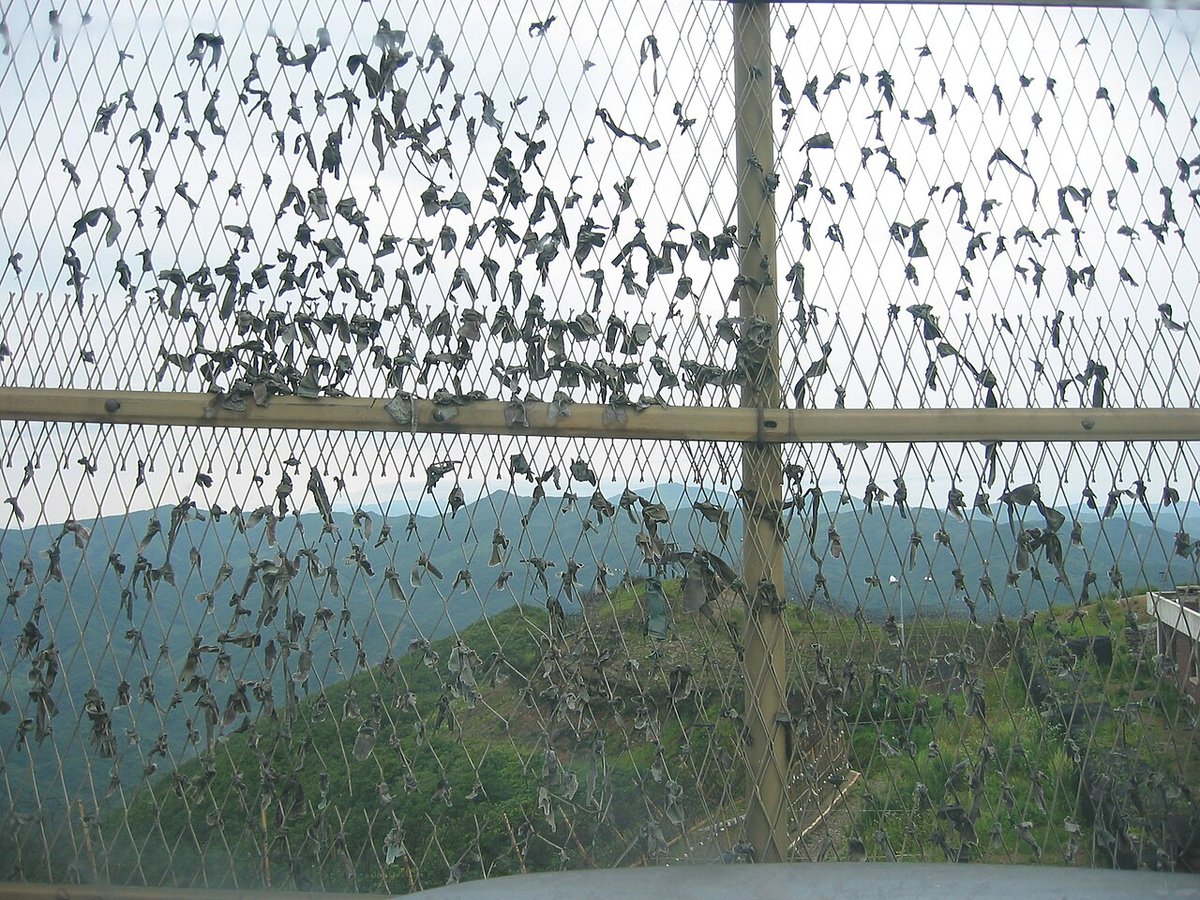
The limit of this record is that it contains no full-scale war.
It includes deadly attacks and shelling, but every event here ended without fighting beyond the incident itself. A real armed conflict would be a different kind of event, and these numbers say nothing about it. A sample of 34 also cannot rule out that the next event plays out differently.
Three things to check on the next North Korea day:
- The won against the dollar. On nuclear test days in this sample it fell about as much as the KOSPI.
- EWY against EEM. In our list, EWY's median day-one change was 0.69 percentage point below EEM's; a much wider gap would suggest Korea moved differently from other emerging markets that day.
- Other news the same week. In our list, the larger moves were concentrated in events that overlapped with other global or domestic news.
For US investors
How US investors can buy Korean stocks
Part of our series Korea, explained for investors. Related: Do Korean stocks follow US stocks? and the Hanwha Aerospace profile.
Also in the series: Trump's statements and Korean industries, in this guide.
Sources and notes
- Koreaticker event study: 34 events (events.csv), calculation scripts and results (nk_event_study.py, nk_event_paths.py), checked 2026.11.12
- KOSPI (^KS11), EWY, EEM and defense stock closes: Yahoo Finance, 2005.06 to 2026.11.10. KOSPI closes match Korea Exchange figures for 2024.11 to 2026.11; for earlier years we used Yahoo alone
- Won/dollar: Federal Reserve H.10 noon buying rates via FRED (DEXKOUS); cross-checked with the Bank of Korea's 3:30 p.m. Seoul close (ECOS) for 2015 onward
- Event dates and times: South Korea's Joint Chiefs of Staff, defense and unification ministries and intelligence service; KCNA and KCTV; USGS seismic records for nuclear tests; for 2026 launches, Korea Times, AP, NPR and USNI News
- JoongAng Daily, market report for October 12, 2026
- Korea Times, market report for September 2, 2026
- Kim, Byung-Yeon and Gérard Roland (2014), "How credible is the North Korean threat?", Economics of Transition 22(3), 433-459, eml.berkeley.edu
- Huh, In and Ju Hyun Pyun (2018), "Does Nuclear Uncertainty Threaten Financial Markets?", Asian Economic Journal 32(1), 55-82, abstract, scholar.korea.ac.kr
- Kim, Joon-Seok and Sohyun Kang, "Analysis on the Causes behind the Korea Discount," Korea Capital Market Institute Issue Paper 23-05 (2023.02.16), kcmi.re.kr
- Robeco, "Unraveling the Korea discount" (2024.02.15), robeco.com
Prices are price changes without dividends. Standard deviation of daily KOSPI moves: 1.44% for 2006 to November 10, 2026.
Since 2015, the Bank of Korea's Seoul close gave a day-one won figure within 0.5 percentage point of the Fed rate in 15 of 23 hostile events, and pointed the other way in 5, so the won figures depend on the time of day measured.
"Size of the move" is the median absolute change. EWY's holdings figure is from our Korea ETFs guide.
Photos from Wikimedia Commons: Travis Wise, Friar's Balsam (CC BY 2.0).
Cover photo: Freedom Bridge at Imjingak, near the DMZ, December 2018, by Lance Vanlewen, via Wikimedia Commons (CC BY-SA 4.0).
For information only, not investment advice. See our full disclaimer.
Update history
- Nov 14, 2026 Said up front in the method section that the events are a hand-picked record with no full-scale war, and reworded several holder lines after a reader-impression review. No figures changed.
- Nov 13, 2026 Added, section by section, what the measured moves mean for a holder of EWY or Seoul shares: the size of the first-day hit in dollars, how long the typical drop lasted, why a dollar holder should watch the won as well as the stocks, how often defense stocks rose when the KOSPI fell in this sample and what the valuation research means for the Korea discount. Existing figures unchanged; three new counts come from the same event data.
Corrections and changes to facts are listed here. See our editorial policy.