Why Korean Stocks Are Hard to Ignore: 6 Reasons to Watch
Korea's main index rose 76% in 2025. In 2026 it more than doubled again by June, then gave back 42% in under five months. Trading was halted by circuit breakers 11 times along the way.
Behind those swings are two companies that take 64% of the world's DRAM revenue, a market that US retail investors could not buy directly until this year, and a set of shareholder rules being rewritten. For a US investor, the useful question is what you are actually buying when you buy Korea, and what it can do to a portfolio.
1. Large swings in both directions
The KOSPI gained 75.6% in 2025, its third-best year on record.
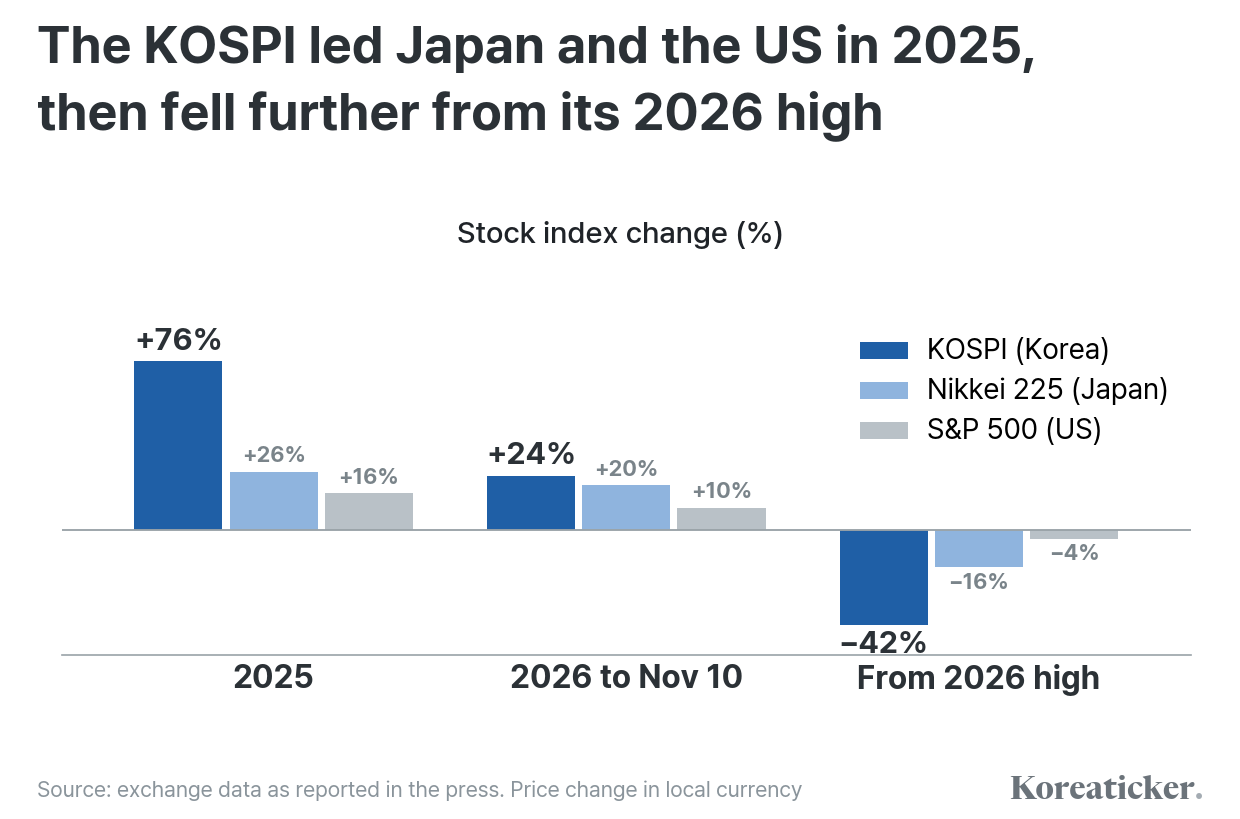
Korean press reported the 2025 gain as the largest among G20 markets. By June 22, 2026 the index was up 116% for the year.
MSCI's Korea index had a three-year annualized volatility of 47.8% at the end of October 2026, more than three times the MSCI Japan index at 14.7%. Put $10,000 in each and, over those three years, the Korea position swung about three times as much as the Japan one.
Shares change hands fast, too: in April 2026 the KOSPI's average daily turnover was 1.48% of market value, against 0.37% for Japan's Nikkei 225 and 0.22% for the S&P 500, according to a Seoul Economic Daily report. Seoul trades during the US night, so the session's moves happen while US holders are asleep.
2. It is where the AI hardware gets made
Samsung Electronics and SK hynix together took 64% of global DRAM revenue in the second quarter of 2026, according to TrendForce.
Every AI server needs memory, and two Korean companies lead that market. Samsung Electronics reported operating profit of ₩107.4 trillion (about $80 billion) for the third quarter of 2026 alone. Buy Korea and much of your money rides on memory demand, which AI servers have been driving. See our HBM market outlook and Korean HBM equipment stocks.
Korea also ranks ninth among the world's arms exporters and sells tanks and howitzers to Europe; see Korean defense stocks. It builds cars, ships and batteries at global scale too, though in shipbuilding and batteries its share has been falling against China. By index weight, though, they are small next to the two memory makers.
3. It trades at 4 times forward earnings, and the rules are being rewritten
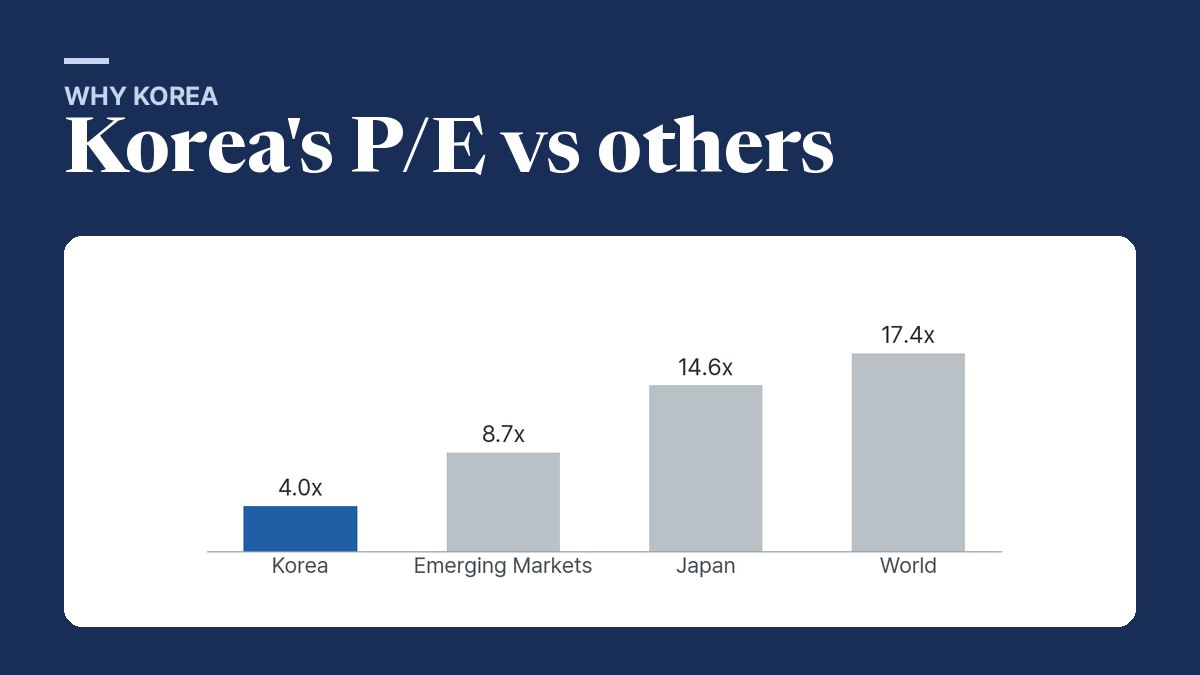
MSCI's Korea index traded at 4.0 times forward earnings at the end of October 2026. The MSCI Japan index traded at 14.6 times.
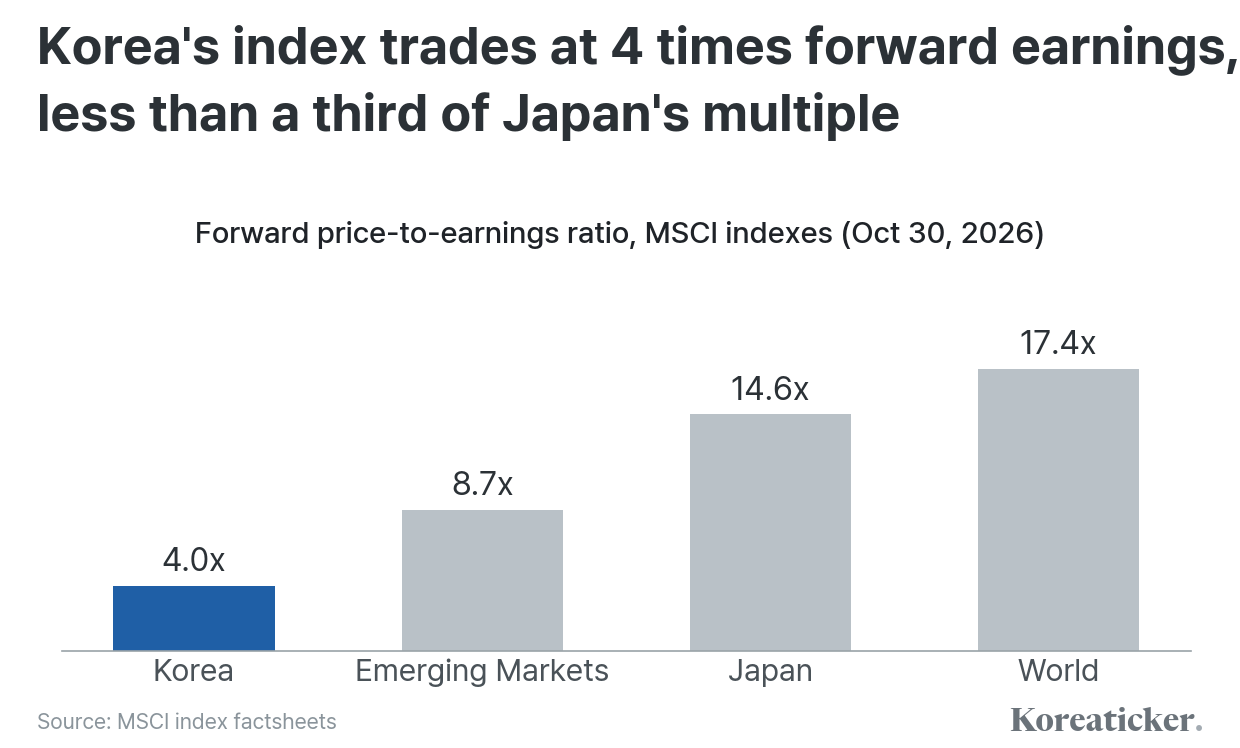
Read that number with care. Memory earnings are near a cyclical high, and cyclical industries look least expensive when profits peak. If memory earnings fall, the multiple on today's price rises, so 4× is not by itself a sign of a bargain. A second measure is steadier: about 60% of KOSPI companies trade below book value, against 33% in Japan.
In Japan, the Tokyo Stock Exchange asked listed companies in March 2023 to explain how they would raise their valuations. The share of its Prime-market companies below book value fell from 50% in mid-2022 to 27% by March 2026, though the figures do not show how much the request caused.
Korea started a similar "Value-up" program in 2024 and followed with binding legal changes, so for Korea holders Japan is the closest guide to what such a push can do.
A March 2026 amendment requires companies to cancel treasury shares instead of sitting on them. By August 2026, 756 companies had published Value-up plans; those that had filed by the end of July made up about 85% of market value.
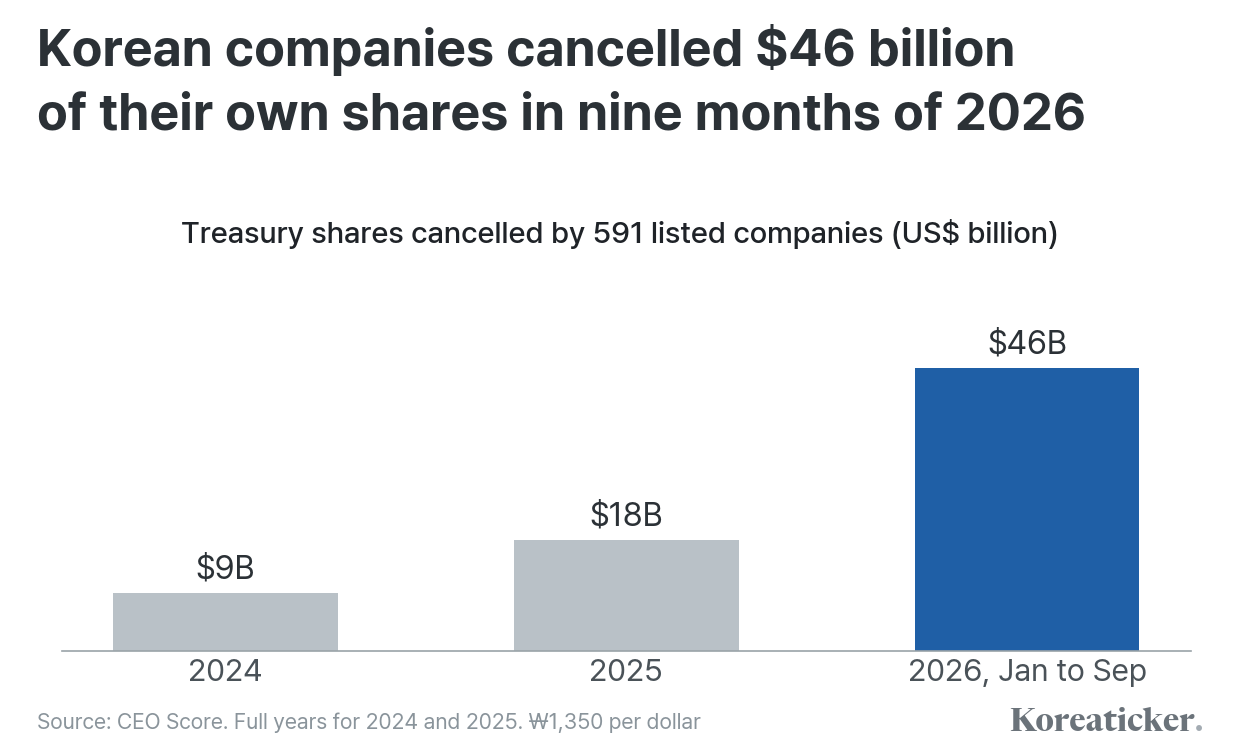
At 591 companies tracked by CEO Score, cancellations rose from $9 billion in 2024 to $18 billion in 2025 and $46 billion in the first nine months of 2026. About half of the 2026 figure came from Samsung Electronics and SK hynix. Cancelled shares can no longer be sold back into the market, removing a source of future dilution.
4. The door has just opened
Interactive Brokers opened Korea Exchange trading to US clients in May 2026, describing itself as the first major US-based broker to do so.
In August 2025 a commenter on Hacker News wrote: "I've been wanting to invest in SK Hynix since early '23 ... I haven't found any brokers that allow you to trade Korea Exchange tickers." Within a year, that changed.
- December 2023: Korea abolished its foreign investor registration requirement
- May 2026: Interactive Brokers opened Korea Exchange trading to eligible US clients
- July 2026: SK hynix listed on Nasdaq as SKHY, and Korea's onshore foreign-exchange market moved to 24-hour weekday trading
- September 2026: the Korea Exchange extended its after-market to 8 pm Seoul time
Together, these changes let eligible Interactive Brokers clients in the US own Seoul shares without Korean investor registration, and trade won through the US day.
SK hynix's Nasdaq offering raised about $26.5 billion. If more Korean companies follow it to US exchanges, each completed listing would add another way in without a Korean account.
Reuters reported in 2025 that the fintech Toss was aiming for a US listing, and Korean press reported that Kakao Mobility made a confidential SEC submission in July 2026 before its parent's board objected in September.
Neither has completed an offering, and Samsung Electronics said in July that it is not considering ADRs. We track each one in Korean companies that could list in the US next.
5. Your emerging-markets fund may already own some
Korea is 19.7% of the MSCI Emerging Markets index. Samsung Electronics is 7.0% of that index and SK hynix 5.2%.
MSCI classes Korea as an emerging market, alongside Taiwan, China and India, even though its income level and industries look like a developed economy's. So $10,000 in an MSCI Emerging Markets index fund already holds about $1,970 of Korea, about $1,220 of it in Samsung Electronics and SK hynix. Check that before buying Korea separately.
FTSE classes Korea as developed, so funds that follow FTSE's emerging index do not hold it. MSCI's next review of Korea's status is due in June 2027; if MSCI upgrades Korea, MSCI emerging-markets funds would eventually stop holding it too.
6. Outside the biggest names, little is written in English
Once you step past the largest names, you will often be reading results in translation or not at all. Only about ten Korean companies have ADRs on a US exchange; they are on our Korean ADR list. The rest file in Korean first.
None of the 21 chip suppliers we compared has a US listing, and their numbers came from Korean filings. A US holder of a smaller Korean stock may learn of a filing later than Korean investors do, so budget time for translation tools, or stick to companies with English results.
Korea and Japan side by side
| Korea | Japan | |
|---|---|---|
| Index change in 2025 | +75.6% (KOSPI) | +26.2% (Nikkei 225) |
| Index change in 2026, to Nov 10 | +24.3% | +20.1% |
| Below 2026 high, Nov 10 | −42.5% | −16.5% |
| 3-year volatility (MSCI, Oct 30, 2026) | 47.8% | 14.7% |
| Forward P/E (MSCI, Oct 30, 2026) | 4.0x | 14.6x |
| Dividend yield (MSCI, Oct 30, 2026) | 0.98% | 1.94% |
| Companies below book value | about 60% | 33% |
| Top 10 stocks' share of MSCI index | 78% | 30% |
| MSCI classification | Emerging | Developed |
A Korea holder got more of the gains in both periods and took a deeper fall from the 2026 high. Its index dividend yield was about half Japan's on October 30, so less of the return came as cash.
Two things to know first
- It rides the memory cycle. Samsung Electronics, including its preferred shares, and SK hynix are about two-thirds of the MSCI Korea index. That gives the index unusually high exposure to memory chip prices: a strong memory year lifted it in 2025, and a weaker stretch can pull it down just as fast. Where the cycle stands is covered in our HBM market outlook
- The currency moves too. The won weakened past 1,560 per dollar in June 2026 and was near 1,340 on November 10. A US investor's return depends on both the share price and the exchange rate: the won's move from 1,560 to about 1,340 raised the dollar value of the same won price by about 16% over that stretch
Next in the series: KOSPI vs KOSDAQ: how Korea's two stock markets differ.
Sources and notes
- Korea Exchange 2025 year-end figures as reported by Korea.net (korea.net and Money S (2025.12); 2026 index levels and circuit breakers from Financial News (2026.11)
- MSCI index factsheets for Korea, Japan, Emerging Markets and World (as of 2026.10.30). msci.com
- Seoul Economic Daily, daily turnover by market (2026.05); companies below book value (2026.03)
- TrendForce, DRAM revenue share, second quarter of 2026. trendforce.com
- Samsung Electronics, third-quarter 2026 results (2026.10)
- SIPRI, arms exporter ranking, 2021 to 2025
- Tokyo Stock Exchange figures as reported by Business Lawyers (2026.05)
- CEO Score, treasury share cancellations by 591 listed companies (2026.10); Korea Exchange monthly Value-up status as reported by Money Today (2026.09)
- Hacker News comment, Aug 21, 2025. news.ycombinator.com
- Interactive Brokers press release, May 7, 2026. interactivebrokers.com ; FTSE Russell country classification
- Reuters on Toss's US listing plan (2025.07); Korean press on Kakao Mobility's US listing attempt (2026.07, 2026.09)
Index changes are price changes in local currency. The June 22 closing high is as reported by Korean financial media. Won amounts are converted at ₩1,350 per dollar. The forward P/E depends on analyst earnings forecasts, which can change quickly for cyclical industries.
Cover photo: "Helicopter view of Seoul" by Neroson, CC BY-SA 4.0, via Wikimedia Commons.
For information only, not investment advice. See our full disclaimer.
Update history
- Nov 14, 2026 Rewrote the English-coverage section and the Korea-Japan table note around what they mean for a buyer, and reworded several lines, after a reader-impression review. No figures changed.
- Nov 13, 2026 Added, section by section, what each reason means for a US investor: how big the swings are against Japan, why the low P/E needs care, how share cancellations help holders, what the new access routes change, how much Korea an emerging-markets fund already holds, and what the won's 2026 move did to dollar returns.
- Nov 12, 2026 Reworded the summary line to note that the 4× forward P/E comes with memory earnings near a cyclical high.
Corrections and changes to facts are listed here. See our editorial policy.