Korean Stocks vs US Stocks: Votes, Price Limits, Settlement and Dividends
Alphabet's founders own shares with ten votes each. Larry Page and Sergey Brin held 52.7% of Alphabet's voting power at the end of 2025 through those Class B shares. Korea's Commercial Act starts from the opposite rule: one vote for each share, with a narrow exception for unlisted venture companies.
Several other Seoul rules change what a US buyer gets and when the money moves. Which of them should you check before the first trade?
The short answer
- Votes: Korean companies generally follow one share, one vote, so your common share votes like the founder's. A Korean "preferred" share may have no vote.
- Price moves: a Korea Exchange stock can move at most 30% from the previous close in a day. US stocks have no fixed limit, only five-minute pauses.
- Timing: Seoul trades during the US night and settles in two business days, so a sale settles a day later than in the US.
- Dividends: many Korean companies now set the dividend before the record date, so you can see the amount before you buy. Fewer have actually done it.
At a glance
| Korea | United States | |
|---|---|---|
| Votes per share (company law) | Korean companies: one per share; venture exception ends within three years of listing | Set by each company's charter: classes can carry extra votes (10 at Alphabet, 29 at Coupang) or none |
| "Preferred" share (company terms) | Korean companies: vote can be removed or limited by the articles, up to a quarter of shares issued | Can be a fixed-rate security, such as Alphabet's 6.25% mandatory convertible preferred |
| Daily price limit (exchange rule) | Korea Exchange: 30% up or down from the base price | No fixed limit; for NMS stocks above $3 in regular hours, 5% or 10% bands with five-minute pauses |
| Regular session (exchange) | Korea Exchange: 9:00 am to 3:30 pm Seoul time | 9:30 am to 4:00 pm Eastern |
| Settlement (market) | Two business days (T+2) | One business day (T+1) since May 28, 2024 |
One share, one vote
Article 369 of Korea's Commercial Act gives one vote for each share. The act lets a company issue shares with no vote or a restricted vote. It has no provision for shares with extra votes.
So a Korean common share votes the same, share for share, as the largest holder's. US companies can do both: Meta's unlisted Class B shares carry ten votes, and Coupang, a Delaware corporation, gives its Class B 29.
Coupang founder Bom Kim held 74.1% of the voting power at the end of 2025. A CPNG holder's vote follows Coupang's charter and Delaware law, not Article 369 (Coupang stock).
Korea's exception, in force since November 2023 under the Venture Business Promotion Act, lets an unlisted venture company give its founder shares with up to ten votes each. For a Korean IPO buyer, two limits matter:
- Some votes stay at one: dividends, director pay, auditor elections and a few other matters, so on those matters, when they come to a vote, the founder's shares count once each, like yours
- It ends after a listing: the shares turn into ordinary shares three years after the company lists, or earlier if the founder sells or leaves the board
What "preferred" means in Seoul
In the US, "preferred stock" can mean a security with a set dividend rate, such as Alphabet's 6.25% mandatory convertible preferred.
In Korea, a preferred share is equity in the same company, so its value rides on that company's results. The Commercial Act lets the articles remove or limit its vote, up to a quarter of shares issued. Samsung Electronics' articles, for example, say its preferred shares "shall be cumulative and non-voting."
Whether a company offers anything for the lost vote, such as a dividend preference, is set in its own articles, so read them before buying. Prices and codes: Korean preferred shares.
A 30% daily limit instead of five-minute pauses
A stock on the Korea Exchange can rise or fall at most 30% from its base price, usually the previous close, in one day.
The limit is measured from the base price, not from what you paid: buy at the day's high of +30% and the stock can still close at −30%, a 46% loss on your price.
At the limit, orders still come in but trade only at or inside it. If more holders want to sell than buy at the floor, some sell orders may not fill, and the rest of the move can carry into the next session. The same band applies in the 4:00 pm to 8:00 pm after-market.
A stock's first trading day after an IPO is different: the range is 60% to 400% of the offering price, so an IPO allottee can lose up to 40% on day one or see the price quadruple.
US exchange-listed stocks have no fixed daily cap, so one US stock can fall more than 30% in a day. Under the Limit Up-Limit Down plan, a stock above $3 gets a band of 5% (S&P 500 and Russell 1000 stocks) or 10% (others) around its average price of the last five minutes.
If quotes stay at the band for 15 seconds, the listing exchange declares a five-minute pause, but there is no daily cap. Market-wide halts are in Why Korean stocks stop trading.
Trading hours and settlement
Seoul's regular session, 9:00 am to 3:30 pm, is 7:00 pm to 1:30 am in New York during US standard time, starting the evening before, and 8:00 pm to 2:30 am in US summer. To trade while Seoul is open, a US investor has to be up at night or leave orders in advance.
Korean trades settle on T+2; the US moved to T+1 on May 28, 2024. A Korean sale therefore settles a business day later than a US one. When you can reuse the proceeds also depends on your broker and on holidays in both countries.
On November 2, 2026, Money Today reported a draft roadmap from market bodies for T+1 from 2028. The final date was left to later consultation, so plan on T+2 for now.
Dividends: check the record date and the amount
Until 2023 most Korean companies fixed who would receive the dividend at year-end and set the amount at the meeting the next spring. The Financial Services Commission put it this way in January 2023: "investors invest in companies without knowing how much they will receive in dividends."
Rules introduced in 2023 and 2024 let companies set the amount first and the record date after, the US order, as with Alphabet's $0.22 dividend announced in October 2026 before its December 7 record date. At those companies you can see what you will be paid before deciding to buy.
Adoption is voluntary. By December 2024, 1,008 listed companies had changed their articles to allow it, the FSC said, but of 321 such companies that paid a 2023 year-end dividend, only 109 actually used the new order. Elsewhere you still buy before the amount is known. For a US holder:
- Timing: buy before the ex-dividend date the company announces; with T+2 settlement that is at least two business days before the record date
- Tax: Korea withholds 22% on dividends to foreigners by default, or 16.5% at the US treaty rate; see Korean dividend tax
Rules aimed at foreign investors
- No more registration: foreign investors had to register with the Financial Supervisory Service before buying until December 14, 2023. Individuals now open accounts with a passport number, one step fewer before a first trade
- Ownership caps: certain telecom carriers, for example, cap foreign holdings at 49% of voting shares, depositary receipts included. Once a cap is reached, foreign investors may be unable to buy more of that stock in Seoul
The FSC banned short selling of all listed Korean stocks from November 6, 2023, a day after announcing it, with exemptions for market makers and liquidity providers, and later extended the ban to March 30, 2025. For a holder, that history shows Seoul's trading rules can change with a day's notice.
Short selling was fully allowed again from March 31, 2025. Investors who expect a fall can again bet on it.
For US investors
How US investors can buy Korean shares
Sources and notes
- Korean Commercial Act, Articles 344-3, 354 and 369 (version in force Sept 10, 2026), National Law Information Center. law.go.kr
- Venture Business Promotion Act (벤처기업육성에 관한 특별법), Articles 16-11 to 16-13 (version in force July 1, 2026) and addendum to Act No. 19416 (May 16, 2023). law.go.kr
- Alphabet, Form 10-K for 2025 (filed 2026.02.05), and Q3 2026 earnings release (2026.10.28); Form 8-K (2026.08.10) on the 6.25% mandatory convertible preferred. sec.gov
- Meta Platforms, Form 10-K for 2025 (filed 2026.01.29). sec.gov
- Coupang, Form 10-K for 2025 (filed 2026.02.26): Delaware incorporation, Class B votes and voting power. sec.gov
- Samsung Electronics, Articles of Incorporation, Article 8 (English, accessed 2026.11.12). samsung.com
- Korea Exchange, KOSPI trading rules: general procedures, price limit, base price (accessed 2026.11.12). regulation.krx.co.kr ; after-market. regulation.krx.co.kr
- Limit Up-Limit Down plan, overview, NMS stocks, regular hours and price bands (accessed 2026.11.12). luldplan.com
- SEC press release 2023-29, T+1 settlement (2023.02.15). sec.gov
- Money Today, draft T+1 roadmap (2026.11.02). mt.co.kr
- Financial Services Commission: dividend procedures (2023.01.31) fsc.go.kr ; adoption count (2024.12.27) fsc.go.kr ; investor registration (2023.12.13) fsc.go.kr ; short selling ban (2023.11.05) fsc.go.kr ; ban extended to March 30, 2025 (2024.06.13) fsc.go.kr ; resumption (2025.03.24) fsc.go.kr
- Telecommunications Business Act, Article 8 (version in force Oct 1, 2026). law.go.kr
- Dividend withholding: Korea-US income tax treaty, Article 12 (15% cap). irs.gov ; KB Financial Group, Form 20-F for 2025, Item 10.E (22.0% default and 16.5% treaty rate, both including local income surtax). sec.gov
Rule summaries are ours; the law and exchange rule texts govern. English quotations of Korean law are our translations. US price bands apply in regular hours and are doubled in the last 25 minutes for some stocks; lower-priced stocks get wider bands.
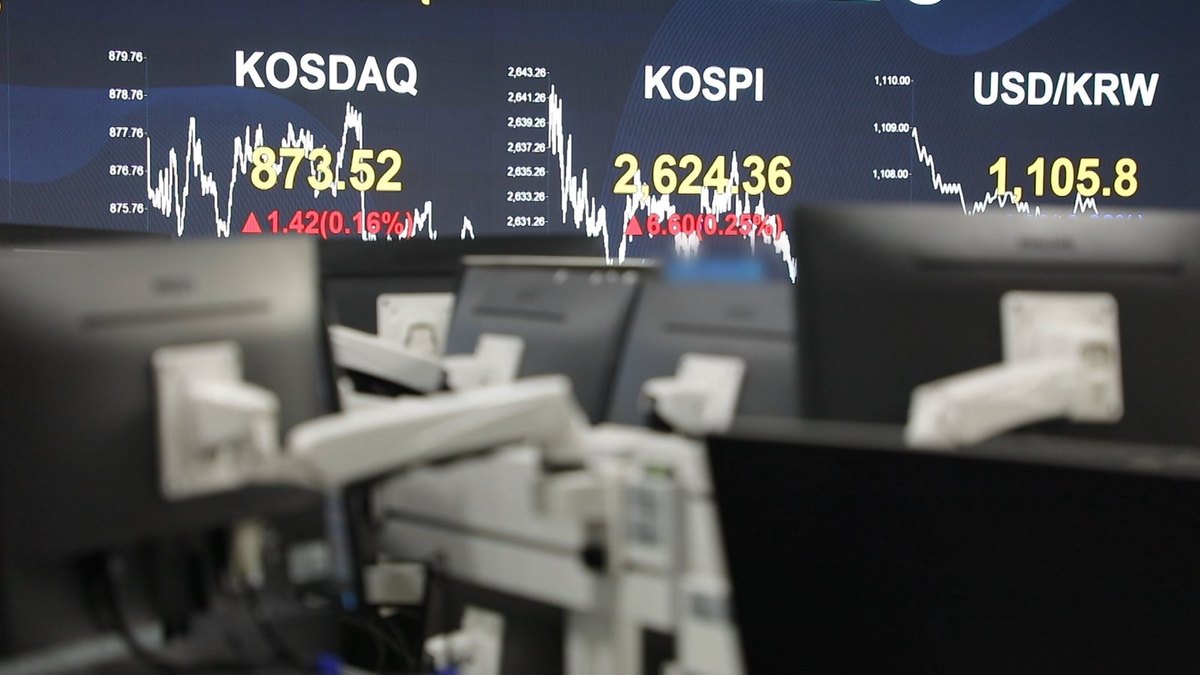
Cover photo: KOSPI, KOSDAQ and won-dollar boards in a dealing room, January 2022, by KBS, KOGL Type 1, via Wikimedia Commons.
For information only, not investment advice. See our full disclaimer.
Update history
- Nov 13, 2026 Rewrote each section around what the rule changes for a US buyer: your vote, how far a stock can move in a day, when a sale settles, when to buy for a dividend and what the foreign caps and short-selling history mean for a holder. Added the FSC count of companies that actually used the new dividend order. Cut details without that angle: the venture founder test, the 'five years' note on the short-selling resumption, the 2015 change to the limit and the wider bands for low-priced US stocks.
Corrections and changes to facts are listed here. See our editorial policy.