Korean Preferred Shares: Samsung and Hyundai Discounts Explained
Many large Korean companies have two kinds of listed stock: common shares and preferred shares. The preferred shares are a claim on the same company, with different voting and dividend terms, and they trade at a large discount. In the two examples below it was 26% and 47%, measured on different dates.
For a US investor, the word "preferred" can mislead. These are not the fixed-income preferreds sold in the United States, and the dividend has no fixed amount.
Buy the preferred and you own a cheaper, less traded class of the same company's stock, with no vote and a price that can drift away from the common. The question is whether the lower price and higher yield make up for that.
What you give up and what you get
- No voting rights. You cannot vote on directors or deals, and that is one reason for the discount. Lower liquidity, governance and investor demand also affect the gap.
- A slightly higher dividend. The premium is usually small. Hyundai Motor's second preferred pays ₩100 a share more than the common each year, so most of the extra yield comes from the lower price, not the extra cash.
- The same business. Earnings and dividends rise and fall with the common shares, so a bad year for the company hurts both classes.
- Lower liquidity. Preferred shares usually change hands less often, which can mean a wider gap between bid and ask when you trade.
Each share class has its own six-digit Korea Exchange code, so check that your order is for the class you mean. Samsung Electronics common is 005930 and its preferred is 005935. Hyundai Motor common is 005380 and it has three preferred classes: 005385, 005387 and 005389.
Two examples
| Common | Preferred | Discount | Date | |
|---|---|---|---|---|
| Hyundai Motor (005380 and 005387) | ₩274,000 | ₩145,400 | 47% | Nov 10, 2026 |
| Samsung Electronics (005930 and 005935) | ₩259,500 | ₩193,300 | 26% | mid-September 2026 |
The two rows come from different dates, so they do not show that Hyundai's preferred is cheaper than Samsung's today.
On Hyundai's minimum annual dividend of ₩10,000 a common share, the yield at the November 10 close was 3.6% on the common and 6.9% on the second preferred. Under that minimum, a preferred holder would get about the same cash per share for roughly half the price; the vote, and some liquidity, are what they give up for it.
The discount moves
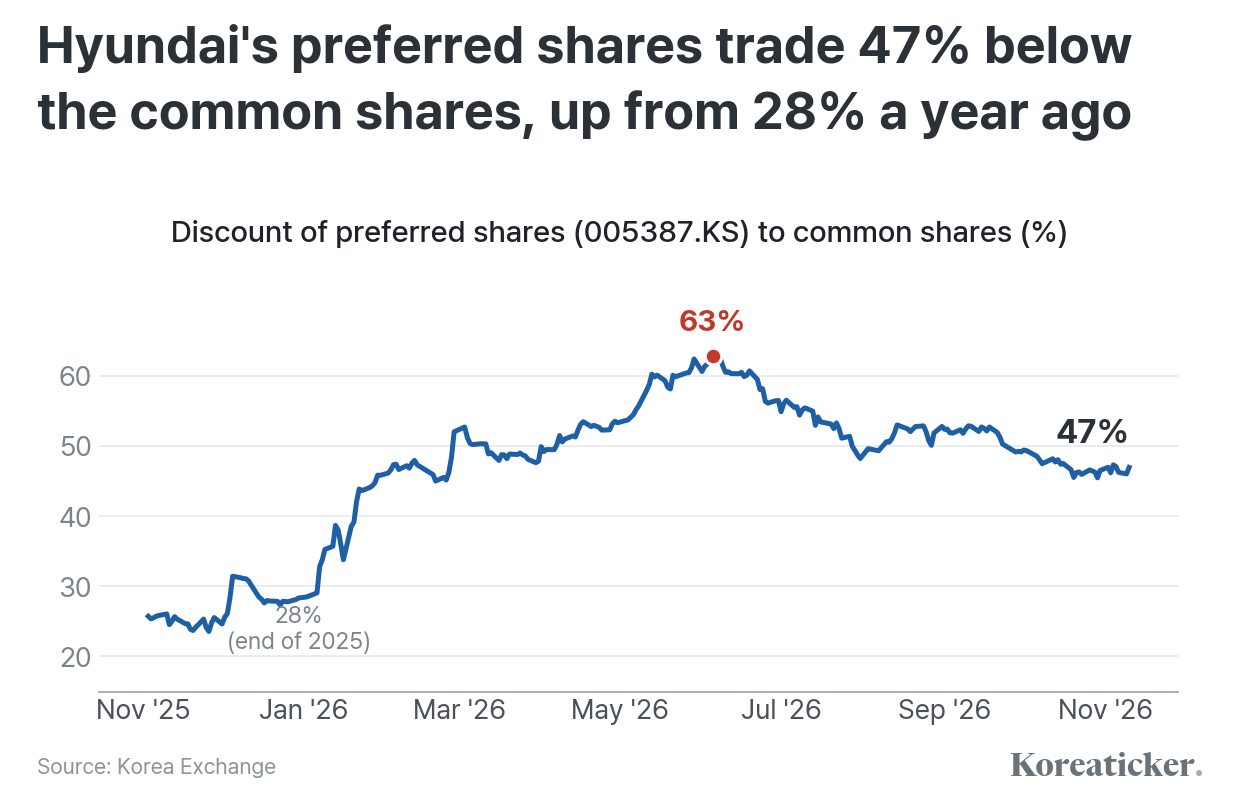
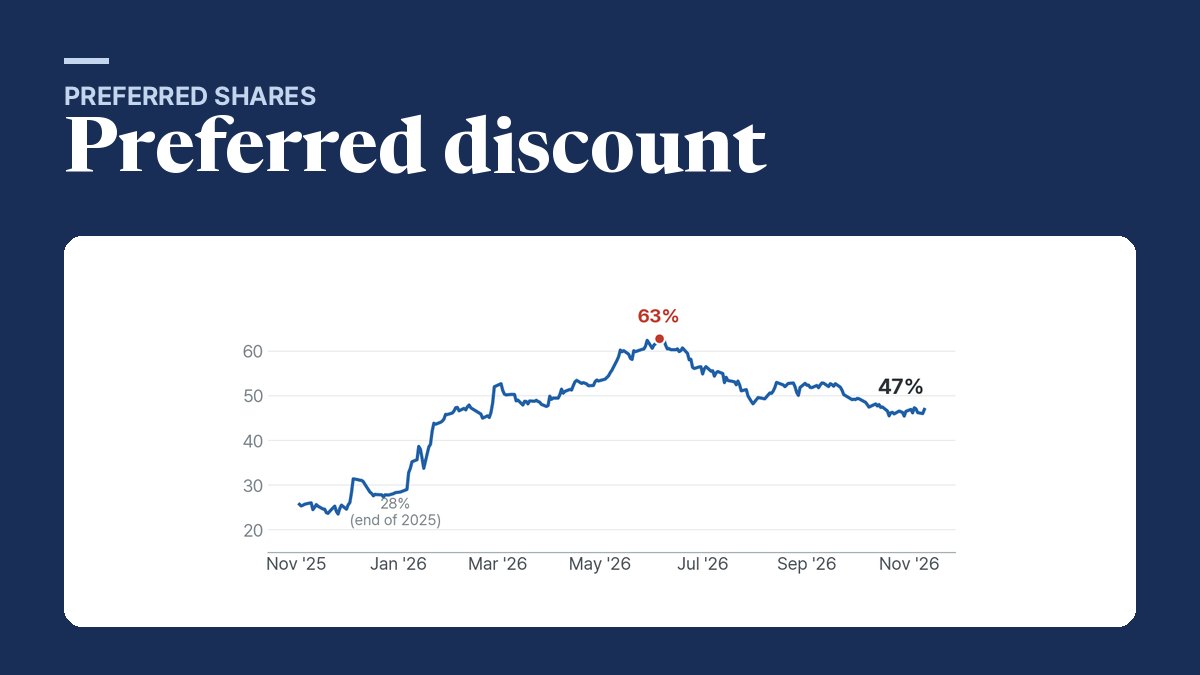
Hyundai Motor's preferred discount went from 28% at the end of 2025 to 63% in June 2026 and back to 47% in November. The widening coincided with a rally in the common shares that news coverage tied to robotics. The full story is in our Hyundai Motor stock report.
Someone who chose the preferred at the end of 2025 to save money fell behind a common holder in the same company. By our arithmetic from those discounts, the preferred was worth 72% of the common's price then and 53% in November. Measured against the common, it lost about 26%. That is a relative figure, not the change in the preferred's own price.
A preferred holder is therefore making two bets: one on the business and one on the discount. When the gap narrows, the preferred catches up with the common. Before buying, compare today's discount with its recent range, 28% to 63% for Hyundai since the end of 2025.
For US investors
How to buy them from the US
Sources and notes
- Korea Exchange closing prices via Naver Finance (Hyundai Motor, 2026.11.10)
- Herald Business, Samsung common and preferred prices (2026.09)
- Hyundai Motor, dividend policy in 2025 earnings release (2026.01)
- Hyundai Motor IR notices on GDR delisting (2024.10, 2024.12)
- StockAnalysis.com, US-listed Korea ETF holdings (checked 2026.11.09)
The ₩100 dividend difference for Hyundai's second preferred is from our research notes and has not been rechecked against the annual report.
The relative performance of Hyundai's preferred against the common is our calculation from the discounts shown (1 − 0.47 against 1 − 0.28) and excludes dividends.
Hyundai prices on this page use the integrated closing price reported by Naver Finance, which can differ slightly from the Korea Exchange close used elsewhere on this site.
Cover photo: Hyundai Motor and Kia headquarters in Seoul, by Chu, CC BY-SA 3.0, via Wikimedia Commons.
For information only, not investment advice. See our full disclaimer.
Update history
- Nov 12, 2026 Summary line no longer gives 47% as the general discount; that figure is Hyundai's only.
- Nov 13, 2026 Rewrote each section around what the preferred share changes for a holder: what giving up the vote buys, what the yield gap means in cash, and how the 2026 widening of Hyundai's discount left preferred holders behind common holders (our calculation from the discounts already shown).
- Nov 14, 2026 Made clear that the 26% is a fall relative to the common, not a price fall, and limited the dividend point to Hyundai, where we have the figure. Reworded the discount section after a reader-impression review.
Corrections and changes to facts are listed here. See our editorial policy.