KOSPI vs KOSDAQ: How Korea's Two Stock Markets Differ
KOSDAQ is often called Korea's Nasdaq. On November 11, 2026, one KOSPI stock, Samsung Electronics, was worth three times the entire KOSDAQ market.
Korea has one stock exchange and two main markets on it. Does it matter to a US investor which one a stock is on? It is a rough first filter. The market tells you how large a company probably is, who trades it, and which suffix its ticker carries on Yahoo Finance.
The two at a glance
| KOSPI | KOSDAQ | |
|---|---|---|
| Opened | 1956 | July 1996 |
| Listed companies | about 830 | about 1,820 |
| Market value (Nov 11, 2026) | $3.3 trillion | $297 billion |
| Largest stock's share | 27% (Samsung Electronics) | 3% (Alteogen) |
| Top 10 stocks' share | 62% | 17% |
| Foreign ownership (Jan 23, 2026) | 37.2% | 9.9% |
| Individuals' share of trading (Jan 2026) | 48% | 74% |
| Yahoo Finance suffix | .KS | .KQ |
Market values and shares are our calculation from prices on the afternoon of November 11, 2026, after the regular session. Ownership and trading figures are Korea Exchange data from January 2026, as reported by Korean media; KOSDAQ has fallen sharply since then, so the mix may have shifted.
Foreign investors held more than a third of KOSPI but about a tenth of KOSDAQ. Buy a KOSDAQ stock from the US and you join a small group of foreign owners in a company held mostly by Koreans.
One exchange, two markets
Both markets sit on one exchange, so the same 30% daily price limit applies to either, and a broker that reaches one usually lists the other.
KOSPI is the main board; strictly, it is the name of an index and, by extension, of the market it measures. KOSDAQ was a separate company until 2005, when it merged into what is now the Korea Exchange.
Nextrade, an alternative trading venue that opened in 2025, does not list companies of its own. KOSPI or KOSDAQ tells you where a stock is listed. Korea Exchange or Nextrade tells you where an order is filled, so a broker routing your order to Nextrade does not change which market the stock belongs to.
Size: a few giants against many small companies
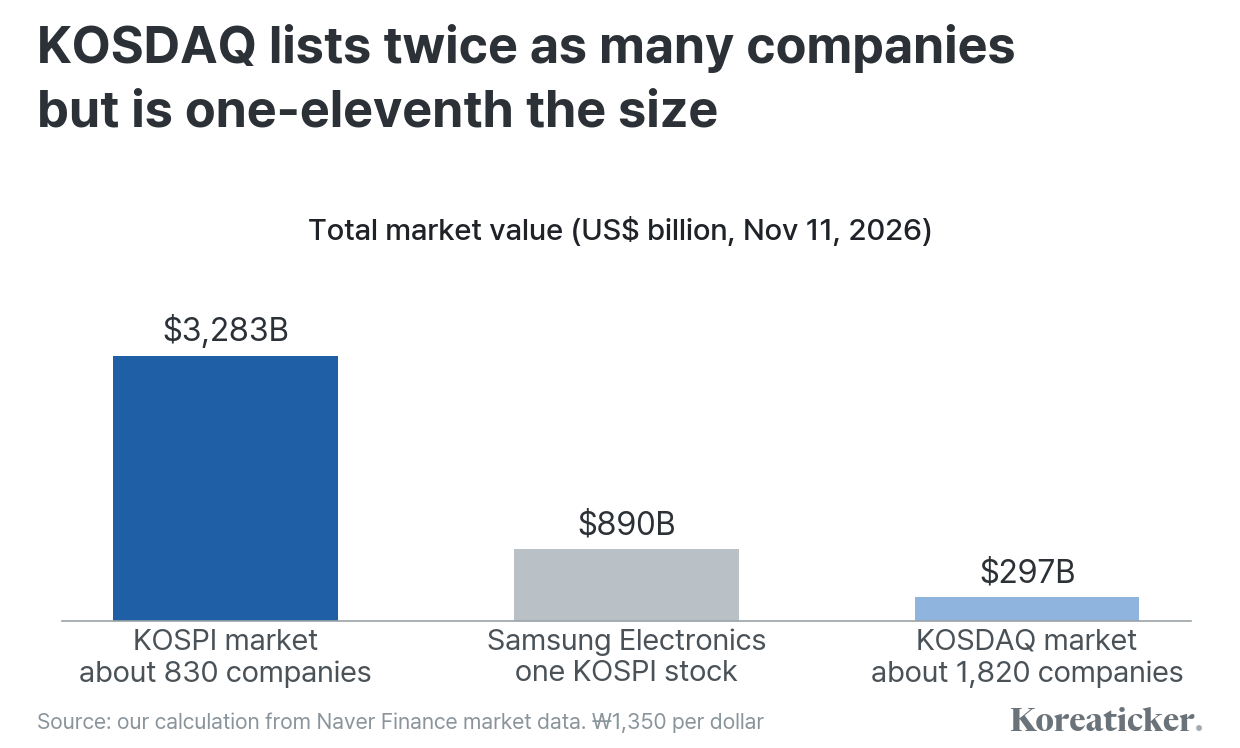
KOSPI is top-heavy. Samsung Electronics and SK hynix common shares made up 48% of its value on November 11, so anyone following the KOSPI market is following two memory chip stocks for nearly half of its value. KOSDAQ is the opposite: only one KOSDAQ stock was worth more than ₩10 trillion ($7.4 billion), against 56 on KOSPI.
What is listed on each
| Rank | KOSPI | KOSDAQ |
|---|---|---|
| 1 | Samsung Electronics (chips) | Alteogen (biotech) |
| 2 | SK hynix (chips) | Ecopro (battery materials) |
| 3 | Samsung Electronics preferred | Ecopro BM (battery materials) |
| 4 | SK Square (holding company) | Jusung Engineering (chip equipment) |
| 5 | LG Energy Solution (batteries) | Rainbow Robotics (robots) |
Ranked by market value at November 11, 2026 prices. The industry labels are ours.
KOSPI holds the exporters most readers have heard of, plus banks, insurers and carmakers. A stock picked from the KOSPI top five is a bet on companies with long public records. KOSDAQ's largest names are in biotech, battery materials and chip equipment, and that list turns over within months.
Someone who bought "the biggest KOSDAQ names" in December 2025 would hold a different set by June 2026.
Korean press counted seven biotech companies in the KOSDAQ top 10 in December 2025, and by June 2026 four of them had been pushed out by chip equipment makers. Several of those suppliers appear in our Korean HBM equipment stocks report.
Who trades them
Individual investors accounted for 74% of KOSDAQ trading by value in January 2026, against 48% on KOSPI. Prices in that market are set mostly by Korean individuals, so a KOSDAQ stock can move on local retail interest that US news never mentions.
Shares also change hands faster there. On November 11, trading came to 1.3% of KOSDAQ's market value in a single day, against 0.4% for KOSPI. The two figures come from different dates, January for the investor mix and one November day for turnover.
A lower bar to get in, and a rising bar to stay
A standard KOSPI listing asks for ₩30 billion ($22 million) of equity. KOSDAQ's technology route asks for ₩1 billion and allows companies that are still losing money.
- KOSPI: equity of at least ₩30 billion, plus a test on sales, profit or market value. One common route needs ₩100 billion ($74 million) of annual sales
- KOSDAQ, standard route: for example, pre-tax profit of ₩2 billion with equity of ₩3 billion
- KOSDAQ, technology route: equity of ₩1 billion and a market value of ₩9 billion, with technology ratings from outside evaluators in place of a profit record. The 300th company to list this way arrived in September 2026
Because the technology route admits loss-making companies, a KOSDAQ listing on its own tells you little about whether the company makes money. The exit rules are tightening too. Since July 2026 a KOSDAQ company whose market value stays below ₩20 billion ($15 million) faces delisting proceedings; the floor is due to rise to ₩30 billion in July 2027.
KOSPI's floor is ₩30 billion, due to rise to ₩50 billion. If you own a small company on either market, its market value against these floors is the number to watch before July 2027. A plan to split KOSDAQ into an upper and a general tier is under discussion and has not been finalized.
Why "Korea's Nasdaq" only goes so far
Nasdaq kept Apple and Nvidia. Several of KOSDAQ's largest companies have left. Korea Exchange data cited by Asia Economy counts 54 companies that have moved from KOSDAQ to KOSPI since 2000, among them the company now called Naver (2008), Kakao (2017) and Celltrion (2018). Kakao was KOSDAQ's second-largest stock when it moved and Celltrion its largest.
Alteogen, today's largest KOSDAQ stock, won shareholder approval for the same move in December 2025, then said in July 2026 that it was putting its application on hold for now.
The KOSDAQ index closed at 705.10 on November 11, 2026, below the 1,000 it started from in 1996 on today's scale, even though the number of listed companies has grown about fivefold.
The departures are one reason the index and the market have diverged: the Korea Times cited an analyst estimate that the index would be near 1,700 if Naver, Kakao and Celltrion had stayed. Anyone who held Naver, Kakao or Celltrion kept the gains after the move. Anyone who held the KOSDAQ index lost them.
Returns and swings
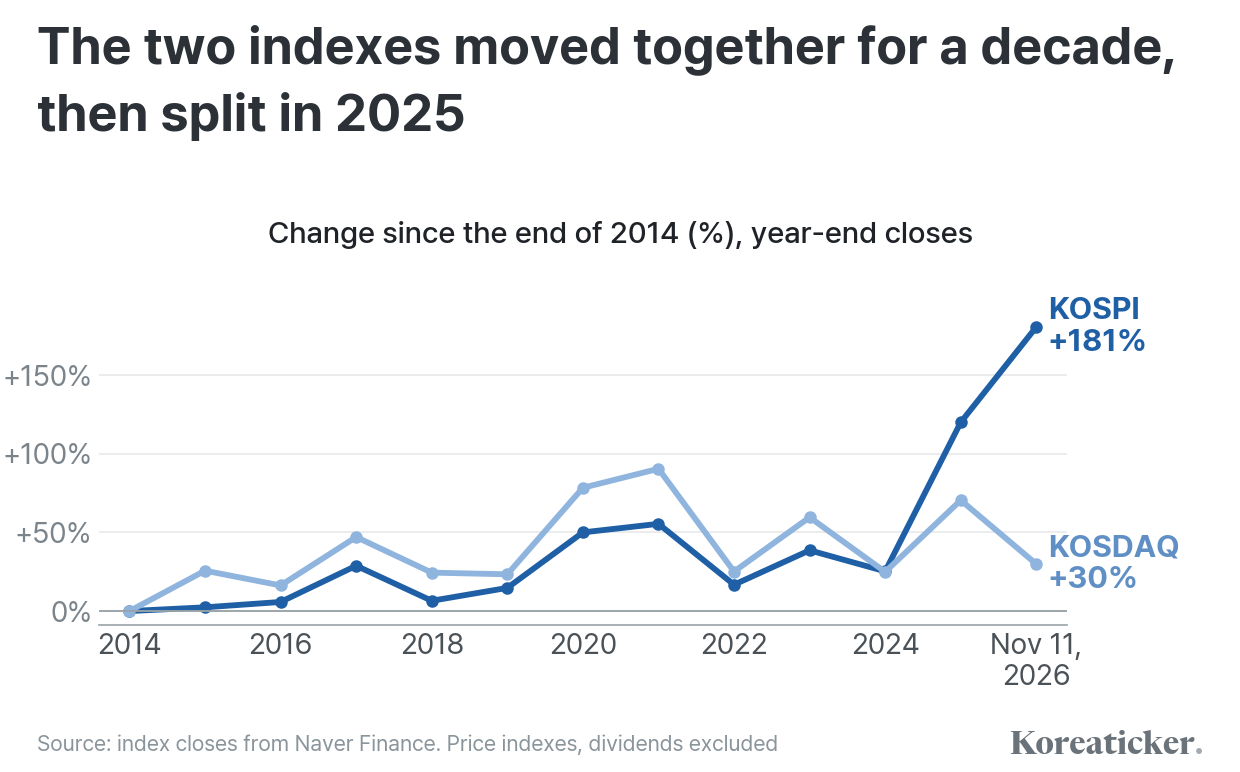
From the end of 2014 to the end of 2024 the two indexes ended almost level: KOSPI up 25.3%, KOSDAQ up 24.9%. The gap opened in 2025 and 2026, when memory chip stocks drove KOSPI.
We measured swings as the annualized standard deviation of daily index changes. By that measure KOSDAQ's daily moves were more volatile than KOSPI's in each of the ten years from 2015 to 2024. In 2024 KOSPI moved more than 3% in a day 4 times and KOSDAQ 8 times.
In 2026, through November 11, that reversed and KOSPI was the more volatile of the two. It moved more than 3% in a day 76 times, against 64 for KOSDAQ. For a holder, the big-company market was not the calmer one this year.
Tickers and trading rules
- Tickers: Yahoo Finance uses .KS for KOSPI stocks and .KQ for KOSDAQ stocks, so Samsung Electronics is 005930.KS and Alteogen is 196170.KQ. Google Finance uses KRX: and KOSDAQ:. The six-digit code alone does not tell you the market, so check the suffix before you trust a quote
- Daily limit: a stock on either market can rise or fall by at most 30% from the previous close in one day
- Circuit breakers: each market has its own, triggered by its own index, so one can halt while the other keeps trading
What the market label tells you
A KOSPI stock is more likely to be large and held by foreign funds; a KOSDAQ stock, to be small and traded mostly by Korean individuals. KOSDAQ has listed companies that grew into Naver and Celltrion, and it also has more companies near the delisting floor, which rises to ₩30 billion in July 2027.
For US investors
How to buy stocks from either market
Next in the series: Do Korean stocks follow US stocks?
Sources and notes
- Korea Exchange, market overview and history (English site). global.krx.co.kr
- Naver Finance market data for November 11, 2026 (market values, index closes, trading value); totals and shares are our calculation
- Herald Business, foreign ownership and investor trading shares on KOSDAQ, citing Korea Exchange data (2026.01)
- Korea JoongAng Daily, individual investors' share of KOSPI trading (2026.08)
- MTN, number of KOSDAQ-listed companies and the market value floor (2026.09, 2026.10)
- Korea Exchange listing requirements for KOSPI and KOSDAQ. listing.krx.co.kr
- Smart Today, 300th technology-route listing (2026.09)
- Korea Times, KOSDAQ at 30 (2026.07); Asia Economy, companies that moved from KOSDAQ to KOSPI (2025.12, and English edition 2023.08); Financial News, rank at the time of transfer (2026.10)
- Edaily, Alteogen's KOSPI transfer put on hold (2026.07)
- Herald Business (2025.12) and Asia Economy (2026.06), changes in the KOSDAQ top 10
- Korea Exchange trading rules: daily price limit and circuit breakers. regulation.krx.co.kr
- Yahoo Finance and Google Finance quote pages, checked Nov 11, 2026
Company counts are approximate: about 830 is our count of KOSPI common stocks on November 11 (938 listed stocks less 107 preferred lines), and about 1,820 is the Korea Exchange figure for August 2026 as reported by MTN. Market totals exclude ETFs and include preferred shares and blank-check companies. Indexes are price indexes without dividends. Won amounts are converted at ₩1,350 per dollar.
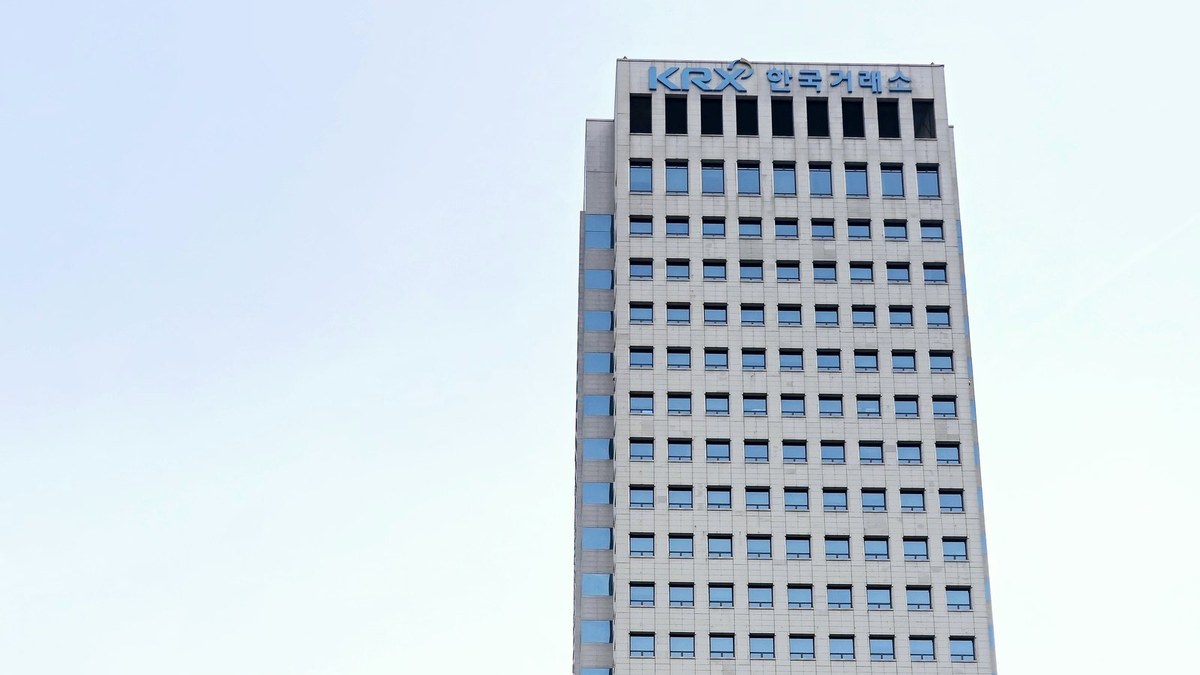
Cover photo: the Korea Exchange Seoul office in Yeouido, by Narubaru7, CC BY 4.0, via Wikimedia Commons.
For information only, not investment advice. See our full disclaimer.
Update history
- Nov 12, 2026 Corrected the conclusion, which called KOSDAQ the more volatile market; in 2026 KOSPI was. Removed an unsupported line about English coverage and added the count of 3% days.
- Nov 13, 2026 Added, section by section, what each difference means for a US investor buying or holding a stock on either market: index concentration, who trades, the delisting floor, the departures from KOSDAQ and which index a fund follows. Cut the KONEX mention and the Korea Exchange quote on the KOSPI name.
- Nov 14, 2026 Rewrote the market structure and top-five sections around what they change for a buyer, after a reader-impression review. No numbers changed.
Corrections and changes to facts are listed here. See our editorial policy.