Korean Dividend Tax for US Investors: 22%, 16.5% and the $55 Gap
Samsung Electronics will pay ₩4,601 a share on November 27, 2026, more than twelve times its first-quarter dividend of ₩372. If you hold the shares in Seoul from the US, Korea takes its cut before the money reaches you, and the rate depends on paperwork filed before the payment.
So how much of a Korean dividend does a US investor keep, and what other Korean taxes apply? The US side depends on your own return, so check that part with a tax adviser.
What a US holder pays in Korea
For most US holders of Seoul shares, two lines in this table decide the cost: the dividend rate their broker applies and the sale tax on every trade.
| Tax | Rate for a US resident | Who collects it |
|---|---|---|
| Dividend withholding, default | 22% | Deducted before payment |
| Dividend withholding, US treaty rate | 16.5% | Needs proof of US residence; otherwise claimed back |
| Capital gains on listed shares | Generally none in Korea, for holdings under 25% | n/a |
| Securities transaction tax on sales | 0.20% of the sale amount | Deducted when you sell in Seoul |
| US-listed ADRs | No Korean transaction tax on US trades | n/a |
Rates as of November 2026.
Dividends: 22% unless Korea knows you are American
The 22% is a 20% national withholding tax plus a local income tax of one-tenth of that. The treaty, in force since 1979, caps the national tax at 15% for a US resident who is entitled to treaty benefits. With the local tax added, that is 16.5%, the figure Korean companies give in their own SEC filings.
The lower rate is not automatic. Korean law requires the beneficial owner to file an application for the treaty rate, with proof of residence, before the dividend is paid.
For a US resident the proof is IRS Form 6166, a certificate of US residency. Without it the payer withholds 22%. For shares held in your own name, that paperwork decides whether Korea keeps 16.5% or 22% of each dividend; a US broker may hold them differently, as the next section explains.
If you hold through a US broker
A US investor who buys through a US broker usually does not hold Korean shares in their own name. The broker's Korean custodian can hold them in a single account for many clients. Korean press reported in June 2026 that Interactive Brokers works with Samsung Securities in this way.
For dividends paid into this kind of foreign omnibus account, Korean law since 2024 has the payer withhold 22% first. The investor then has the legal right to claim the treaty difference from the Korean tax office within five years, and the office must respond within six months.
We have not filed such a claim ourselves, so we cannot tell you which form to use, which office handles it or what it costs. Interactive Brokers' own documentation did not tell us which rate it withholds for US clients, or whether it files the claim for them.
Until you know otherwise, plan on 22% and treat the treaty difference as money that comes back only if someone files the claim. Ask your broker before you buy, and check the rate on your first dividend statement.
What the difference is worth
Take a dividend of $1,000 before tax.
- At 22%, Korea keeps $220 and you receive $780
- At the treaty rate of 16.5%, Korea's share is $165
- The $55 between the two can, in principle, be claimed back from Korea
The $55 matters on the US side too. IRS Publication 514 says a foreign tax credit is figured at the treaty rate, not the amount actually paid, because tax withheld above the treaty rate is refundable.
So the $55 generally cannot be claimed from the IRS either. We could not confirm from IRS guidance whether the 1.5% local tax inside the 16.5% counts for the US credit.
What changes on your US return
Up to the treaty rate, the Korean tax can be credited against your US tax, and how long you hold the shares decides whether the dividend gets the lower US rate.
- Foreign tax credit: Korean tax withheld up to the treaty rate may be credited against US tax, subject to the rules in Publication 514. If your total foreign tax is $300 or less ($600 on a joint return) and appears on a 1099-DIV, you can claim it without Form 1116
- Holding period for the credit: you generally must hold the shares for at least 16 days in the 31-day period that starts 15 days before the ex-dividend date, not counting days when your risk of loss was hedged
- Qualified dividends: Korea is a treaty country under Publication 550, so Korean dividends can qualify for the lower US rate. You must hold the shares for more than 60 days in the 121-day period around the ex-dividend date, and the company must not be a passive foreign investment company in the year of the dividend or the year before
- Currency: dividends on Seoul shares are paid in won. For US tax they are translated into dollars at the exchange rate on the day you receive them, so the dollar figure on your return also depends on the won rate that day
- What is not creditable: the Korean transaction tax on sales, according to KB Financial's SEC filing
These are general rules from IRS Publications 514 and 550 for 2025. We could not confirm whether your broker reports Korean dividends as qualified.
Selling: no Korean capital gains tax, but a 0.2% sale tax
A US resident who sells Korean listed shares on the exchange generally owes no Korean tax on the gain.
Korean rules exempt non-residents who, together with related parties, did not hold 25% or more of the company at any time in the year of the sale or the five years before. The treaty also exempts US residents' gains, with exceptions such as real estate.
What you do pay is the securities transaction tax, charged on the sale amount whether you made a profit or not. In 2026 it is 0.20% on both KOSPI and KOSDAQ, and Interactive Brokers' fee page passes it to the selling client. Buying is not taxed.
The tax falls on every sale, so it matters most to someone who trades often: ten sales of $10,000 each cost $200, even if every trade lost money. A long-term holder pays it only when selling.
Korean record dates are changing
Until 2023 Korean companies with December year-ends commonly used December 31 as their record date and announced the dividend amount two or three months later, so buyers did not know what they were buying.
Rules introduced in 2023 and 2024 let companies set the amount first and the record date after, so at companies that use them, a buyer can see the dividend before deciding to own the shares on the record date.
For a buyer, that means the date to check differs from company to company:
| Company | How often | Recent dividend per share | Record date |
|---|---|---|---|
| Samsung Electronics | Quarterly | ₩4,601 for 3Q26 | End of the quarter (Sep 30) |
| SK hynix | Quarterly | ₩20,000 for 3Q26, as reported | Nov 30, 2026 |
| Hyundai Motor | Quarterly | ₩2,500 for 3Q26 | Nov 30, 2026 |
| KB Financial | Quarterly | ₩1,167 for 3Q26, as reported | Set by the board after the amount |
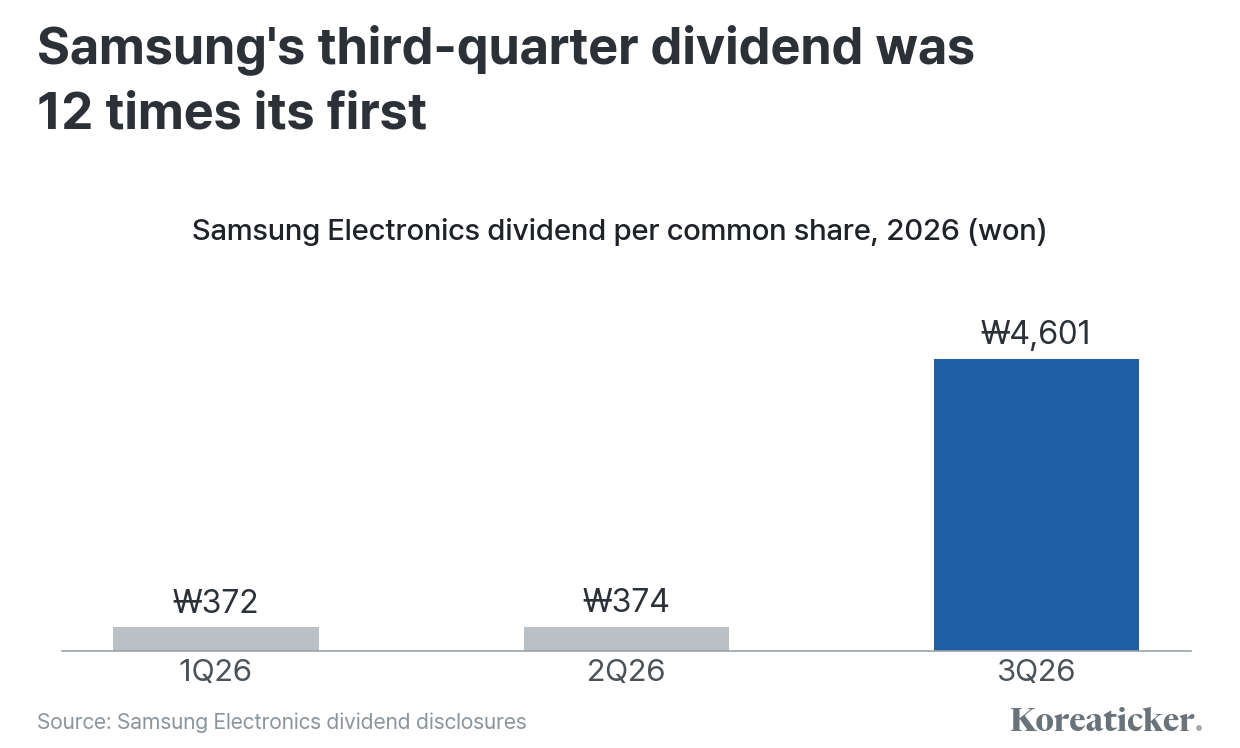
Samsung Electronics' figures are from its disclosures and Hyundai Motor's ₩2,500 from its own newsroom; the others are as reported by Korean media.
Check each company's disclosure for the record date. Korean trades settle two business days after the trade, so the shares have to be bought at least two Seoul business days before the record date. Seoul trades during the US evening, so count Seoul business days, not US ones.
So how much do you keep?
On a ₩4,601 Samsung dividend, a US holder keeps ₩3,842 a share if 16.5% is withheld, or ₩3,589 if 22% is withheld and the difference is never claimed. The rest depends on your US return.
For US investors
How US investors can hold Korean dividend payers
Sources and notes
- Korean Income Tax Act, Articles 156, 156-6 and 156-9 (as in force Jan 1, 2026). law.go.kr
- US–Korea income tax convention (signed 1976, in force 1979), Articles 12 and 16. irs.gov
- PwC Worldwide Tax Summaries, Korea: withholding taxes (reviewed June 4, 2026). taxsummaries.pwc.com
- KB Financial Group, Form 20-F for 2025, Item 10.E Taxation (filed April 28, 2026). sec.gov
- Korean Income Tax Act Enforcement Decree, Article 179(11); Corporate Tax Act Enforcement Decree, Article 132(8)
- Securities Transaction Tax Act Enforcement Decree, Article 5; Special Tax for Rural Development Act, Article 5 (2026 rates)
- Interactive Brokers, Korea stock fees. interactivebrokers.com
- Korea JoongAng Daily, Interactive Brokers and Samsung Securities (2026.06)
- IRS Publication 514, Foreign Tax Credit for Individuals (2025); IRS Publication 550, Investment Income and Expenses (2025)
- Financial Services Commission, dividend procedure reform (2023.01.31) and adoption count (2024.12.27). fsc.go.kr
- Samsung Electronics, dividend disclosures for 2026. samsung.com
- Hyundai Motor Group newsroom, 2026 results; Korean media on Hyundai, SK hynix and KB Financial dividends (2026.10)
Not tax advice. Tax rules change and individual circumstances differ; consult a tax adviser. Won-to-dollar examples are illustrative.
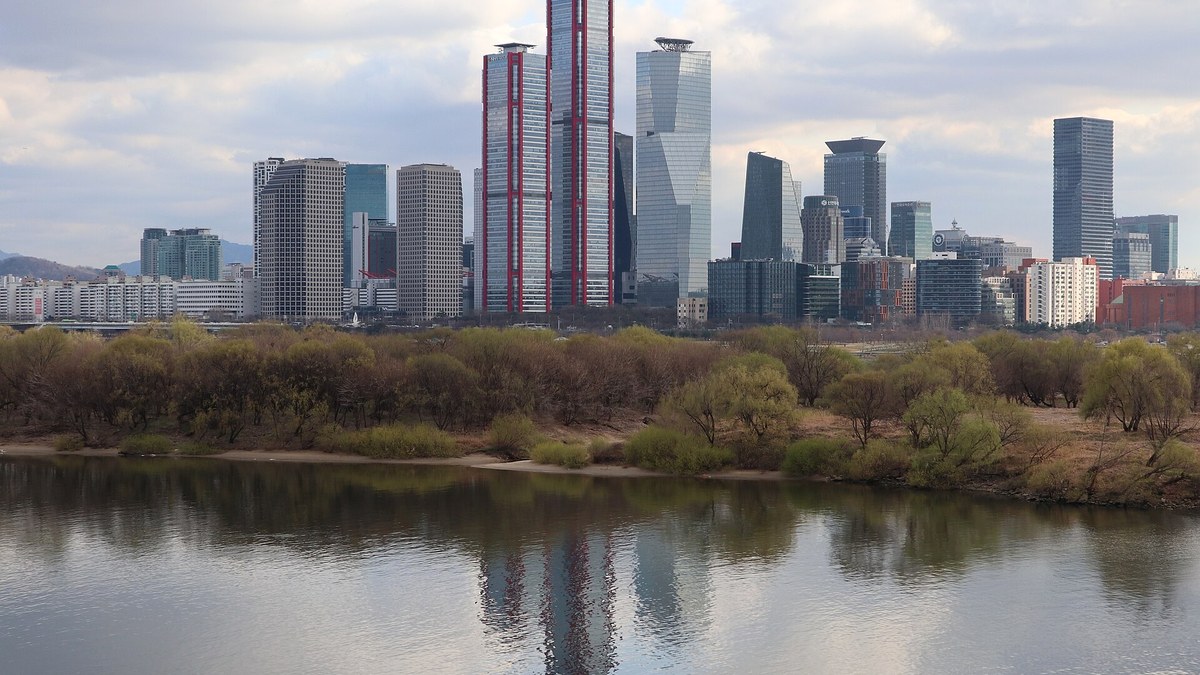
Cover photo: "Skyline of Yeouido, a prominent finance district in Seoul" by S h y numis, CC BY 4.0, via Wikimedia Commons.
For information only, not investment advice. See our full disclaimer.
Update history
- Nov 14, 2026 Changed the title, which promised a refund method we have not tested, and rewrote the summary table and US-side sections around what each rule changes for a holder, after a reader-impression review. No rates or figures changed.
- Nov 13, 2026 Added, section by section, what each rule means for the money a US holder keeps and what to do about it; cut the breakdown of the sale tax and the count of companies that changed their record-date rules.
- Nov 12, 2026 Reworded the summary line, which promised a way to claim the $55 back; we have not tested how practical that claim is.
Corrections and changes to facts are listed here. See our editorial policy.