Korea Value-Up Index Explained: How It Picks Stocks and How It Has Done
The Korea Value-Up Index reached 4,276.72 on June 22, 2026, up 331% from the day its real-time calculation began. By October 30 it was 2,691.90, 37% below that level.
The index is the market-facing part of Korea's push to close the "Korea discount," the gap between Korean share valuations and those abroad. Before buying it, you want to know whether it gives you anything a broad Korea fund does not, and whether the rules around it change what Korean shareholders receive.
What it is
The government launched the Corporate Value-up Program in February 2024, asking listed companies to publish plans for raising their valuations. The Korea Exchange followed with this index:
- Base: January 2, 2024 = 1,000. Real-time calculation began on September 30, 2024, at 992.13
- Members: 100, from both KOSPI and KOSDAQ
- Weighting: by free-float market value, with any one stock capped at 15%
- Review: once a year, in June, plus special changes
The cap is meant to limit how much of a holder's money sits in one stock. The ETF figures further down show two stocks above it, and we could not confirm from the exchange when the weights are next reset.
How it picks stocks
| Step | Screen |
|---|---|
| 1. Size | Top 400 companies by market value |
| 2. Profit | Exclude companies with losses in both of the last two years, or a combined two-year loss |
| 3. Payouts | Keep companies that paid dividends or cancelled shares in each of the last two years |
| 4. Valuation | Keep the upper half by two-year average price-to-book, within the industry or the market |
| 5. Efficiency | Rank by two-year average return on equity within each industry group |
Source: Korea Exchange (Sep 24, 2024), rules at launch.
Step 4 keeps the companies with the higher price-to-book ratios, so the index favors companies that already earn good returns and trade at decent valuations. Because the screen ranks within an industry, a company with a low price-to-book can still qualify, but the index leans away from the cheapest names, where the Korea discount is deepest.
The cheapest companies are tracked on a separate list instead. On November 2, 2026, the exchange published its first list of 151 companies with low price-to-book ratios that had not disclosed improvement plans.
The 2026 rule: every member has a plan
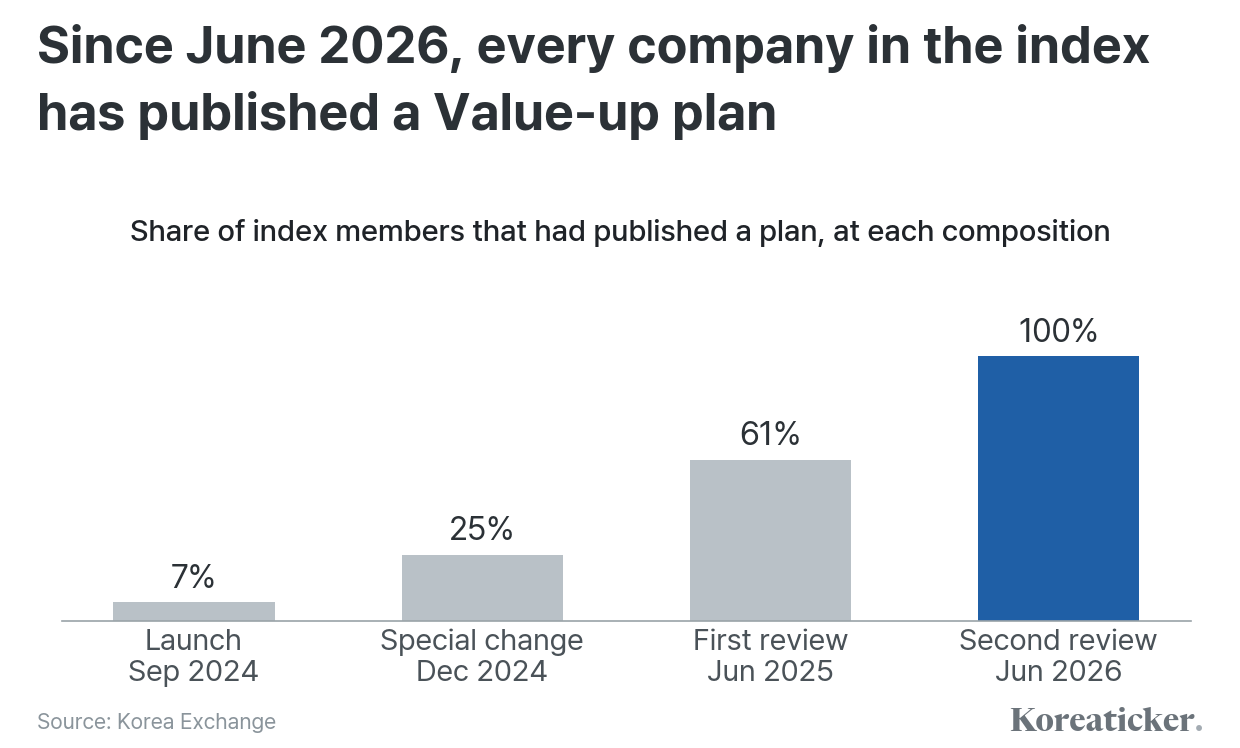
The exchange phased in a requirement over three steps. At launch, only 7% of members had published a Value-up plan. At the June 2026 review, which took effect on June 12, every one of the 100 members had, so a holder can read what each company said it would do, though a published plan is not a promise of results.
That review added 20 companies and removed 19. A merger had left the index with 99 members in December 2025, so it was back to 100 afterward.
Additions included HD Hyundai Heavy Industries, HD Korea Shipbuilding & Offshore Engineering, SK Square, Samsung E&A, APR and NH Investment & Securities. Hyundai Rotem, Hyosung Heavy Industries, LS Electric, POSCO DX and Chong Kun Dang were among those removed.
Funds that track the index usually drop removed members at the rebalance, so their holders lose that exposure. The exchange did not give a reason for each removal.
Some large companies are not in it at all. Samsung Biologics and Celltrion are in the KOSPI 200 but not in the Value-Up Index, so a Value-up fund leaves out two large biotech companies.
How it has done
| Period | Value-Up Index | KOSPI |
|---|---|---|
| 2025 | +89.4% | +75.6% |
| Sep 30, 2024 to Jun 22, 2026 | +331.1% | +251.5% |
| 2026 to Oct 30 | +49.8% | +36.0% |
Price changes as reported by the Korea Exchange and, for 2025, Seoul Economic Daily. The KOSPI 200 rose 48.5% in 2026 to October 30, close to the Value-Up Index.
The index has beaten the KOSPI in each period above, though against the KOSPI 200 of large companies the 2026 gap almost disappears. We have not broken down where the lead came from. The largest holdings are the same memory chip stocks that led the market.
In an ETF that tracks the index, SK hynix was 18.1% of assets on November 10, Samsung Electronics 16.5% and SK Square, SK hynix's largest shareholder, 7.6%. About 42% of that ETF sat in the three: two chip makers and SK hynix's largest shareholder.
That much in three stocks offered little protection when they fell.
Between June 30 and November 6, 2026, the 13 Value-up ETFs listed in Seoul lost between 37% and 47%, while the KOSPI fell 40%. Three of the 13 are actively managed and one sells covered calls, so the range is wide. None held up clearly better than the KOSPI in that fall.
The ETFs
We found no US-listed ETF that tracks this index, so a US investor who wants it has to buy one of the Seoul funds.
Thirteen ETFs in Seoul follow the Value-up theme: nine track the index, three are actively managed and one sells covered calls. Their combined net assets were about ₩3.2 trillion ($2.4 billion) at the end of October 2026, down from ₩4.2 trillion at the end of June.
Seoul Economic Daily reported in January 2026 that during 2025, when the index rose 89%, Value-up ETFs accounted for 0.58% of the growth in Korea's ETF market assets. That figure mixes price gains with new money, so it is a rough measure of demand, not a count of new money.
US-listed Korea funds such as EWY follow MSCI or FTSE indexes instead, so they hold many of the same companies under different rules.
The laws alongside it
The index is voluntary: companies choose whether to publish plans. Three amendments to the Commercial Act, by contrast, apply to listed companies whether or not they are in the index, though some only above a size threshold:
- July 22, 2025: directors' duty of loyalty, owed to the company under Korean law, now extends to shareholders. That could give minority holders firmer ground to challenge deals that favor a controlling family
- March 6, 2026: treasury shares bought back must generally be cancelled within one year, with 18 months for shares already held. Cancelled shares cannot be sold back into the market, so a later resale cannot undo what a buyback did for remaining holders. Shares kept under a shareholder-approved plan, for example for employee pay, are among the exceptions
- September 10, 2026: listed companies with total assets of ₩2 trillion or more can no longer opt out of cumulative voting, and must elect at least two audit committee members separately. Both could make it easier for minority holders to get a voice on the board; how much depends on shareholder votes still to come
By the end of October 2026, 801 companies had published Value-up plans. They made up 83.8% of the market's value but 31% of listed companies, so the companies without plans are, on average, much smaller.
So is it a value index?
Not in the usual sense of buying cheap stocks. It is a quality screen with a governance requirement: profitable companies that pay shareholders, trade above the middle on price-to-book, and have now all published a plan.
Buy a Value-up fund today and your largest positions are the same chip stocks a broad Korea fund holds. Where the program could still change prices is outside the index, among the 151 low-valuation companies named on November 2, if they publish improvement plans.
For US investors
How US investors can get exposure
Sources and notes
- Korea Exchange, Korea Value-Up Index launch and methodology (2024.09.24)
- Korea Exchange, 2026 regular review of the Korea Value-Up Index (2026.05.28)
- Korea Exchange, monthly Value-up status reports (June and October 2026)
- Korea Exchange, first list of low price-to-book companies (2026.11.02)
- Seoul Economic Daily, Value-up index and ETF flows in 2025 (2026.01.01)
- Pinpoint News, Value-up ETF performance since June, citing Korea Exchange data (2026.11.08)
- Newsway, large companies outside the index (2026.06.11)
- FunETF, holdings of a Korea Value-Up index ETF (Nov 10, 2026)
- Shin & Kim newsletter (2026.04.13) and Kim & Chang notes on the Commercial Act amendments; Herald Business on the September 2026 effective date
- Financial Services Commission, Corporate Value-up Program announcement (2024.02.26). fsc.go.kr
Index levels and returns are price changes as published by the Korea Exchange. The screening rules are those announced at launch; the 2026 announcements did not mention changes, and we have not seen an updated methodology document. Won amounts are converted at ₩1,350 per dollar.
Cover photo: Financial Services Commission sign in Seoul, by Piotrus, CC BY-SA 3.0, via Wikimedia Commons.
For information only, not investment advice. See our full disclaimer.
Update history
- Nov 14, 2026 Stopped saying the chip stocks drove the index's lead, which we have not broken down, noted that the 13 ETFs mix index, active and covered-call funds, opened the ETF section with the US route, and reworded several lines after a reader-impression review. No figures changed.
- Nov 13, 2026 Rewrote each section around what the rules mean for an investor: what the price-to-book screen leaves out, what removals mean for index fund holders, how much of a Value-up ETF rides on three chip-related stocks, and what each Commercial Act change could do for minority shareholders.
Corrections and changes to facts are listed here. See our editorial policy.