Why Korean Stocks Stop Trading: Sidecars, Circuit Breakers and the 30% Limit
The KOSPI market triggered a sidecar 57 times in 2026 by early November. Its circuit breaker, the stronger measure, went off 11 times in the same period, out of 17 in its history. Brakes of some kind were common this year, though most of them paused only program orders.
For anyone holding Seoul shares or a Korea ETF, the two brakes mean very different things. Which one leaves your orders working, and which one stops you from selling?
Three brakes, from lightest to heaviest
| What triggers it | What stops | For how long | |
|---|---|---|---|
| Sidecar | Index futures move 5% (KOSPI) or 6% (KOSDAQ), up or down | Program trading orders in the direction of the move | 5 minutes |
| Circuit breaker, stage 1 | Index falls 8% | All trading in that market | 20 minutes |
| Circuit breaker, stage 2 | Index falls 15% | All trading in that market | 20 minutes |
| Circuit breaker, stage 3 | Index falls 20% | All trading in that market | Rest of the day |
| Daily price limit | One stock moves 30% from the previous close | Further moves in that stock beyond the limit | Until the next session |
Source: Korea Exchange trading rules.
Sidecar: a pause for program trades
Other orders continue to execute during a sidecar.
A buy or sell order for one stock is not a program trade, so it can still trade as usual.
What stops is program trading in the direction of the move: in a sharp fall, program sell orders wait five minutes; in a sharp rise, program buy orders do. That removes one source of selling or buying for five minutes, but prices can keep moving on everyone else's orders.
On KOSPI, it triggers when KOSPI 200 futures move 5% or more from their base price for one minute; on KOSDAQ, when KOSDAQ 150 futures move 6% or more and the KOSDAQ 150 index 3% or more. Of the 57 KOSPI sidecars counted by Financial News through November 6, 30 were sell-side and 27 buy-side.
That near even split matters when you read the news. A sidecar tells you the market moved fast, not which way, so check the direction before treating it as a crash signal. Sidecars do not trigger in the last 40 minutes of the regular session or outside it.
Circuit breaker: the whole market stops
A circuit breaker halts every stock in that market, along with the futures and options linked to it. It triggers only on falls.
- Stage 1: the index is down 8% or more from the previous close for one minute. Trading stops for 20 minutes and new orders are not accepted
- Stage 2: the index is down 15% or more, and at least 1% lower than when stage 1 triggered. Another 20-minute halt
- Stage 3: the index is down 20% or more, and at least 1% lower than at stage 2. The market closes for the day
For a holder, a halt means 20 minutes with no new orders, though orders already in the book can be cancelled. Then comes a 10-minute single-price auction before normal trading resumes, so selling can take half an hour or more. What happens to an order you send during the halt depends on your broker.
The auction sets one price, and only orders that match it fill. That first price can be well away from the last trade before the halt.
After stage 3 you cannot sell in that market for the rest of the regular session. Each stage can trigger once a day, and stages 1 and 2 do not trigger in the last 40 minutes.
KOSPI and KOSDAQ are judged separately, each on its own index, so one market can halt while the other keeps trading. On October 15, 2026, KOSDAQ's stage 1 triggered at 12:23 pm with the index down 8.01%, according to Asia Economy. Before reacting, check which market your stock is listed on.
The 30% limit: a cap on each stock
A Korean stock cannot trade more than 30% above or below its base price, usually the previous close, in one day.
For a holder, that caps one day's fall in a single stock at 30%, but it does not cap the loss. If more sellers are waiting at the limit than buyers, a sell order can sit unfilled for the rest of the day, and the selling pressure can carry into the next session.
Orders can still be placed at the limit, but trades happen only at or inside it. The same 30% band applies in the Korea Exchange's after-market. US stocks have no fixed daily limit; their limit-up, limit-down bands move with the stock's recent price and trigger five-minute pauses, after which trading resumes.
How this differs from the US
| Korea | United States | |
|---|---|---|
| Market-wide halt levels | 8%, 15%, 20% | 7%, 13%, 20% |
| Measured on | KOSPI or KOSDAQ index, separately | S&P 500 |
| Halt length before the final level | 20 minutes | 15 minutes |
| Pause for program trading (sidecar) | Yes | No direct equivalent |
| Limit on a single stock | Fixed 30% a day | Moving price bands with 5-minute pauses |
US levels are the market-wide circuit breakers in NYSE and Nasdaq rules. In the US the 7% and 13% levels do not halt trading after 3:25 pm.
US habits can mislead here: a 7% index fall that would halt New York does not trigger Seoul's circuit breaker, though it can trigger a sidecar. A Seoul halt lasts five minutes longer. And a single Seoul stock can stay pinned at its 30% limit for hours, where US rules use moving bands and five-minute pauses.
Why 2026 produced so many
These rules respond to the size of index moves, and 2026 had large ones in both directions. The KOSPI more than doubled by June and then fell 42.5% from its high by November 10.
Two memory chip stocks make up about half the KOSPI's value, so large moves in those two alone can push the index toward these levels; our KOSPI vs KOSDAQ page shows the weights.
A count of halts measures how volatile the year was. It says nothing about which way the market goes next, so a busy year for sidecars is no reason by itself to buy or sell.
When the Korean market is open, in New York time
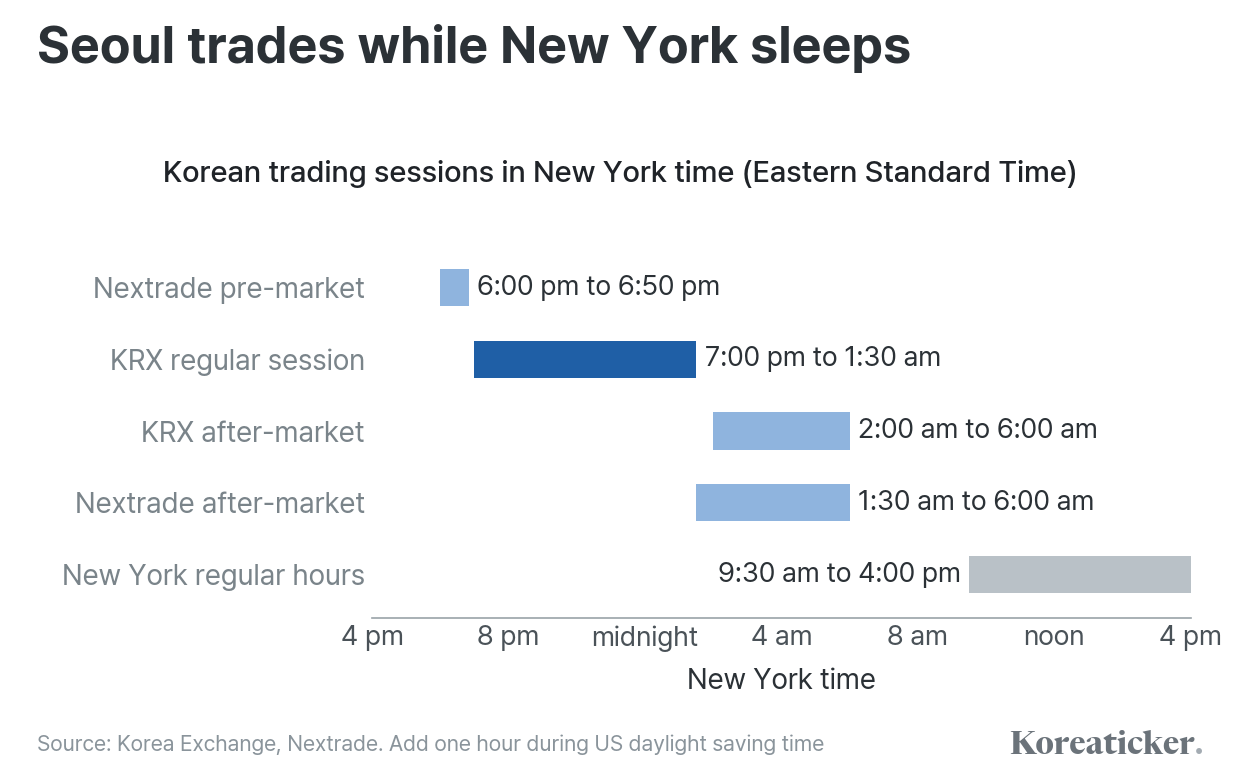
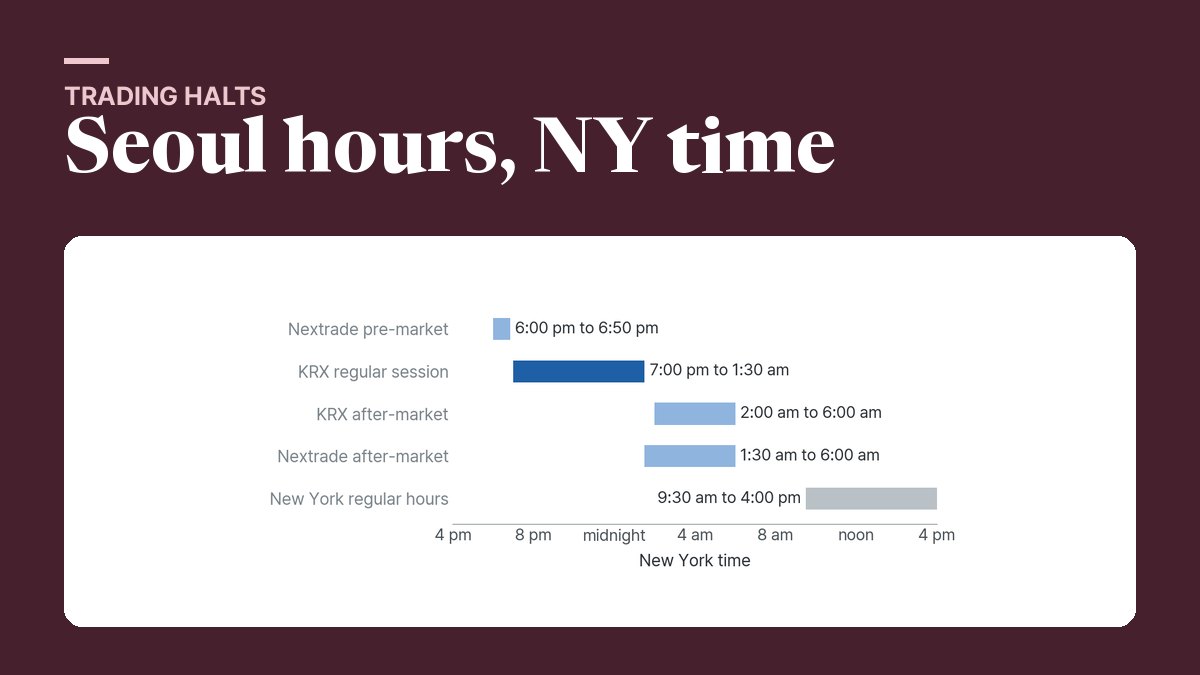
Korea does not use daylight saving time, so Seoul is 14 hours ahead of New York in winter and 13 hours ahead in summer. The regular session, 9:00 am to 3:30 pm in Seoul, runs from 7:00 pm to 1:30 am in New York on standard time.
A halt in Seoul happens during your evening or overnight, so an order you leave with a broker can meet it while you are asleep.
- Regular session: where sidecars and circuit breakers apply
- Korea Exchange after-market: 4:00 pm to 8:00 pm Seoul time since September 14, 2026, limit orders only
- Nextrade: an alternative venue with a pre-market from 8:00 am and an after-market until 8:00 pm Seoul time, for the stocks it covers
- Settlement: two business days after the trade
The full table, with daylight saving times, is in How to Buy Korean Stocks from the US.
After hours and offshore
In the after-market the 30% limit and the volatility interruptions on single stocks still apply, but there is no sidecar or circuit breaker. None of these rules reaches the offshore contracts described in Korean stocks now trade 24/7 on crypto exchanges, which trade under their own rules, so their prices can keep moving while Seoul is stopped.
For US investors
How US investors are affected by a halt
Sources and notes
- Korea Exchange trading rules: KOSPI circuit breakers (regulation.krx.co.kr KOSPI sidecar (regulation.krx.co.kr KOSDAQ circuit breakers and sidecar, daily price limit
- Financial News, circuit breaker and sidecar counts for 2026 (2026.11.06). fnnews.com
- Asia Economy, KOSDAQ circuit breaker on October 15, 2026 (2026.10). core.asiae.co.kr
- Korea Times, Korea Exchange after-market extended to 8 pm (2026.09.09). koreatimes.co.kr
- Nextrade, market overview, accessed Nov 10, 2026. nextrade.co.kr
- Nasdaq Trader, market-wide circuit breakers. nasdaqtrader.com
- Korea Exchange, general procedures of trading (settlement). global.krx.co.kr
- Limit Up-Limit Down plan, price bands for US stocks. luldplan.com
Counts are as reported on November 6, 2026 and cover the year to that date. The rule summaries are ours; the Korea Exchange's rule text governs. New York times are for US standard time; add one hour during daylight saving time.
Cover photo: the Korea Stock Exchange trading floor in Yeouido, 1984, Seoul Museum of History (Seoul History Archive), KOGL Type 1, via Wikimedia Commons.
For information only, not investment advice. See our full disclaimer.
Update history
- Nov 12, 2026 Clarified that the 57 count is sidecars only, with 11 circuit breakers counted separately, and put the sources in order.
- Nov 13, 2026 Rewrote each section around what a halt does to a US investor's orders and holdings: which orders keep working, when you cannot sell, how prices restart and what to check. Cut the KOSDAQ sidecar count.
Corrections and changes to facts are listed here. See our editorial policy.