POSCO Holdings Credit Rating: Cut to BBB+, With Moody's on Negative Outlook
On January 16, 2026, POSCO, the steelmaker inside POSCO Holdings, sold five-year dollar bonds paying 4.5%, rated A- by S&P. Two months later S&P took that A- away from the steelmaker and from its parent.
A credit rating grades a company for its lenders. For holders of POSCO Holdings in Seoul or its NYSE shares (PKX), the squeeze behind the cut shows up in two places: the profit that goes to interest, and the cash left for dividends after the steel and battery spending. Which should you watch, the grade or the cash gap?
The short answer
- The cash gap behind the cut is what to watch. Spending has run ahead of operating cash flow, which strains the debt ratios the agencies test and competes for the cash that pays shareholders, whose returns have followed adjusted profit since April.
- The grades are still investment grade. S&P has rated POSCO Holdings BBB+ with a stable outlook since March 2026, one notch down from A-. Moody's rates it Baa1, the equivalent grade, and moved the outlook to negative on Feb 26, 2026.
- The first half paid less than half of 2025's total. POSCO Holdings paid ₩4,000 a share in the first half of 2026, against ₩10,000 for all of 2025.
The stock, and a US comparison
| Company | Share price (Nov 23, 2026) | Market cap (Nov 23, 2026) | Revenue (12 months to Sep 2026) | Operating profit (same period) | Operating margin | P/E (12 months to Sep 2026) | P/B (equity at Sep 30, 2026) | S&P / Moody's (Aug 2026 filing) |
|---|---|---|---|---|---|---|---|---|
| POSCO Holdings (005490.KS, NYSE: PKX) | ₩242,500 ($180 for one Seoul share, equal to four PKX ADSs) | ₩18.3 trillion ($13.6B) | ₩73.1 trillion ($54.2B) | ₩2.48 trillion ($1.84B) | 3.4% | 15.7x | 0.33x | BBB+ / Baa1 |
POSCO Holdings owns POSCO, the steelmaker, along with other businesses that include battery materials. Steel was about half of consolidated revenue in the first half of 2026, so steel margins move much of the profit in the table, and S&P lists them first among the risks to its grade.
- US peer: Nucor (NUE) traded at 15.3 times earnings and 2.4 times book value at the Nov 20, 2026 close, according to StockAnalysis. In its Oct 26, 2026 results release, Nucor says S&P and Fitch rate it A- and Moody's A3, all with stable outlooks.
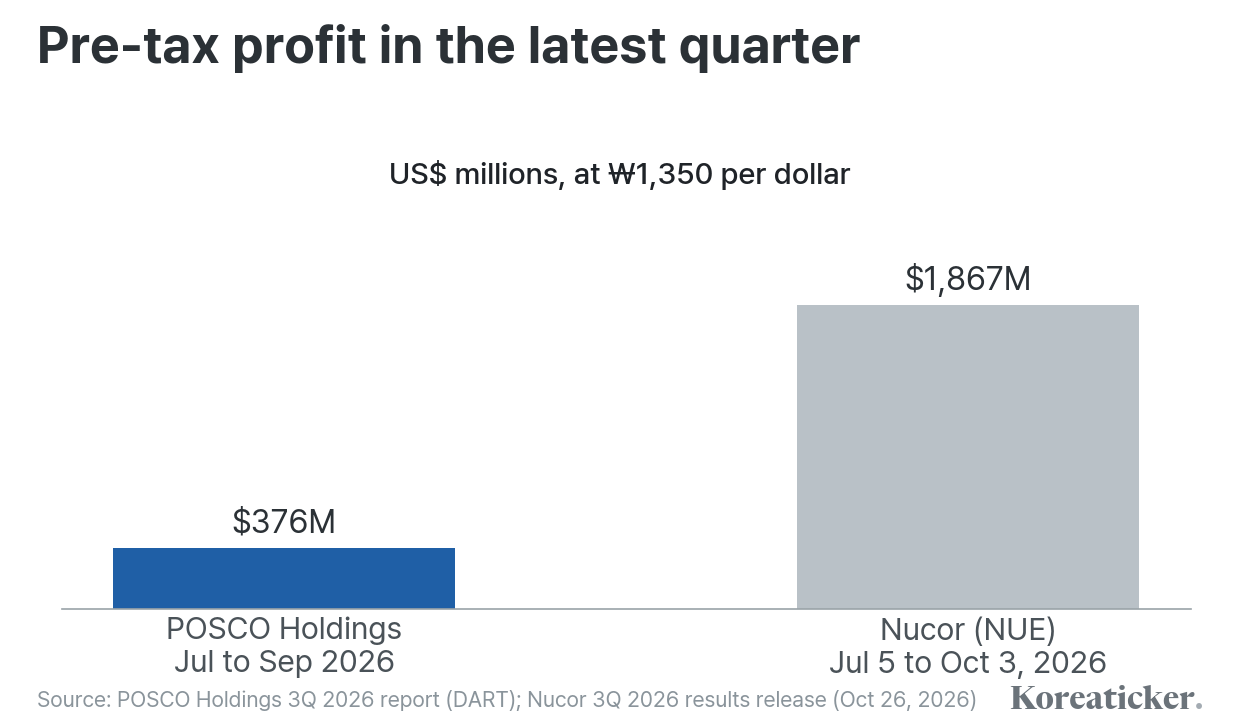
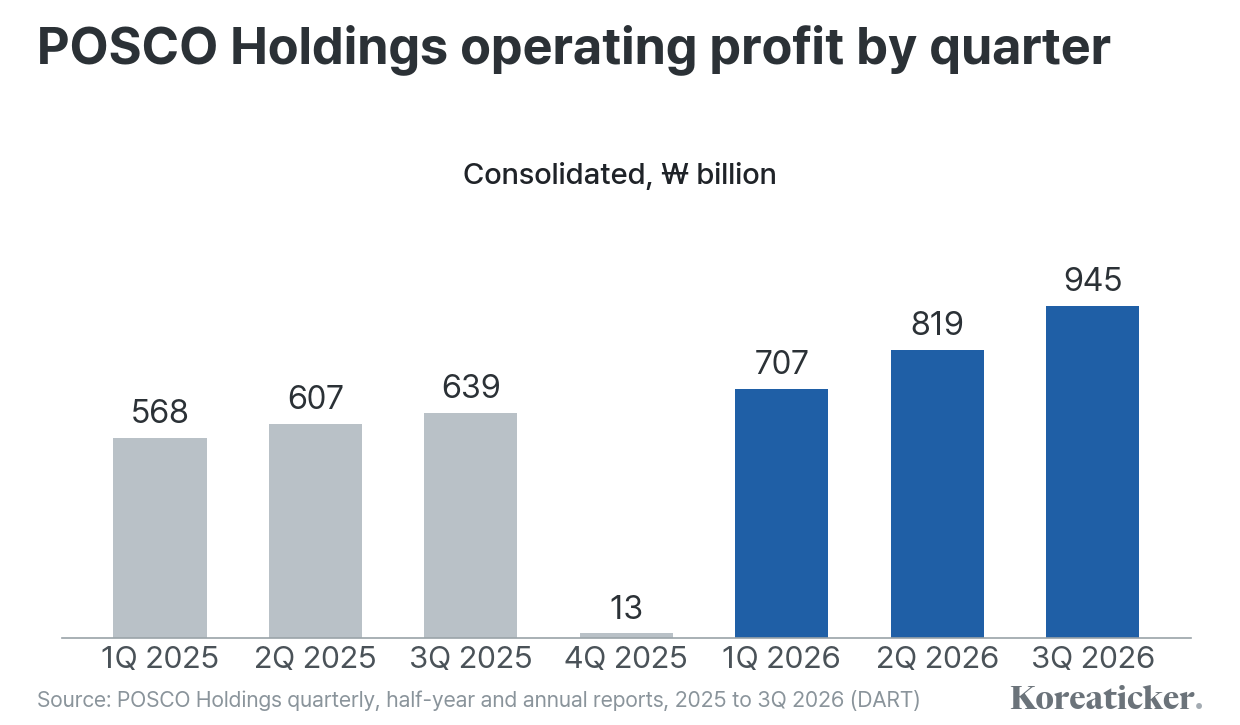
Nucor earned about five times as much before tax in roughly the same three months. Size alone does not set a grade, since Moody's tests POSCO Holdings on debt against EBITDA, and for a holder the company's own quarterly profit trend matters more to that test than the gap with Nucor.
From A- to BBB+: the record since 2021
| Agency | 2021 | 2022 | 2023 | 2024 | 2025 | 2026 |
|---|---|---|---|---|---|---|
| S&P | BBB+ (Positive) | A- (Stable) | A- (Stable) | A- (Stable) | A- (Negative) | BBB+ (Stable) |
| Moody's | Baa1 (Stable) | Baa1 (Stable) | Baa1 (Stable) | Baa1 (Stable) | Baa1 (Stable) | Baa1 (Negative) |
S&P held POSCO Holdings at A- from 2022 to 2025; March's cut matched the BBB+ that POSCO carried in 2021, before the 2022 split created POSCO Holdings. BBB+ and Baa1 sit three notches above speculative grade. The group can still sell dollar bonds to investment-grade buyers, and the next Moody's step down, Baa2, would put it one notch below S&P.
The share price has not tracked the rating calendar. The shares fell 14% between Moody's move on Feb 26 and the March 18 report of S&P's cut, then rose 53% to their high on May 7, seven weeks later, with both new grades in place.
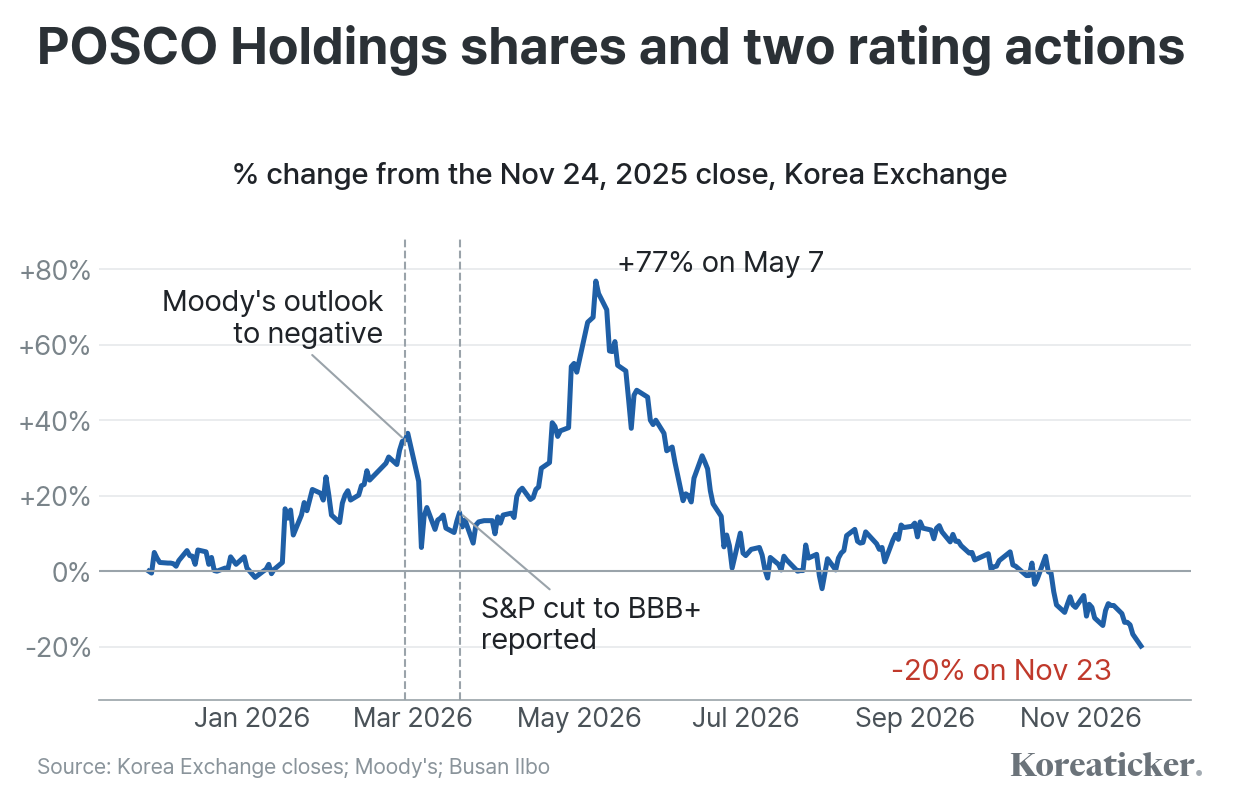
Since the May peak the shares have lost more than half their value. Through the half-year report filed Aug 14, the grades, set on the company's cash and debt, stayed put while the price swung.
Why S&P cut: more cash out than in
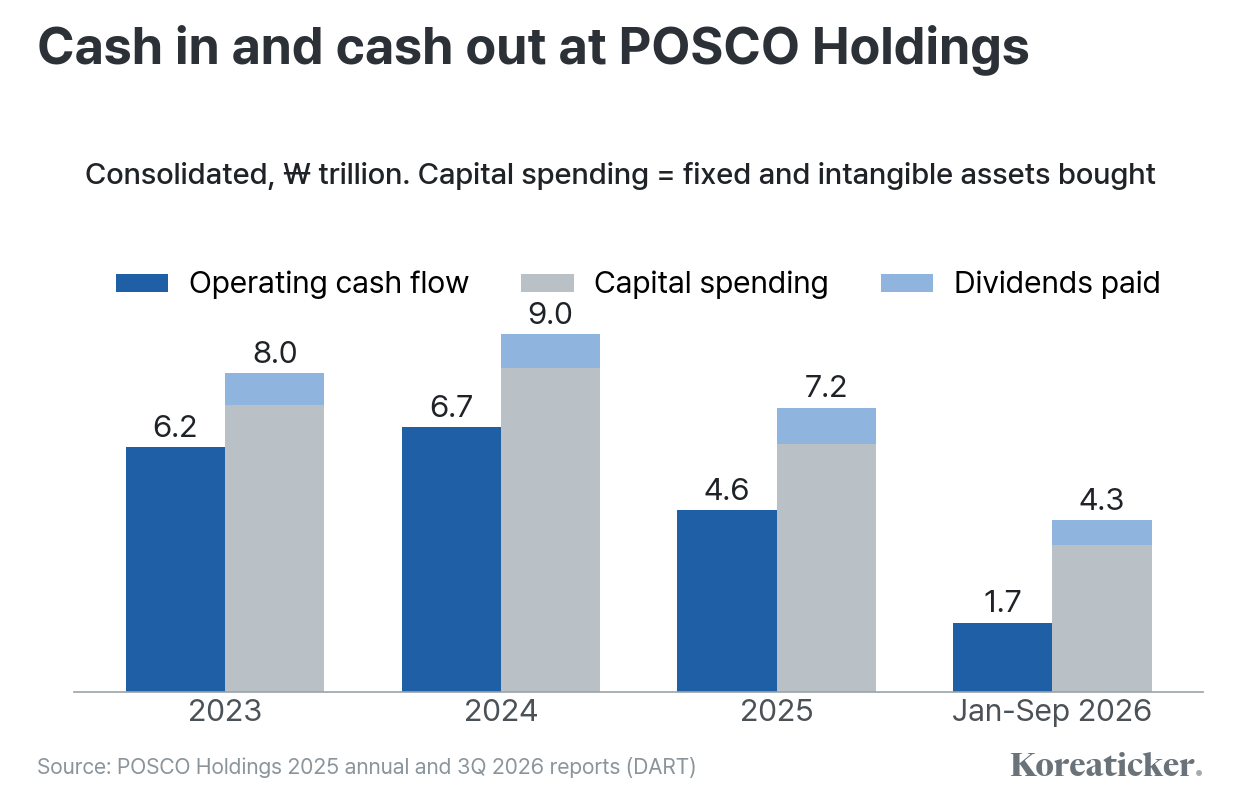
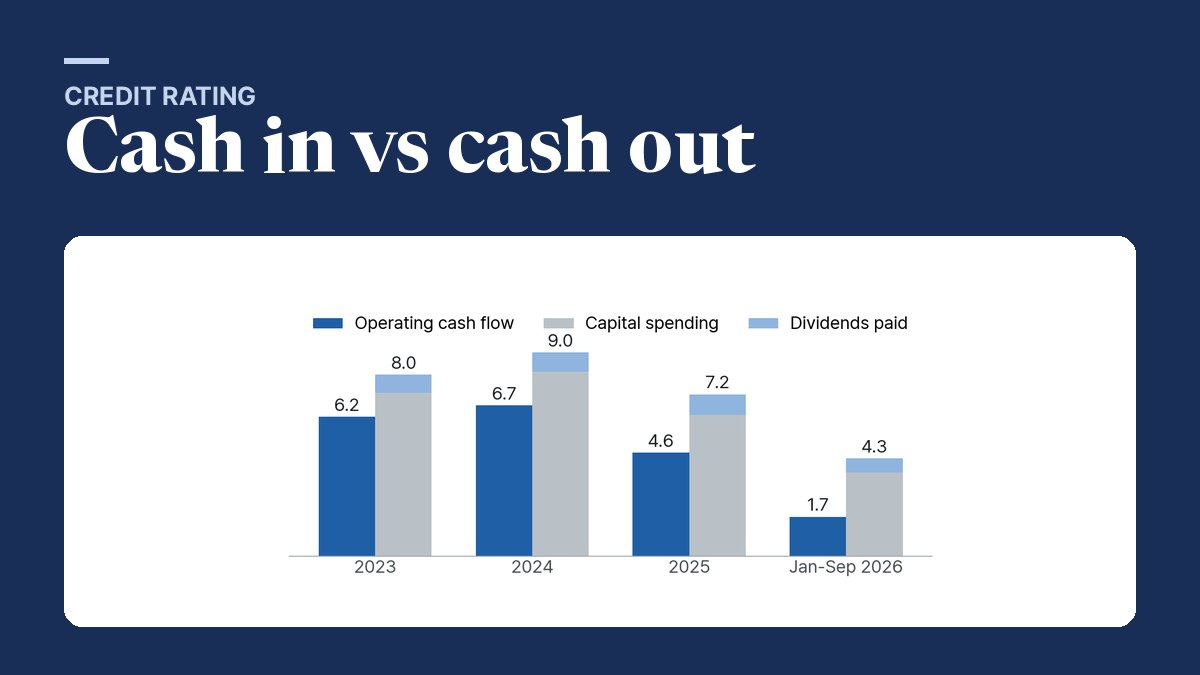
Over 2023 to 2025, capital spending plus dividends ran about ₩6.8 trillion ahead of operating cash flow. The gap left less cash for every other use and was met from borrowing, cash on hand or other inflows.
Lenders rank ahead of shareholders, and their claim grew. Total borrowings rose from ₩26.0 trillion at the end of 2023 to ₩28.5 trillion at the end of 2025, then eased to ₩27.3 trillion on Sep 30, 2026.
S&P expected more of the same. It estimated 2026 operating cash flow at about ₩6.9 trillion, short of ₩8.3 trillion of planned capital spending and ₩0.9 trillion of shareholder returns, Busan Ilbo reported on March 18. S&P listed what could bring a further cut:
- Weaker steel margins
- More investment
- A wider hit from US and European steel tariffs
- Larger losses in battery materials
S&P also said a large fall in debt, from a steel recovery or smaller investment, could lead to an upgrade, Busan Ilbo reported. Both lists turn on steel margins and the investment budget.
In January to September 2026 the gap was already about as large as in all of 2025, after changes in working capital took ₩3.4 trillion out of operating cash flow. Unless some of that reverses in the fourth quarter, 2026 would be the fourth straight year of spending above operating cash flow, the pattern both agencies flagged.
Moody's set two tests for returning the outlook to stable, Etoday reported. It wants adjusted net debt at 2.0 times EBITDA or less, from 2.2 times in 2025, and adjusted total debt, before netting cash, below 3.5 to 4.0 times EBITDA, from 4.5 times.
It moved the outlook to negative because it expected debt to stay high through 2026 and 2027 on heavy investment. That puts the spending plan, more than one year's profit, at the center of Moody's next decision, and the capital spending line of each quarterly cash flow statement is where it shows.
What the cut does to the interest bill
Interest expense was ₩831 billion in January to September 2026, 5% more than a year earlier and about a third of operating profit. The bond table in the third-quarter report gives a rough sense of what new debt costs.
POSCO's January bonds, rated A-, paid 4.5% for five years. In June, POSCO International, another POSCO Holdings subsidiary, rated BBB by S&P and Baa2 by Moody's, paid 5.125% for five years.
The two issues came from different companies five months apart and at different grades, so the gap does not measure what the downgrade costs. It still gives a scale: 0.625 points on ₩1 trillion of debt is about ₩6 billion a year, money that would come out of the profit pool that now sets shareholder returns.
Shareholder returns now follow profit
On April 30, six weeks after the S&P cut, POSCO Holdings replaced its dividend policy. The old rule paid out of cash left after investment; the new one sets total shareholder returns, dividends plus buybacks, at 35% to 40% of adjusted net profit attributable to shareholders for 2026 to 2028.
The company said it will keep investing in steel and energy materials, and will buy back and cancel new shares. Nothing in the release points to lower capital spending.
Because the 35% to 40% covers buybacks too, a holder's cash dividend depends on profit and on how the board splits returns between the two. Higher steel margins would enlarge the pool even while capital spending stays high, and weaker margins would shrink it.
Shareholder returns still compete with capital spending for the same cash, and S&P counted the planned returns among the 2026 outflows in its assessment. The payout itself is set by adjusted profit, and the three ₩2,000 quarterly dividends declared so far in 2026, the latest on Nov 13, were the first set that way.
The grade and the payout therefore share a cause, spending above operating cash flow, and that gap is the line a holder should track ahead of the letter grade. That reading would be wrong if Moody's cut as well and lenders began charging the group far more than the 0.625-point gap between its 2026 bonds.
The next full test is the 2026 annual report, due on DART by March 31, 2027. In 2026, Moody's acted on Feb 26 and S&P in March, around the March 11 filing of the 2025 annual report.
For US investors
How US investors can hold POSCO Holdings
Sources and notes
- POSCO Holdings, half-year report for 2026 (반기보고서), section on credit ratings, DART, Aug 14, 2026. dart.fss.or.kr
- POSCO Holdings, 2025 annual report (사업보고서): credit ratings, consolidated balance sheet and cash flow statement, DART, Mar 11, 2026. dart.fss.or.kr
- POSCO Holdings, 3Q 2026 quarterly report: balance sheet, income statement, cash flow, finance costs note, debt securities issued, dividends (section II.6), DART, Nov 13, 2026; quarterly operating profit for 2025 and 2026 from the quarterly and annual reports on DART. dart.fss.or.kr
- POSCO, Credit Rating Status (investor relations page), accessed Nov 23, 2026. posco.co.kr
- Etoday, "포스코홀딩스·포스코·포스코인터…무디스, 투자부담에 등급전망 '부정적' 하향," Feb 26, 2026. etoday.co.kr
- Busan Ilbo, "S&P, 포스코 신용등급 하향… '버는 돈보다 쓰는 돈이 많아'," Mar 18, 2026. busan.com
- POSCO Newsroom, POSCO Holdings 1Q 2026 results and 2026 to 2028 shareholder return policy, Apr 30, 2026. newsroom.posco.com
- POSCO Holdings, Interim Report for January to June 2026, Form 6-K Exhibit 99.1 (dividends per share), SEC. sec.gov
- Nucor, "Nucor Reports Results for the Third Quarter of 2026," Oct 26, 2026, Form 8-K Exhibit 99.1, SEC. sec.gov
- Korea Exchange daily closes for 005490 (Nov 24, 2025 to Nov 23, 2026); TTM revenue, operating profit, net income, equity and share count from POSCO Holdings' DART filings, compiled in Koreaticker's stock data
- StockAnalysis, Nucor P/E and P/B as of the Nov 20, 2026 close. stockanalysis.com
- POSCO Holdings, Form 20-F for 2025 (ADS ratio), SEC, Apr 29, 2026; Interactive Brokers, "Interactive Brokers Launches Access to Korean Equities," May 7, 2026. sec.gov
- iShares MSCI South Korea ETF, Form N-PORT for Aug 31, 2026, SEC, filed Oct 23, 2026. ishares.com
Won figures are converted at ₩1,350 per dollar. Capital spending is purchases of fixed and intangible assets; borrowings are the current and long-term borrowing lines of the consolidated balance sheet. Nucor's quarter ran from July 5 to October 3, 2026; POSCO Holdings' from July 1 to September 30.
For information only, not investment advice. See our full disclaimer.